Watching a massive lawsuit completely wipe out a lifetime of savings is a terrifying thought. I always assumed my standard home and auto insurance limits were enough to protect my family, until a financial advisor showed me exactly how easily a clever lawyer could break through those basic shields. It turns out, protecting your net worth from a catastrophic lawsuit is incredibly cheap and simple if you understand how secondary liability coverage actually works. Let's look at why your current policies are leaving you completely exposed and how an umbrella policy can lock down your financial future today.

Your Fast-Track Liability Protection Plan:
- The Liability Gap: Standard auto and home insurance policies usually cap out at $300,000, leaving your personal home and future wages completely exposed to multi-million-dollar lawsuits.
- The Ultimate Shield: An umbrella policy provides an extra $1 million to $10 million in excess coverage that automatically activates the exact second your primary limits run out.
- Hidden Coverage: Unlike standard policies, umbrella insurance travels globally and covers non-physical claims like online defamation, libel, and slander.
- The Bargain Cost: Because it is a secondary layer of defense, a massive $1 million umbrella policy typically costs less than $300 a year for the average family.
Demystifying the Personal Umbrella Shield
To stop worrying about unexpected legal threats, you have to understand how a personal umbrella policy actually works. Think of your standard homeowners and auto insurance policies like individual, small shields that protect your arms and legs.
They work beautifully for minor scrapes and small accidents, but they leave your head and chest completely exposed to a massive blow. An umbrella policy is a giant, secondary dome that sits completely over both of those smaller shields, protecting your entire financial body from absolute destruction.
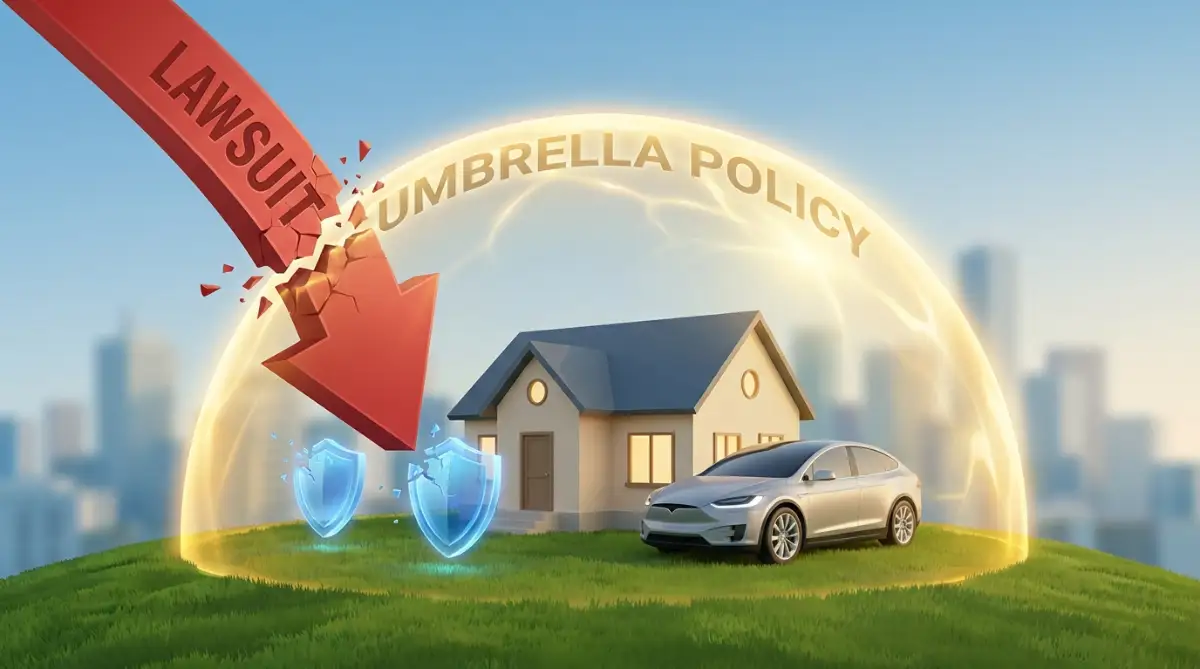
It is designed to kick in only when your primary policy limits are completely exhausted. Let's look at the actual mechanics of why this secondary protection is so important.
The Reality of the Liability Gap
When you buy a standard auto insurance policy, you typically select a bodily injury liability limit, such as two hundred and fifty thousand dollars per person. This sounds like a massive amount of money until you look at modern hospital bills.
If you cause an accident that results in long-term rehabilitation or permanent disability for another driver, their medical costs can easily exceed one million dollars.
Once your auto insurance pays its maximum limit of two hundred and fifty thousand, the remaining seven hundred and fifty thousand dollars does not just magically disappear. You are personally, legally responsible for paying that entire remaining balance.
An umbrella policy is specifically built to fill this exact gap. It will automatically wake up, step in, and pay the remaining seven hundred and fifty thousand dollars so you do not have to sell your home or file for bankruptcy.
The Homeowners Liability Ceiling
The exact same dangerous gap exists inside your homeowners insurance policy. Most people keep their personal liability limit at the default three hundred thousand dollars to save a few pennies on their monthly premiums.
But what happens if a guest slips on your wet pool deck, suffers a severe brain injury, and can never work again?
Their lawyer will easily calculate their lost lifetime earnings, and the lawsuit will quickly reach into the millions. Your standard homeowners policy will pay its tiny three-hundred-thousand-dollar limit and immediately walk away from the case.
An umbrella policy provides the excess liability coverage necessary to settle the rest of the claim smoothly. It ensures your family is never left facing a catastrophic financial judgment alone.
My Quick "Do I Need an Umbrella?" Audit ☂️
If you are wondering if this policy is actually necessary for you, ask yourself these three simple questions:
- Does my total net worth (including home equity and retirement) exceed $300,000?
- Do I have a teenage driver living in my house?
- Do I own a swimming pool, a trampoline, or a large dog?
- If you answered "YES" to any of these, you are a prime target for a massive lawsuit, and an umbrella policy is absolutely mandatory.
Standard Liability Limits vs. Umbrella Policy Protection
What Does Umbrella Insurance Actually Cover?
Many people believe that umbrella insurance is only useful if someone gets physically hurt on your property. This is a very common, highly dangerous misunderstanding of how the legal system actually operates.
An umbrella policy is incredibly broad, providing protection against a massive array of unusual, non-physical legal threats. Let's look at the hidden areas of safety this policy provides.
Protection Against Slander, Libel, and Defamation
In our modern, highly connected world, we are constantly sharing our opinions online. We write passionate reviews of local businesses, post comments on social media, and share news stories without thinking twice.
If you write a highly negative review of a local contractor, and they can prove your words caused them to lose clients, they can legally sue you for business defamation.
Standard homeowners insurance will completely reject a defamation claim because no physical injury occurred. But a personal umbrella policy specifically covers non-physical personal injury claims like libel, slander, and false arrest.
It pays for your legal defense and settles the claim, keeping your family safe from online disputes. This digital safety net is just as important as knowing how to troubleshooting home wi-fi dead zones without buying an expensive router. Both strategies focus on protecting your daily environment from unexpected, silent disruptions.
Global Defense for Worldwide Incidents
Your standard auto insurance policy typically stops working the exact second you drive across an international border. If you rent a car while vacationing in Europe or Asia, you are completely outside your safety zone.
If you cause an accident in a foreign country, you can find yourself facing a highly confusing, terrifying foreign legal system.
An umbrella policy travels right along with you, providing global liability protection anywhere in the entire world. Whether you are renting a jet ski in Mexico or renting a moped in Italy, the umbrella shield remains active.
It ensures you always have a team of professional lawyers ready to defend your rights, no matter how far away from home you are.
Are you wondering exactly how an umbrella policy interacts with your existing home and auto insurance during a real lawsuit? Watch this highly revealing video of a licensed insurance specialist breaking down a real-world claim scenario:
The Absolute Bargain of Excess Liability
When people hear the word "million-dollar policy," they naturally assume the cost must be astronomical. They think, "I am already struggling to pay my basic bills, so I certainly cannot afford a million-dollar luxury policy."
This is the most surprising myth in the entire insurance industry. Because an umbrella policy is a secondary layer that only pays out in rare, catastrophic situations, the risk to the insurance company is actually extremely low.
Because the risk is low, the price is incredibly cheap. You can typically secure a full one-million-dollar umbrella policy for less than twenty dollars a month.
That is roughly the cost of a single streaming service subscription. Trading the price of a movie ticket for absolute protection against financial ruin is the single smartest money decision you can ever make.
Pro Tip: The Multi-Policy Discount Hack 💰
Here is a brilliant secret insurance agents rarely mention: if you bundle your auto, home, and umbrella policies all under the exact same insurance company, the "multi-policy discount" you receive on your car and house can sometimes be larger than the cost of the umbrella policy itself! You can essentially get a $1 million safety net for absolutely free.
Pro Tip: I spent years thinking my assets were too small to justify buying an umbrella policy because I didn't own a mansion. My biggest realization came when my financial advisor explained that an umbrella policy does not just protect what you currently own; it legally protects your future wages from being garnished for the next twenty years. I immediately called my agent, adjusted my auto limits, and bought a million-dollar policy the exact same afternoon.
Understanding the Underlying Limit Requirement
Before you can buy an umbrella policy, the insurance company will require you to raise the liability limits on your basic policies to a specific level. They want to ensure your primary shields are strong enough to handle normal, minor scrapes.
Usually, you must raise your auto liability to two hundred and fifty thousand per person, and your homeowners liability to three hundred thousand.
Raising these basic limits will cost you a few extra dollars a month, but it is a necessary step to build the foundation of your defense. Once those underlying limits are in place, the umbrella policy sits perfectly on top, creating a solid, seamless wall of protection.

Protecting the Future of Your Business
If you run a small home-based business or work as an independent creator, your personal assets are highly vulnerable to commercial disputes. A client can easily claim that your work caused them to lose revenue, and they will try to target your personal bank accounts.
If you do not have a separate corporate structure, a standard home policy will completely reject these commercial claims. Naming yourself as a sole proprietor is one of those silent freelance profile mistakes that keep you from getting your first client while exposing your personal wealth.
An umbrella policy can often be extended with a simple business rider to protect your personal savings from professional liabilities. It ensures that an innocent mistake in your home office does not result in you losing the very house you live in.
By taking a few minutes to connect your policies together, you build an unbreakable wall of protection around both your career and your family. You stop playing defense against the legal system and start confidently commanding your own financial future.
Advanced Strategies for Maximum Asset Protection
Once you understand how the basic umbrella dome protects your home, it is time to look at strategies that build deep, long-term safety. A personal umbrella policy is not just a defensive shield that you buy once and completely forget about. It is a highly active financial tool that needs to grow alongside your personal net worth. Let's look closely at the advanced secrets that wealth managers use to protect their clients' estates from sudden legal disasters.
Coordinating Your Multi-Policy Limits and Deductibles
One of the most important steps in setting up your defense system is ensuring your basic policies fit perfectly with your umbrella coverage. If there is even a tiny one-inch gap between where your auto policy stops and your umbrella policy starts, a clever lawyer will easily exploit that gap.
For example, if your auto liability limit is capped at two hundred thousand dollars, but your umbrella policy strictly requires an underlying limit of two hundred and fifty thousand, you have a fifty-thousand-dollar gap. If you get into a major accident, you will be forced to pay that fifty-thousand-dollar gap completely out of your own pocket before the umbrella policy ever wakes up.
To prevent this, you must ask your insurance agent to perform a comprehensive audit of all your active policies.
Utilizing Trusts and Asset Protection Vehicles
If your net worth begins to grow past two million dollars, relying on an umbrella policy alone can become slightly risky. You need to combine your insurance shield with a strong legal structure, such as an irrevocable trust.
An irrevocable trust physically transfers the legal ownership of your home and bank accounts out of your personal name and into the name of the trust. Because you no longer legally own those assets, a personal lawsuit against you cannot touch them.
According to legal research published by the Legal Information Institute at Cornell Law School, separating personal liability from property ownership is the single most effective way to protect family estates. When you combine an asset protection trust with a massive umbrella policy, you create an unbreakable fortress. The umbrella policy handles the immediate litigation costs, while the trust guarantees your physical home remains completely safe from being seized.
Tracking Your Wealth Growth for Annual Policy Adjustments
Your financial life changes constantly. You might receive a promotion at work, buy a second home, inherit family property, or make a lucky investment in the market.
If your net worth suddenly increases from five hundred thousand to one and a half million dollars, your old one-million-dollar umbrella policy is no longer large enough to protect you. You must make it a strict habit to review your total assets with your financial planner every single year.
Ignoring your policy limits is a very dangerous habit, similar to dangerous morning routine mistakes that secretly destroy your daily productivity. By keeping your coverage aligned with your actual wealth, you ensure that you are never underinsured during a sudden crisis.

Dangerous Pitfalls That Can Instantly Void Your Protection
Even when people have the best intentions, the complexity of insurance contracts can cause them to make terrible, completely avoidable mistakes. They assume that since they have a "million-dollar policy," they are completely covered for every single thing that happens in their lives.
This is a massive, highly dangerous misunderstanding of how insurance companies actually operate. If you do not recognize these specific loopholes, your provider will completely deny your claim during a lawsuit. Let's look closely at the worst mistakes that cause immediate, catastrophic insurance denials.
The "Business Activity" Exclusion Trap
The single biggest mistake small business owners and freelancers make is assuming their personal umbrella policy protects their professional work. Almost every standard personal umbrella policy has a strict, absolute exclusion for any claim arising from business activities.
If you run a small consulting business from your home office, and a client sues you for professional negligence, your personal umbrella policy will completely ignore the lawsuit. If you try to claim the loss, the provider will instantly deny the claim and potentially cancel your entire policy.
To protect your business earnings, you must buy a dedicated commercial umbrella policy or add a specific business pursuits rider to your personal policy. Ignoring these business exclusions is a massive, costly mistake, much like making mistakes that destroy your home insurance payout. Always keep your personal life and your business liabilities completely separated on paper.
Failing to Report Board Positions and Volunteer Work
Many successful people love to give back to their communities by volunteering to sit on the board of directors for local charities or homeowners associations. They assume that since they are working for free, they have zero personal liability if the organization gets sued.
This is an incredibly dangerous assumption. If the nonprofit gets sued for financial mismanagement, every single board member can be personally named in the lawsuit.
Standard home insurance will completely reject a director's liability claim because it did not involve physical property damage. You must ensure your nonprofit has a dedicated Directors and Officers (D&O) liability policy in place before you ever sign the board agreement. If the organization does not have this policy, you must ask your own umbrella provider to add a specific volunteer board endorsement to your personal coverage to protect your savings.
Leaving your personal assets exposed to nonprofit lawsuits is a massive gamble, similar to making dangerous password management mistakes that leave your digital identity exposed. You must always protect your digital and physical boundaries aggressively.
The Tragedy of Naming Uncovered Drivers
If you have a teenage driver in your house, your auto insurance premiums are likely incredibly high. To save money, some parents make the terrible choice to not list their teenager as an active driver on their auto policy, assuming they will only drive the car occasionally.
This is an absolute nightmare scenario. If that teenager gets into a major accident while driving your car, your auto insurance company will completely deny the claim because of driver concealment.
Because your primary auto policy was voided, your umbrella policy will also instantly refuse to pay a single dime. Suddenly, you are left personally facing a massive multi-million-dollar lawsuit with absolutely zero help from any insurance company.
A single mistake like this can easily force you to search for unsecured loans with bad credit and actually get approved just to avoid immediate, life-altering bankruptcy. Always be completely honest with your insurance provider about every single driver living under your roof.
Your Personal Blueprint for Permanent Peace of Mind
We have covered a massive amount of intense financial and legal ground today. The goal here is not to make you terrified of every single person who steps onto your driveway.
The real goal is to give you absolute, unshakeable control over your own financial future. When you understand how the legal system operates, you stop playing defense and start proactively defending your family's hard-earned wealth.
Your 30-Day Asset Protection Plan
Do not let this complex information paralyze you into doing nothing. If you own a home and have moderate savings, you need to start building your defense system next week.
Here is your straightforward action plan to secure your perimeter:
- Week 1: Calculate your true net worth, including your home equity, your retirement savings, and your investments.
- Week 2: Call your current home and auto insurance providers and ask them to raise your basic liability limits to their maximum levels.
- Week 3: Ask your agent for a formal quote on a one-million-dollar personal umbrella policy.
- Week 4: Carefully read the entire fine print of the new policy, paying special attention to the listed exclusions.
If your laptop screen suddenly freezes while you are trying to review your policy details, do not panic. Simply follow the proper steps to speed up your phone simple steps to clear app cache on android or clear your computer's browser cache to get right back to your research.
Neglecting your policy reviews is one of those overlooked habits that quietly destroy your smartphone battery lifespan by ignoring gradual wear and tear. You must treat your insurance portfolio with the exact same serious care you use to protect your daily physical health.
If you suffer a sudden legal crash, having a verified, active umbrella policy is the only way to rescue your financial future. It is the ultimate digital and physical shield, much like having a solid backup plan when your hard drive crashed how to rescue your lost files before it s too late.
I spent nearly three years carrying massive anxiety about my family's financial security because I assumed my basic homeowners policy was a perfect shield. I felt completely exposed, watching the news of massive lawsuits every single day. But the exact morning I finally signed my first one-million-dollar umbrella policy and locked my limits together, my constant financial worry vanished entirely. I promise you, if you take the time to build this cheap, powerful shield around your assets today, you will finally achieve the deep, unshakeable peace of mind you deserve.
Frequently Asked Questions About Umbrella Liability
Does a personal umbrella policy cover damage to my own physical house?
No, personal umbrella insurance is strictly a liability policy, meaning it only pays for damage or injuries you accidentally cause to other people. It will absolutely not pay to repair your own house after a storm or replace your stolen car. You must rely entirely on your basic homeowners and auto comprehensive coverage to protect your own physical property.
What is Self-Insured Retention (SIR) and how does it work?
Self-Insured Retention is essentially a deductible for your umbrella policy, but it only applies to very rare situations that are not covered by your basic home or auto policies (such as a foreign slander lawsuit). If you experience a non-covered incident, you must pay the SIR amount (usually around two hundred and fifty to one thousand dollars) out of pocket before the umbrella policy kicks in to cover the rest.
Can I buy an umbrella policy if I do not own any real estate?
Yes, absolutely. In fact, many renters who have high-paying jobs or significant investment accounts buy personal umbrella policies specifically to protect their future wages from being garnished during a lawsuit. You do not need to own a physical home to be targeted by an aggressive personal injury lawyer.
How do insurance companies calculate the rate for an umbrella policy?
Because an umbrella policy is a secondary layer of protection, the risk to the insurance company is extremely low. The rates are calculated based on your total risk profile, including how many cars you own, whether you have a swimming pool, and the driving records of everyone in your household. According to consumer guidelines from the National Association of Insurance Commissioners (NAIC), most standard one-million-dollar policies cost less than three hundred dollars a year.
Will my umbrella policy cover me if I get sued by an employee working in my home?
If you hire a regular housekeeper, nanny, or personal gardener, a standard personal umbrella policy will typically exclude injuries to domestic employees unless you buy a specific worker's compensation endorsement. You must discuss your household employees with your agent to ensure you have the proper employer liability riders in place before they ever start working on your property.
What happens if I get sued for more than my one-million-dollar umbrella limit?
If a court enters a judgment against you for one and a half million dollars, and you have a one-million-dollar umbrella policy, the insurance company will pay their maximum limit of one million and walk away. You will be personally, legally responsible for paying the remaining five hundred thousand dollars using your own assets, home equity, or future wages. This is why many high-net-worth individuals choose to increase their umbrella coverage to five or ten million dollars as their wealth grows.
Disclaimer: The information provided in this blog post is strictly for educational and informational purposes only and does not constitute formal legal, financial, or professional insurance advice. Insurance regulations, policy exclusions, and liability laws vary significantly by state and country. Always consult directly with a licensed, independent insurance broker or a certified financial planner to thoroughly evaluate your personal asset protection needs before purchasing any policy.