
Have you ever stared at a sky-high repair bill after a minor fender bender, only to realize your insurance deductible is higher than your entire bank account? It is an incredibly sinking feeling that catches thousands of drivers off guard every single year. We pick cheap monthly premiums just to save a few bucks, completely ignoring the financial trap waiting for us. Let me show you how your policy actually works so you can balance your premium, protect your savings, and drive with absolute peace of mind.

Why We All Struggle To Understand Insurance Jargon
Millions of drivers go through this exact same stressful scenario every single day. We are forced to buy auto coverage by law, but no one ever sits us down to explain how it actually works. We just sign the digital paperwork and hope for the best.
This lack of clear information causes a huge amount of hidden anxiety in our daily lives. You work incredibly hard for your money, and handing it over to an insurance company every month feels frustrating when you do not see any immediate benefit.
When a sudden accident happens, the confusing paperwork and unexpected out-of-pocket costs can push a normal family into deep debt. It is incredibly unfair that everyday people are penalized simply because the insurance industry uses complicated financial language.
📌 Quick Summary: Master Your Car Insurance
- Balance the Seesaw: Understand that lower monthly premiums mean higher out-of-pocket deductibles if an accident occurs.
- Match Your Savings: Only choose a high deductible if you have enough cash in an emergency fund to cover it instantly.
- Protect Your Record: Defensive driving keeps traffic tickets off your history, directly locking in your lowest possible rates over time.
- Check Your Credit: A low credit score can quietly spike your monthly insurance bill; keeping track of your report saves cash.
Decoding The Mystery: What Exactly Is A Premium?
To stop feeling overwhelmed, we need to break these confusing terms down into plain English. Let us start with the most common word you will hear: the premium. Your auto insurance premium is simply the exact amount of money you pay to keep your policy active.
You can think of your premium like a regular subscription service, very similar to your monthly Netflix or gym membership. You pay this specific fee whether you actually use the insurance or not.
Most companies give you the option to pay this premium once a month, every six months, or once a year. If you stop paying your premium, your coverage is instantly canceled. This leaves you completely unprotected if you get into an accident.
The most important thing to remember is that your premium is a fixed cost. You can easily plan your monthly household budget around it because you know exactly how much they will charge you. However, the price of your premium is heavily influenced by another major factor.
What Is A Deductible And Why Does It Hurt So Much?
Now we need to talk about the part that usually causes the most financial pain. The deductible is the specific amount of money you must pay out of your own pocket before your insurance coverage finally kicks in to help you.
Imagine you are going to an exclusive concert and there is a strict cover charge at the front door. You have to pay that entry fee before you can go inside and enjoy the free food and music. Your auto insurance deductible works in a very similar way.
If you have a five hundred dollar deductible and your car needs two thousand dollars in repairs, you must pay the first five hundred dollars yourself. The insurance company will then write a check for the remaining fifteen hundred dollars.
Real-Life Example: The Deductible Math
If your policy carries a $1,000 deductible and a storm causes $3,500 in body damage, you write a check to the mechanic for the first $1,000, and your insurer covers the remaining $2,500. Knowing this exact split stops you from filing costly micro-claims that spike your rates!
You only pay your deductible when you actually file a claim for an accident. If you go ten years without ever crashing your car, you will never have to pay your deductible. This is why choosing the right number is such a massive financial decision.
The Secret Balancing Act: How They Work Together
Here is the biggest secret that insurance agents rarely explain clearly to beginners. Your premium and your deductible have a direct, inverse relationship with each other. They operate exactly like a playground seesaw.
When one side goes up, the other side automatically goes down. If you want to pay a very small premium every month, you must agree to take on a very high deductible. The insurance company is rewarding you for taking on more of the financial risk yourself.
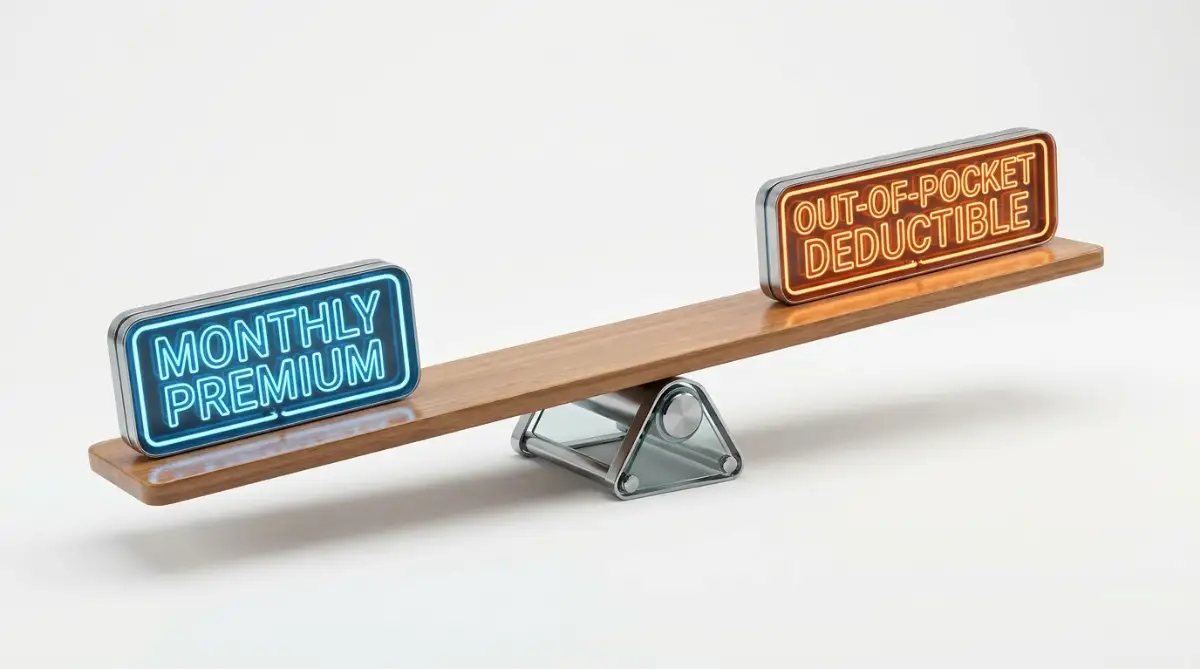
On the other hand, if you want a very low deductible so you do not have to worry about sudden repair bills, your monthly premium will be much higher. The insurance company is charging you more because they are taking on almost all of the financial risk.
Let us look at a quick comparison to make this completely clear:
Finding The Perfect Number For Your Personal Budget
So, how do you actually decide which option is right for your unique situation? The answer depends entirely on your current bank account balance, not on your driving skills. You must be completely honest with yourself about your finances.
Ask yourself one simple question today. If you walked outside tomorrow morning and a tree branch had smashed your car windshield, how much cash could you easily access without using a credit card?
If your savings account is completely empty right now, you cannot afford a high deductible. Even though a high deductible would make your monthly bill cheaper, a sudden accident would completely ruin you financially.
My Personal Pro Tip: I learned the hard way that saving twenty dollars a month on my premium was simply not worth the constant anxiety. I finally sat down and adjusted my deductible to exactly match the amount of money I keep in my emergency savings account. This simple change instantly made me feel so much safer on the road, knowing I could actually afford an accident if it happened.
Expert Financial Advice:
Always align your auto insurance deductible directly with your liquid emergency fund. If you have $1,000 saved up in a bank account, set your deductible to $1,000. Never gamble on a high deductible just to lower your monthly bill if you lack the cash backup.
If you have a solid emergency fund with a few thousand dollars sitting safely in the bank, you can afford to take a bigger risk. You can comfortably choose a higher deductible, which will heavily reduce your monthly premium payments. Over time, those monthly savings can add up to a huge amount of money.
Let's Watch This Quick Explainer
If you are more of a visual learner, take a moment to watch this highly informative breakdown that perfectly explains how to balance these two costs.
Common Myths That Cost Everyday Drivers Money
There are so many false rumors about auto insurance floating around the internet. Relying on bad advice from friends or family members can end up costing you hundreds of extra dollars every single year. Let us clear up some of the biggest misunderstandings right now.
Myth 1: Your deductible stays the exact same for every type of accident.
This is simply not true. Your auto policy is actually broken down into different categories of coverage. You have a specific deductible for collisions (hitting another car) and a totally separate deductible for comprehensive claims (like fire, theft, or hail damage).
You can actually set these numbers at different levels to save money. For example, you might choose a high collision deductible because you are a very safe driver. But you might keep a low comprehensive deductible because you live in an area with really bad weather.
Myth 2: Red cars cost more to insure.
This is a very old and completely silly rumor. Insurance companies honestly do not care about the color of your vehicle. They calculate your premium based on the specific make, model, and year of the car, along with its overall safety rating.
Myth 3: Your rates automatically drop the day you turn twenty-five.
While age is a big factor in calculating your monthly premium, there is no magic button that gets pushed on your twenty-fifth birthday. Your rate drops gradually over time as you build a longer history of safe driving without any traffic tickets.
How Your Driving History Controls Your Monthly Bill
Your premium is not just a random number pulled out of thin air by a computer program. Insurance companies use a very complex mathematical formula to figure out exactly how much of a risk you are to insure. Your past behavior behind the wheel is their biggest clue.
If you have a history of speeding tickets, running red lights, or causing minor accidents, the insurance company assumes you will eventually cause a big accident. To protect their own profits, they will dramatically increase your monthly premium.
Every single mistake you make on the road stays on your official driving record for a long time. Even a simple parking lot fender bender can cause your rates to spike for several years.
The absolute best way to keep your monthly payments as low as possible is to drive defensively every single day. Leave early for work so you never have to rush. Put your cell phone in the glove box so you are never tempted to text and drive.
The Surprising Impact Of Your Credit Score
This next fact usually shocks most beginners when they first hear it. In many different places, your personal credit score plays a massive role in how much you pay for your monthly car insurance premium.
Insurance companies have spent millions of dollars researching human behavior. Their data shows that people with lower credit scores are statistically much more likely to file expensive insurance claims. Because of this data, they charge higher rates to drivers with bad credit.
If you are currently paying a very high premium, you should immediately pull a copy of your credit report. Check carefully for any weird mistakes or unpaid bills that you forgot about.

Working hard to slowly improve your credit score will do more than just help you buy a house one day. As your score goes up, you can easily call your insurance agent and politely ask them to recalculate your risk. This one simple phone call can instantly drop your monthly premium by a significant amount.
When Does It Make Sense To Change Your Deductible?
Your life is constantly changing, and your auto insurance policy should definitely change right along with it. You are never locked into your coverage choices forever. You can easily adjust your premium and deductible amounts whenever you want to.
If you recently got a big promotion at work and finally built up a strong emergency savings fund, call your agent immediately. Ask them to raise your deductible to one thousand dollars. This simple move will instantly lower your monthly premium and put more cash back into your pocket every payday.
On the other hand, what if you recently lost your job or had a baby, and your budget is suddenly incredibly tight? You should seriously consider lowering your deductible right now. Yes, your monthly premium will go up slightly. But you will have total peace of mind knowing you will not face a massive, unexpected repair bill if someone hits your car.
Taking Control: Expert Strategies To Lower Your Monthly Rates
Understanding the basic math behind your policy is just the very first step of your journey. If you truly want to beat the system and keep more cash in your wallet, you have to think like an insider. I want to share a few incredibly powerful strategies that everyday drivers rarely use.
One of the best ways to instantly drop your premium is to ask your agent about a usage-based discount program. These programs rely on a small piece of technology, often just a simple app you download on your phone. The app quietly monitors your daily driving habits for a few weeks to see how safe you really are.
It tracks things like how hard you brake, how fast you take sharp corners, and what time of day you usually travel. If you are someone who strictly follows defensive driving behaviors, this technology can easily cut your monthly bill by thirty percent. The insurance company rewards you directly because they have actual proof that you are a low-risk customer.
Another massive money-saving secret is to combine your auto policy with your other coverage needs. This is widely known in the industry as bundling. When you buy your renters or homeowners coverage from the exact same company that insures your car, they almost always give you a heavy loyalty discount.
If you own a house, making sure all your policies are aligned is incredibly smart. You never want to end up overlooking hidden property liabilities just because your paperwork is scattered across three different companies. Bundling keeps your billing simple and drastically lowers your total costs.
You should also take a hard look at your actual daily commute. Since millions of people now work from their own living rooms, they are driving significantly less than they used to. If you are only driving to the grocery store and back, you should not be paying the exact same premium as someone commuting fifty miles a day.
Call your agent today and update your estimated annual mileage. This one tiny update in their computer system can drop your rate almost instantly. You are literally paying for miles you never drive, which is a complete waste of your hard-earned money.
It is also incredibly helpful to think about how your daily lifestyle choices impact your overall focus. Just like disrupting your healthy morning flow can ruin a whole workday, driving while exhausted or distracted ruins your safety record. Staying alert keeps you out of minor accidents, which is the ultimate way to keep your premiums locked at a low price.
Finally, consider taking an approved defensive driving course over the weekend. Many local community centers and online platforms offer these short, inexpensive classes. Handing that completion certificate to your insurance agent proves you are dedicated to safety, automatically triggering a nice discount on your file.

Dangerous Traps That Quietly Drain Your Bank Account
Even with the best intentions, it is incredibly easy to make a wrong turn when setting up your coverage. I have seen so many friends make tiny mistakes that completely ruined their financial stability after a sudden accident. Let us walk through the most common pitfalls so you can avoid that same terrible fate.
The single biggest mistake people make is setting their deductible extremely high when they have zero emergency savings. I understand the temptation perfectly. You see that a massive deductible gives you the cheapest possible monthly premium, so you click accept without thinking it through.
But what happens when you actually slide on an icy road and smash your bumper? If you chose a two-thousand-dollar deductible but only have fifty bucks in your checking account, you are completely trapped. Your car stays broken in the driveway, and you cannot get to work.
This desperate situation often forces normal, hardworking people into panic mode. They end up relying on extremely high interest lending just to cover that initial out-of-pocket cost. The long-term debt from that one rushed decision can haunt a family for years.
Another terrible mistake is hiding the truth from your insurance provider just to get a slightly better rate. Some drivers lie about where they park their car at night, claiming it is in a locked garage when it actually sits on a busy city street. Others lie about who exactly is driving the vehicle most often.
This is technically known as unintentional application misrepresentation, and the consequences are brutal. If the insurance company finds out you lied during the application process, they can instantly deny your accident claim. You will be forced to pay for every single repair entirely by yourself.
You also have to be very careful with how you handle your online insurance accounts. Most of us pay our premiums through a digital dashboard on our phones. If you are using weak passwords, you are exposing your sensitive digital identity to hackers who can steal your payment information or cancel your coverage without you knowing.
Another silent trap is putting your policy on auto-renew and completely ignoring it for years. Insurance companies love customers who never check their mail or read their updated statements. They slowly bump up your premium a few dollars every single renewal cycle, hoping you are simply too busy to notice.
Treat your driving record exactly like you treat your favorite expensive gadgets. Much like the small daily actions that ruin your smartphone battery, minor traffic tickets slowly destroy your good standing with the insurance company. One careless speeding ticket can easily cost you an extra five hundred dollars in premium hikes over three years.
You must also know exactly when it is time to drop certain types of coverage. If you are driving a heavily used car that is fifteen years old, paying for comprehensive coverage might be a terrible mathematical choice. If the car is only worth two thousand dollars, spending six hundred dollars a year to fully protect it just does not make financial sense anymore.
You have to sit down and honestly evaluate understanding how comprehensive auto policies work versus the actual cash value of your vehicle. Sometimes, the smartest move is to drop the extra coverage entirely and put that monthly payment directly into a new car savings fund.
These traps might seem small on the surface, but they add up to a massive amount of wasted money over a lifetime. Being proactive and paying attention to the fine print is your best defense against an industry designed to maximize their own profits. Take the time to read every single document they send you.
Your Personal Action Plan For Total Financial Peace
We have covered a tremendous amount of ground together, and I know this topic can feel incredibly heavy. But you now have the exact knowledge you need to stop overpaying and start protecting yourself properly. You are no longer in the dark about how these numbers actually work.
Your immediate goal for tomorrow morning is to pull out your current policy documents and find your exact deductible amount. Look at that specific number and then immediately check your actual bank account balance. If those two numbers do not match up comfortably, you need to call your agent before lunchtime.
Do not be afraid to negotiate, ask for new discounts, or simply walk away if your current company is overcharging you. You hold the actual power here, because you are the paying customer. If they refuse to work with your budget, there are dozens of other companies ready to earn your business.
Take ten minutes this weekend to start reviewing your official credit file for any weird errors that might be inflating your monthly rates. Fixing one tiny mistake on that report could easily save you enough cash to pay for a nice family vacation. Every small adjustment you make today protects your financial future tomorrow.
I know firsthand how intimidating it feels to sit on the phone with a fast-talking insurance agent while trying to protect your budget. But once I finally understood how my own deductible actually worked, that heavy anxiety completely disappeared from my daily life. My biggest hope is that you use these exact same strategies today, so you can drive with absolute confidence and keep your hard-earned money exactly where it belongs.
Quick Answers To Your Biggest Coverage Questions
Does a higher deductible actually guarantee a lower premium?
Yes, choosing a higher deductible almost always guarantees a noticeably cheaper monthly bill. When you agree to pay more cash out of your own pocket after a crash, the insurance company takes on much less financial risk. They happily pass those savings directly back to you through a heavily reduced premium.
Will my monthly rates go up just for asking my agent a question?
Absolutely not. Simply calling your customer service agent to ask hypothetical questions or request a free quote adjustment will never trigger a rate increase. Your premium only changes if you officially modify your coverage limits, get a traffic ticket, or file an actual accident claim.
Should I completely drop comprehensive coverage on an older vehicle?
If your car is extremely old and its total market value is very low, dropping comprehensive coverage is usually a very smart financial move. If the total cost of your annual premium plus your deductible is higher than what the car is actually worth, you are simply throwing your money away.
How fast do insurance companies actually pay out after a crash?
The timeline always depends heavily on the specific details of the accident and how fast you submit your paperwork. For a simple fender bender with clear photos, you might receive your repair check within five to ten business days. For complicated accidents involving injuries or multiple drivers, the investigation can easily drag on for several weeks.
Can I legally change my deductible amount in the middle of a policy year?
Yes, you can absolutely contact your provider and change your deductible numbers at any point during your active policy. You do not have to wait for your official renewal date to make a smart adjustment to your budget. However, you can never change your deductible after an accident has already happened just to save money on that specific claim.
Disclaimer: The information provided in this article is for general educational and informational purposes only and does not constitute professional financial or legal advice. Auto insurance laws, rates, and coverage regulations vary heavily depending on your specific location and personal circumstances. Always consult directly with a licensed insurance agent or certified financial advisor before making any major changes to your personal policies or coverage limits.