How to Jump-Start a Modern Car Safely (Without Frying the Computer)
Hearing a dead click when you turn your car key is bad enough, but grabbing jumper cables without knowing the modern rules can instantly turn a simple dead battery into a three-thousand-dollar electrical disaster. Today's vehicles are rolling computers, and connecting clamps in the wrong order sends high-voltage spikes straight into your car's sensitive electronic control unit. In this guide, I will show you the exact sequence to jump-start your car safely, where to place that critical fourth clamp, and how to wake up your engine without frying a single computer chip.
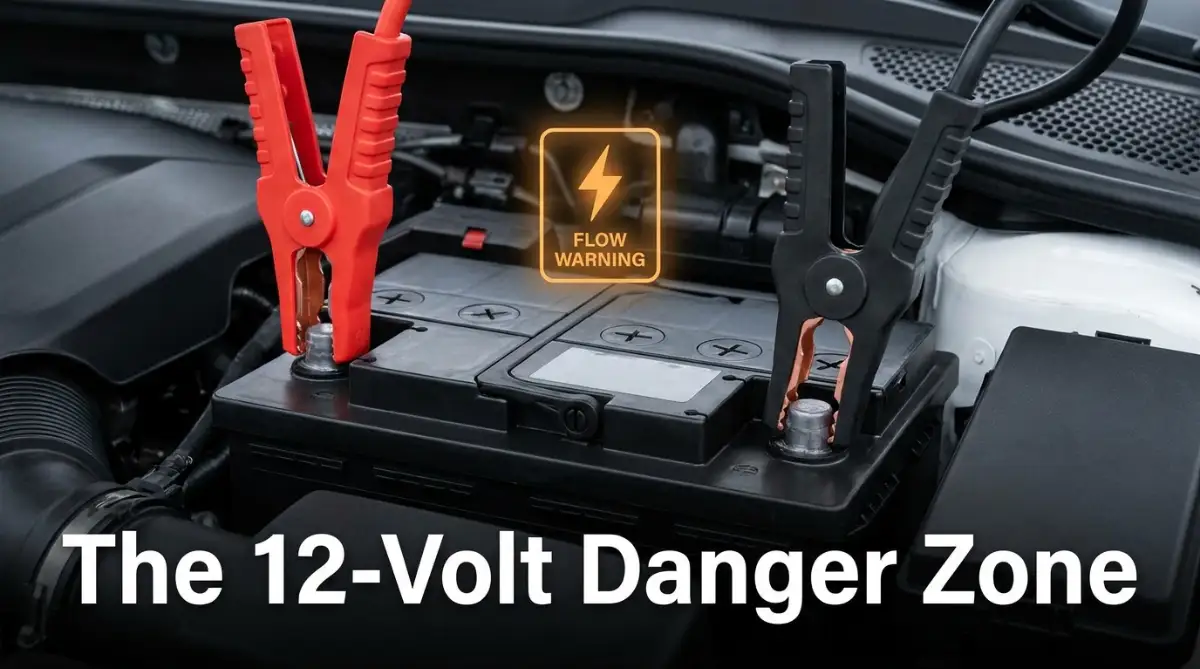
📌 The Golden Rules of Modern Jump-Starting:
- Remember the sequence: Red to Dead, Red to Donor, Black to Donor, and Black to unpainted engine metal.
- Never clamp negative to negative: The final connection always sparks; keep it far away from flammable hydrogen gas venting out of the dead battery.
- Keep donor car at idle: Never rev the good car's engine, as high alternator output creates dangerous voltage spikes for sensitive modern ECUs.
- Ditch the cables for a lithium pack: Portable jump starters feature built-in reverse polarity and surge protection, making them 100% safe for modern onboard computers.
Decoding the Anatomy of Modern Car Batteries
To understand why a jump-start can be so incredibly dangerous, we have to look closely at what is actually happening underneath the hood. Your car battery is essentially a massive bucket of stored chemical energy.
When your car is turned off, the battery sits quietly at around 12.6 volts. This is exactly the amount of power the computer expects to see when it wakes up.
When your battery dies, that bucket is completely empty. The pressure inside the electrical system drops down to zero.
When you hook up a running donor car to your dead battery using heavy copper cables, you are instantly forcing a massive river of electricity into that empty bucket. A running car does not push 12 volts; its alternator usually pushes over 14 volts at an incredibly high amperage to keep its own systems alive.
This sudden, violent rush of unregulated power is called a voltage spike or a power surge.
Old cars could easily absorb this messy surge because their wiring was thick and incredibly simple. But your modern car has tiny, delicate microchips that are strictly designed to run on perfectly smooth, highly regulated power. If a massive 14-volt surge hits a sensor that is only expecting a tiny 5-volt signal, the sensor literally burns from the inside out.
To protect your wallet, we have to control the flow of this electrical river.
⚡ Then vs. Now: Why Your Dad's Jump-Start Method Fails Today
My Rule of Thumb: Never let a helpful stranger rev their truck engine while hooked to your modern car. Keep the donor car running strictly at idle speed—you want a gentle voltage trickle, not an electrical tidal wave.
The Golden Rule of Preparing the Vehicles
Before you ever touch a metal clamp, you have to set the stage perfectly. This is the most critical preparation phase that almost everyone completely ignores when they are in a rush.
First, position the two cars close enough that the cables can easily reach both batteries without being stretched tight. You never want the cables hovering directly over moving engine belts or hot exhaust pipes.
Most importantly, you must absolutely ensure that the two metal frames of the cars are not physically touching each other. If the bumpers touch, it creates an instant, ungrounded electrical bridge between the two vehicles, which can cause an immediate short circuit before you even open the hood.
Once the cars are parked safely, turn completely off the ignition in both vehicles. Take the keys entirely out of the ignition switch.
This step is absolutely non-negotiable. If you leave the keys turned to the accessory position, the delicate computers in the dashboard are actively awake and waiting for data. If a power surge hits while the computer is awake, the damage will be catastrophic. By removing the keys completely, you force the electronic brains to go into a deep, protective sleep mode.
Finally, turn off all the heavy accessories in the dead car. Make sure the headlights are switched to the off position, turn off the climate control fan, and unplug any phone chargers from the USB ports. You want all the incoming electricity to go straight into the empty battery, not into the radio or the headlights.
🎬 Visual Masterclass: The ChrisFix Safe Jump-Start Method
If you are holding jumper cables right now and want to see the exact clamp positions in real time, watch this quick tutorial from YouTube’s most trusted mechanic, ChrisFix. He walks you through the engine bay, shows you the correct hookup order, and demonstrates how to ground the connection without throwing a single dangerous spark:
Mastering the Four-Step Cable Connection
The actual sequence of attaching the jumper cables is the exact moment where most people destroy their electronics. You cannot just slap the clamps on randomly. The order matters more than anything else because you are actively managing explosive hydrogen gas and high-voltage arcs.
You must memorize this exact sequence to protect your sensors.
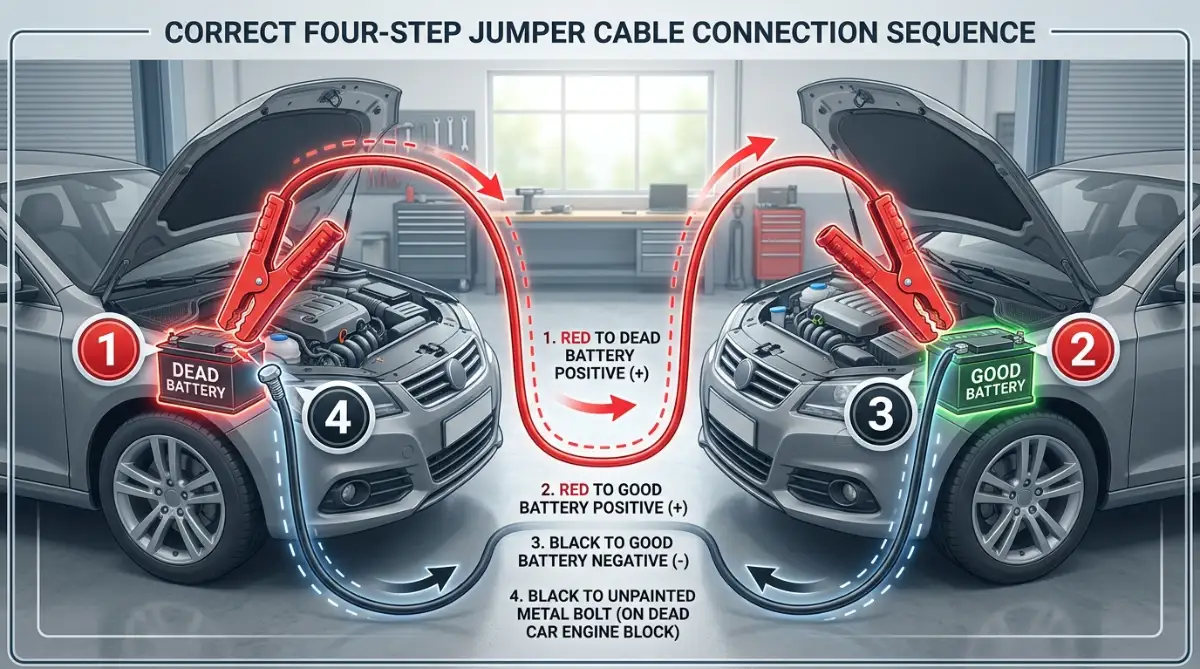
Step One: The Dead Red.
Take the Red (Positive) clamp and attach it firmly to the Positive terminal of the DEAD battery. The positive terminal is usually marked with a plus sign (+) or covered by a red plastic cap. Make sure the metal teeth bite down hard into the lead post.
Step Two: The Live Red.
Take the other end of the Red (Positive) cable and attach it directly to the Positive terminal of the GOOD, working battery.
Step Three: The Live Black.
Take the Black (Negative) clamp and attach it directly to the Negative terminal of the GOOD, working battery. This terminal is usually marked with a minus sign (-).
Step Four: The Grounding Point (The Lifesaver).
This is the single most important step in the entire process. You now have the final Black (Negative) clamp in your hand.
Do not, under any circumstances, clamp this black wire directly onto the negative terminal of the dead battery.
When you make the final electrical connection, a small spark will always happen. Car batteries naturally vent highly flammable hydrogen gas. If you create a spark directly on top of the dead battery, you can easily trigger a massive chemical explosion right in your face.
Instead, you must find a solid, unpainted metal grounding point on the engine block of the dead car. Look for a thick metal bolt or a heavy metal bracket that is at least a foot away from the battery itself.
By clamping the black wire to the engine block, you are sending the electricity safely into the heavy metal frame of the car, completely away from the explosive gases and the delicate battery sensors.
🎯 Where to Clamp That 4th Black Wire (Safe Grounding Spots)
If you are staring under the hood wondering what counts as "unpainted metal," look for these three easy targets at least twelve inches away from the battery:
- The Engine Lift Bracket: A thick, bare steel hook near the top of the engine block designed to hoist the motor.
- An Unpainted Strut Tower Bolt: Look along the inner fender wall for a bare, raw steel mounting nut.
- The Alternator Mounting Bracket: Heavy solid metal bolted directly into the chassis ground path.
Never clamp onto: Fuel lines, plastic engine covers, or painted body panels. Paint acts as an electrical insulator, forcing sparks right back into the electronics!
I actually blew the main 100-amp safety fuse in my wife's sedan because I got lazy and clamped the black wire straight to her dead battery terminal. The sudden spark jumped the wrong way and instantly melted the safety relay. I had to pay a mechanic seventy dollars just to replace a tiny piece of plastic that I broke by rushing.
The Gentle Wake-Up Procedure
Now that your cables are perfectly connected in the correct sequence, it is time to actually transfer the power.
Start the engine of the donor car (the good car). Let it run quietly at idle speed for about three to five minutes. Do not rev the engine wildly like you are at a race track.
Revving the donor engine forces the alternator to dump a massive, aggressive spike of high-voltage power through the cables. This is exactly the kind of dirty, unregulated surge that destroys the sensitive microchips in the dead car.
By letting the donor car idle smoothly, you are allowing a gentle, steady trickle of clean power to slowly fill up the dead battery. You are basically warming up the cold electronics instead of shocking them awake.
After five minutes of gentle charging, get into the dead car and turn the key. If everything was connected properly, the car should start smoothly.
If it just clicks slowly, do not keep grinding the starter motor. Turn the key completely off, wait another five full minutes for the battery to build more pressure, and try one more time.
The Critical Disconnection Sequence
Congratulations, your dead car is finally running! But you are not completely out of the danger zone yet. The way you remove the cables is just as important as how you put them on.
When you remove the clamps, the electrical system experiences a sudden drop in resistance. If you do this incorrectly, a reverse voltage spike can shoot back through the cables and damage the donor car's computer.
You must remove the cables in the exact reverse order that you put them on.
First, remove the Black clamp from the unpainted metal grounding point on the previously dead car.
Second, remove the Black clamp from the negative terminal of the donor car.
Third, remove the Red clamp from the positive terminal of the donor car.
Finally, remove the Red clamp from the positive terminal of the previously dead car.
As you remove each clamp, hold the metal ends completely apart from each other. If the red and black clamps accidentally touch while they are still connected to a running vehicle, they will create a massive, blinding shower of sparks and instantly fry the electrical system of the running car.
Why You Must Leave the Engine Running
Once the cables are safely put away in your trunk, you might be tempted to immediately turn your car off and run back inside the house to grab your coffee.
This is a terrible mistake.
Your battery is still essentially empty. The jump-start simply provided enough surface energy to spin the starter motor once. If you turn the engine off now, the car will absolutely not start again.
You need to let the engine run continuously for at least twenty to thirty minutes. This gives your car's internal alternator enough time to generate fresh electricity and deeply recharge the chemical cells inside the battery.
If you just let the car idle in the driveway, the alternator spins very slowly and produces a very weak charge. The absolute best way to recharge the battery is to actually drive the car around the neighborhood at normal city speeds.
Driving forces the engine to spin faster, which allows the alternator to push a strong, healthy current back into the empty bucket.
The Hidden Danger of AGM Batteries
If you drive a very modern car featuring automatic start-stop technology (where the engine shuts off at red lights), you probably do not have a standard lead-acid battery under the hood.
These advanced cars use something called an AGM (Absorbent Glass Mat) battery. AGM batteries are incredibly powerful, but they are also notoriously sensitive to heat and voltage spikes.
If you accidentally apply too much raw power during a jump-start, an AGM battery can actually boil its internal chemicals, completely destroying its ability to hold a charge permanently.
This is why following the exact sequence and allowing the gentle, five-minute trickle charge is absolutely mandatory for modern vehicles. You cannot treat a highly advanced AGM cell the same way you treated a cheap battery from 1995.
Pro-Level Tactics: The Safe Alternative to Cables
Even when you memorize the exact cable sequence perfectly, stringing heavy copper wires between two separate vehicles is inherently dangerous. You are relying on the other driver to have a healthy electrical system, and you are hoping their alternator does not randomly spike during the transfer.
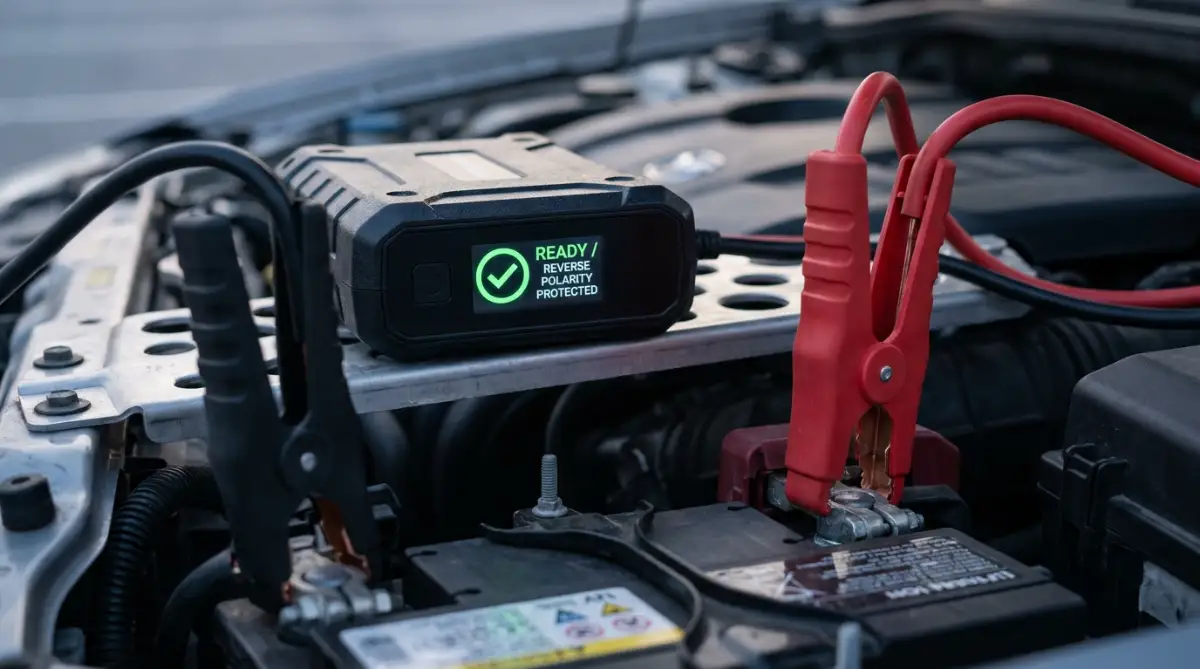
The smartest, most advanced way to handle a dead battery today completely removes the second car from the equation. Professional mechanics and smart drivers now rely exclusively on portable lithium-ion jump starter packs.
These tiny, lightweight boxes are specifically engineered to provide incredibly smooth, highly regulated power directly to your dead battery. Because they are not connected to a massive spinning alternator, there is absolutely zero risk of a random high-voltage surge destroying your dashboard computers.
These modern battery packs have built-in microprocessors that constantly monitor the electrical connection. If you accidentally hook the red and black clamps up backward, the smart pack simply refuses to send power. It flashes a warning light instead of blowing up your engine block, making it completely foolproof for anyone to use safely on the side of a busy highway.
Why You Need to Check the Terminals First
Before you ever hook up a smart pack or traditional cables, you have to look closely at the physical metal posts on your battery. Over time, battery acid naturally leaks out as a gas and builds up a thick, crusty layer of white or blue corrosion around the terminals.
This crust acts like an incredibly strong electrical shield. If you clamp your metal jaws directly on top of that heavy corrosion, the electricity cannot push through into the battery.
You might think your battery is completely dead and needs replacing, but it actually just has a dirty connection. Keep a small wire brush in your trunk and aggressively scrub that crust away before making any electrical connections.
According to technical service bulletins from the National Institute for Automotive Service Excellence (ASE), simply cleaning the terminals and tightening the loose metal clamps solves nearly thirty percent of all reported non-starting issues during cold weather.
The Deep Cycle Recovery Method
Sometimes, a car sits in a garage for weeks, and the battery drops so low that even a strong jump-start cannot wake it up. The internal chemistry has fallen completely asleep.
If your battery drops below two or three volts, standard jumper cables often fail because the donor car's computer senses a massive, dangerous vacuum and automatically stops the flow of power to protect itself.
In this specific scenario, you cannot force the jump. You must use a dedicated, slow-trickle smart charger plugged into a wall outlet.
These smart chargers push a tiny, very slow stream of electricity over twelve to twenty-four hours. This gentle process slowly wakes the chemical layers back up, safely raising the voltage without creating explosive heat or triggering safety cutoffs.
If you are currently managing complex freelance projects, you cannot afford to be stranded with a dead car. You must treat your vehicle maintenance just like you would fix silent freelance profile mistakes by proactively updating your tools before the problem actually ruins your week.

The Catastrophic Mistakes That Total Modern Cars
We naturally panic when our cars refuse to start, especially when we are running late or stuck in a dangerous, dark parking lot. That heavy, rushing panic forces our brains to completely ignore basic safety logic.
I have watched incredibly intelligent people completely destroy their thirty-thousand-dollar vehicles simply because they tried to rush through a five-minute mechanical process.
Let us walk through the most devastating emotional and physical traps you must avoid at all costs. These are the specific mistakes that tow truck drivers see every single day, and they always end with a massive repair bill.
The "Sparks Mean It Is Working" Illusion
There is an incredibly old, terrifying myth that you should tap the red and black jumper clamps together to "test if the power is flowing." You might remember seeing your grandfather do this, creating a quick, bright shower of sparks before hooking them to the battery.
Never, ever do this with a modern vehicle.
When you intentionally tap the live cables together, you are creating a dead short circuit. This violent electrical crash sends a massive shockwave directly backward through the donor car's entire wiring harness.
You can easily melt the donor car's primary safety fuses or instantly fry its main electronic control unit. By trying to be a tough mechanic, you just broke the car of the nice person who stopped to help you.
Always keep the metal clamps completely isolated from each other. If you are struggling with basic technical habits, you might also be making dangerous password management mistakes that leave your digital life just as vulnerable as your electrical systems.
Attempting to Jump a Frozen Battery
If you live in a climate with extremely harsh winters, this is the most dangerous scenario you will ever face. When a battery fully dies in sub-zero temperatures, the liquid electrolyte inside physically freezes solid like a block of dirty ice.
When water freezes, it expands, which often causes the hard plastic battery case to warp or crack invisibly along the bottom edge.
If you hook high-voltage jumper cables to a physically frozen battery, the sudden electrical heat will cause the frozen chemicals to expand violently. The plastic case will literally shatter like a bomb, spraying highly corrosive, boiling sulfuric acid all over your face and engine bay.
Before jumping a car in freezing weather, take off your glove and physically touch the side of the battery case. If it feels strangely bulging or you see visible cracks in the plastic, step entirely away from the vehicle and call a tow truck.
Ignoring the Alternator Warning Signs
People often successfully jump their car, drive home, and think the problem is completely solved. But the next morning, the car is totally dead again.
They assume they need to buy a brand new battery, so they spend two hundred dollars at the auto parts store. Two days later, the new battery is also completely dead.
This painful, expensive cycle happens because they completely ignored the true underlying problem: a failing alternator. The battery only starts the car; the alternator is what keeps the car running and recharges the battery while you drive.
If your dashboard battery light is glowing bright red while the engine is running, your alternator has failed. Jumping the car will not fix this.
You must diagnose the root cause immediately. Ignoring dashboard warning lights is just as destructive as ignoring the silent DIY solar mistakes that destroy your home insurance payout. If you do not fix the broken power source, you will just keep destroying perfectly good batteries.
A Smart Action Plan For Automotive Peace of Mind
Navigating a dead car battery does not have to feel like a high-stakes gamble with your checking account. You now possess the exact, expert-level knowledge required to protect your vehicle's expensive computer systems during a stressful roadside emergency.
You understand why that sudden surge of unregulated power is so incredibly dangerous, and exactly why the grounding sequence is your ultimate shield. By investing in a smart, portable lithium jump pack and keeping your battery terminals sparkling clean, you take all the anxiety completely out of the equation.
You are no longer relying on outdated myths or the random kindness of strangers with old, rusty cables. You have the total power to get yourself back on the road quickly and safely without causing thousands of dollars in collateral damage.
I used to sweat through my shirt every time I had to open my hood, terrified of making a wrong move. The day I finally memorized the proper sequence and bought a smart lithium pack, all that roadside anxiety completely vanished. You can build that exact same confidence and protect your expensive investment starting right now today!
Common Questions About Vehicle Battery Systems
Do I really need to wear safety glasses when jumping a car?
Yes, you absolutely should. Lead-acid batteries naturally vent highly explosive hydrogen gas through small pressure valves. If an accidental spark occurs near those valves, the battery can rupture violently, spraying dangerous, blinding acid directly into your eyes.
Can I jump a gas-powered car using a hybrid or electric vehicle?
No, you should never attempt to jump a traditional gas engine using an EV or a hybrid car as the donor vehicle. The massive electrical draw required by a traditional starter motor can severely damage the delicate 12-volt accessory system and power inverters inside the electric vehicle.
How long does a modern car battery actually last?
In normal driving conditions, a high-quality lead-acid or AGM battery typically lasts anywhere from three to five years. Extreme ambient heat, leaving electronics plugged in constantly, and driving mostly very short distances will drastically reduce that overall lifespan.
Why do some modern cars put the battery in the trunk?
Automakers often move the heavy battery to the trunk or under the rear seats to improve the overall weight distribution and handling of the vehicle. If your battery is in the trunk, look for clearly marked, dedicated "jump-start posts" located safely under the front hood specifically designed for connecting cables.
Will jumping my car completely erase my radio presets and dashboard clock?
If the battery dies completely and drops to zero volts, the car's computer loses its temporary memory, which erases your clock and radio presets. The actual jump-start does not erase them; the total loss of base voltage prior to the jump is what clears the temporary memory banks.
Is it safe to leave a portable lithium jump starter in a hot car all summer?
It is not recommended. Extreme heat inside a parked car can cause the internal lithium cells of the jump pack to degrade rapidly or swell dangerously. Always store your portable jump pack in a cool, dry place, or keep it low on the floorboard away from direct, baking sunlight.
Disclaimer: The information provided in this article is for educational, informational, and emergency preparedness purposes only. Automotive electrical systems, battery locations, and specific jump-starting procedures vary significantly between different vehicle manufacturers and models. Always consult your official vehicle owner's manual before attempting any electrical repairs or jump-starts to avoid voiding your warranty. If you feel unsafe or lack the proper equipment to handle a dead battery, immediately contact a certified towing service or professional roadside assistance. We are not responsible for any personal injury, vehicle damage, or financial losses resulting from the interpretation of this general safety guide.