Signs Your Brake Pads Are Bad (And How to Check Them in 60 Seconds)
Tapping your brake pedal only to hear a sharp screech or feel your steering wheel shake violently is your car’s urgent way of telling you that your stopping power is running out. Most drivers turn up the radio to drown out that high-pitched squeal, but ignoring worn brake pads is the easiest way to turn a simple eighty-dollar maintenance job into a thousand-dollar rotor and caliper replacement. In this guide, I will show you how to decode the warning sounds under your wheels, how to check your pad thickness in sixty seconds without a car lift, and how to spot brake failure before your pedal hits the floorboard.
📌 What You Must Know About Failing Brake Pads:
-
Squeaking is an early warning: The high-pitched whistle is caused by a built-in metal wear tab telling you that roughly 20% of your pad life remains.
-
Grinding means emergency damage: A deep metal roar means your friction material is 100% gone and the steel backing plate is carving grooves into your rotor.
-
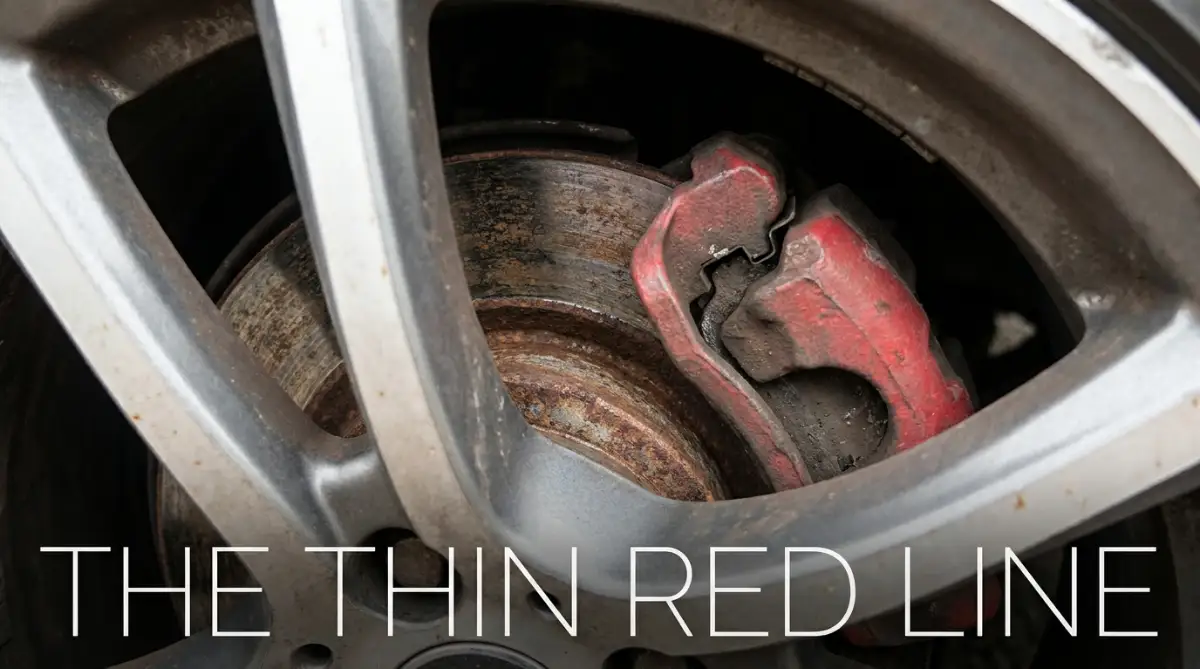
The 3mm visual rule: Look through your wheel spokes monthly; if the friction block is thinner than a quarter of an inch (3mm), replace your pads immediately.
-
Spongy pedal means fluid trouble: If your pedal sinks all the way to the floor, moisture in your hydraulic brake lines is boiling into compressible steam.
Decoding the Hidden Language of Your Braking System
To understand why your car is trying to warn you, we have to look closely at what happens down by the wheels every single time you press your foot down. Your car does not stop because of pure magic; it stops through intense, brutal friction.
When you press the brake pedal, hydraulic fluid pushes a heavy metal clamp called a caliper tightly against a spinning metal disc attached to your wheel.
Bolted inside that clamp are two small blocks of high-friction material known as brake pads. As those pads squeeze against the spinning disc, they generate massive kinetic energy conversion, turning forward motion into heat and bringing your car safely to a halt.
Because this process relies entirely on friction, your brake pads are explicitly designed to wear down slowly over time. They are literal sacrificial lambs engineered to take the damage so your expensive metal wheels and rotors remain unharmed.
When you buy a brand-new set of pads, that friction material is nice and thick, measuring roughly half an inch across.
As you drive through city traffic, stop at red lights, and cruise down the highway, that thickness slowly shaves away into microscopic dust particles. The manufacturing engineers knew this would happen, so they built an ingenious warning voice directly into the hardware of the pad itself.
Let us break down the exact physical signals your car sends out when those pads are dangerously close to vanishing completely.
The High-Pitched Screech of Despair
Let us tackle the most common warning sign first: the dreaded high-pitched squeal. If your car lets out a sharp, metallic whistle every time you tap the pedal, your vehicle is talking directly to you.
Automotive engineers deliberately embed a tiny, flexible piece of metal called a wear indicator deep inside the friction material of the brake pad.
This little metal indicator is set at a very specific depth. It is positioned so that when your brake pad wears down to about twenty percent remaining life, the metal shim becomes exposed.
The second that thin metal edge lightly kisses the spinning steel rotor, it produces a piercing, unmistakable acoustic frequency designed to cut through closed windows and loud music.
🛑 Brake Pad Thickness Guide: Safe vs. Danger Zones
My Rule of Thumb: Never let your pads drop below 3 millimeters. Once you hit the metal backing plate, you add an extra fifty feet to your emergency stopping distance and double your repair bill.
This screech is not a mechanical defect or a random glitch; it is an intentional, friendly cry for help. It means you have roughly a few weeks of safe driving left before the padding is completely gone.
I ignored this exact sound on my sedan for two weeks, telling myself I would fix it after my next paycheck. That delay cost me an extra four hundred dollars because the bare metal backing plate had completely chewed up and ruined my brake rotors, turning a simple pad swap into a full mechanical overhaul.
🎬 Mechanic’s Sound Guide: Why Brakes Squeak at Low Speeds
If you hear an annoying squeal every time you roll up to a stop sign or crawl in traffic, watch this hands-on breakdown from Honest Mechanic Colorado. He gets right under the wheel well to demonstrate the most common pad noises, showing you why brakes squeak at low speeds and how to spot real mechanical damage:
Now that you know why pads squeal at low speeds, let us look at what happens when that warning is ignored and the noise escalates into a brutal grinding roar:
The Danger of the Scraping Metal Roar
If you ignore that polite high-pitched screech for too long, the situation escalates rapidly from a minor warning into an active mechanical emergency. If you now press your brake pedal and hear a deep, harsh, aggressive metal-on-metal grinding sound, your safety buffer is entirely gone.
That initial warning indicator has completely broken off or worn away, and the bare steel backing plate of your brake pad is now violently scraping directly against your spinning rotor.
This is the automotive equivalent of rubbing two knives together at high speeds.
Instead of generating friction through safe composite material, you are grinding raw iron against iron. Your stopping distance increases dramatically because slick steel sliding against steel has terrible grip compared to specialized brake compound.
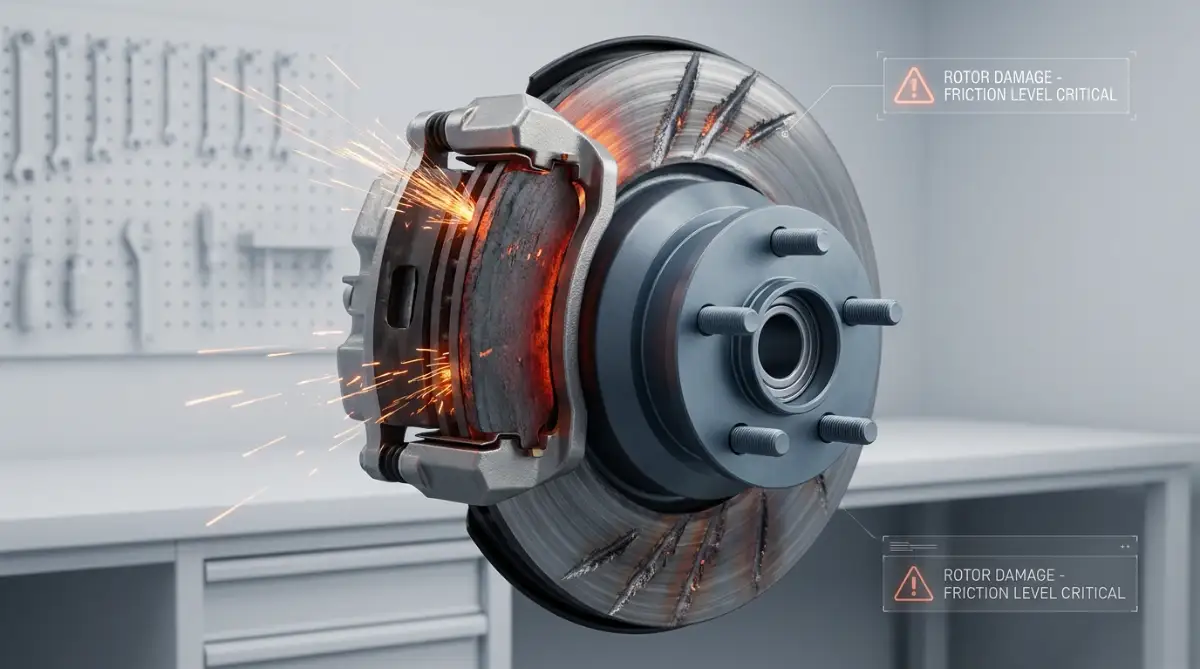
More importantly, every single time you come to a stop while hearing that scraping roar, you are carving deep, ugly gouges into your expensive brake rotors.
You are actively destroying the surrounding hardware, turning a cheap pad replacement into a massive, highly expensive multi-part repair job. If you keep driving on scraping brakes, you risk completely cracking the rotor or causing the brake caliper to jam shut, which can instantly lock up your wheel while driving down the highway.
The Tell-Tale Steering Wheel Vibration
Sometimes your ears won't warn you as clearly as your hands will. If you are cruising down the highway at sixty miles per hour and you gently press the brake pedal, but your steering wheel starts violently shaking and vibrating back and forth, you have a serious structural issue.
This pulsation usually happens because your brake rotors have become warped or unevenly coated with old brake pad material.
When the pads squeeze down onto a rotor that has high spots and low spots due to excessive heat and extreme wear, the caliper bounces rhythmically against your foot and your steering column.
This vibration tells you that your braking system is suffering from severe thermal fatigue. The metal parts are literally bending under the pressure of stopping a heavy vehicle with zero padding left to absorb the brutal friction heat.
Ignoring this shaking steering wheel will eventually lead to uneven tire wear and severe suspension damage. Your car is physically struggling to keep a straight line under braking pressure.
The Soft, Spongy Pedal Feel
When you step on the brake pedal, it should feel firm, tight, and completely predictable under your foot. If you press the pedal down and it feels mushy, soft, or sinks unusually close to the floorboard before the car actually responds, your braking system is losing hydraulic integrity.
This often points to a combination of severely worn-out pads and boiling brake fluid.
As your brake pads thin out, the hydraulic pistons inside your brake calipers have to push much further outward to bridge the gap and press the pads against the rotor.
This excessive movement requires more fluid volume, which changes the internal pressure dynamics of your master cylinder.
If your pads are dangerously thin, your braking system has to work twice as hard just to achieve the exact same stopping power. A spongy pedal means your margins for safety are shrinking by the hour.
The Burning Chemical Odor
Have you ever pulled into your driveway after a normal commute and smelled a sharp, acrid, chemical odor resembling burning carpet or hot metal drifting through your open windows?
That terrible smell is a massive red flag.
When your brake pads are worn down to their final millimeter, the mechanical components have to work with extreme friction to slow the car down. This creates localized heat spikes that can easily exceed five hundred degrees Fahrenheit.
At that extreme temperature, the remaining adhesives and chemical resins inside the brake assembly start literally cooking and melting.
This burning chemical smell tells you that your brakes are overheating from overuse and lack of material protection. If you pop your hood or smell this near your wheels, give the car time to cool down and inspect the wheels immediately.
The Unpredictable Vehicle Pulling
When you apply the brakes on a straight stretch of empty road, your car should glide smoothly to a stop without requiring any steering corrections. If your vehicle suddenly yanks hard to the left or the right the second you touch the pedal, you have an uneven braking crisis.
This dangerous pull usually happens because your brake pad