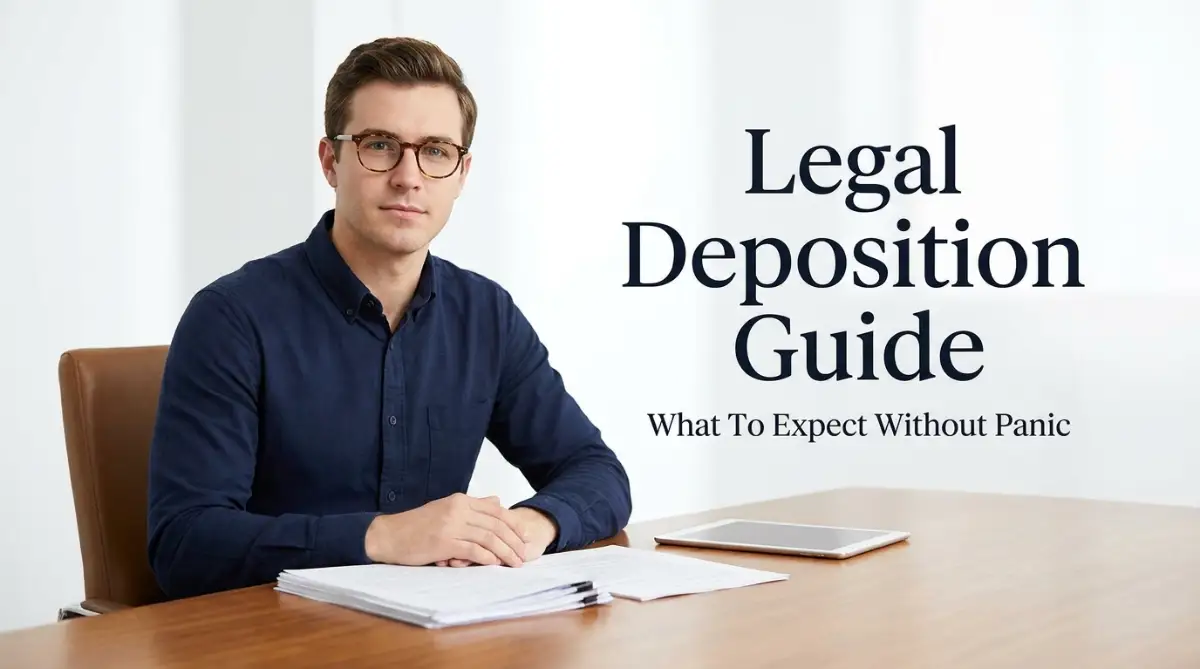
The Heavy Weight of the Unknown
Are you completely terrified about your upcoming legal deposition? Do not worry, your feelings are perfectly normal. Most people assume a deposition is like an intense television drama where aggressive lawyers scream at you until you break down. But the reality is usually just a very boring meeting in a quiet conference room. If you know exactly how the game is played, you can walk into that room, answer the questions safely, and walk out with your case completely intact. Let me show you how to beat the fear of the unknown.

📌 Quick Summary: How to Survive Your Deposition
- The 3-Second Rule: Always pause for three full seconds before answering so your lawyer has time to object.
- "I Don't Know" is Safe: Never guess! If you cannot remember a detail, saying "I do not recall" is the most truthful and safest answer.
- Beware of Silence: Do not fill awkward silences with extra talking; answer the exact question and wait patiently.
- Read Everything: If they hand you a document, take your time to read the entire page before commenting on it.
Pulling Back The Curtain: The Physical Setup
Before we talk about how to answer difficult questions, we need to completely demystify the physical environment. A deposition rarely happens in a grand, intimidating courtroom with a judge looking down at you. In reality, the setting is usually surprisingly boring and completely ordinary.

You will most likely walk into a standard, quiet conference room at a law firm. There is no judge present, there is no jury box, and there are no heavy wooden gavels. It usually just looks like a completely normal corporate business meeting space.
The Cast Of Characters In The Room
When you walk through the door, you will typically see three or four specific people waiting for you. First, your own lawyer will be sitting right next to you for the entire duration. Their primary job is to protect your rights and ensure the questioning remains fair.
Across the table will sit the opposing counsel, which is the lawyer representing the other side of the lawsuit. This is the person who will be asking you the vast majority of the questions. They might seem friendly at first, but remember they are actively doing a job for their client.
At the end of the table sits the most important person in the room: the court reporter. This person operates a specialized typing machine to record absolutely everything said in the room. In some modern cases, there might also be a professional videographer quietly running a camera in the corner.
The Sacred Rule Of The Oath
Just because you are sitting in a comfortable leather chair does not mean the rules of truth are relaxed. Before anyone asks you a single question, the court reporter will ask you to raise your right hand. You will officially swear or affirm to tell the whole truth.
This simple oath instantly transforms that ordinary conference room into an extension of a real courtroom. Everything you say carries the exact same heavy legal weight as if you were sitting on a witness stand in front of a real judge.
Understanding The Goal Of The Opposing Side
Many people mistakenly believe that a deposition is their big chance to tell their entire story and win the case. This is a very dangerous mindset. You cannot win your case during a deposition, but you can certainly lose it.
The opposing lawyer is not there to listen to your emotional truth or give you sympathy. They are simply there on a fishing expedition. They want to lock down your permanent story so you cannot change it later at the actual trial.
They are actively looking for small inconsistencies in your memory. They want to find out what you know, what you do not know, and how well you handle pressure. Your only goal is to provide short, completely truthful answers and survive the day without volunteering extra details.
Did You Know? The Silence Trap
Opposing lawyers are heavily trained in human psychology. They will often sit completely silent after you finish answering a question. Why? Because normal people hate awkward silence and will naturally keep talking to fill the quiet gap! That extra talking is usually where major mistakes happen. Embrace the awkward silence and keep your mouth shut.
The Golden Strategy For Answering Safely
Think of a deposition like a highly structured game of tennis, rather than a casual coffee shop chat. In normal daily life, if someone asks you a question, you naturally want to fill the silence with a long, helpful story. You want to be polite and explain all the background details.
In a legal setting, being overly helpful is your absolute biggest enemy. If you give them extra information, you are simply giving the opposing lawyer fresh ammunition to use against you. You must completely retrain how you speak for this specific event.
The Magic Of The Mandatory Pause
This is the single most effective tool you have in your entire arsenal. When the opposing lawyer asks you a question, you must force yourself to wait three full seconds before you open your mouth.
Why is this pause so powerful? First, it gives your own lawyer enough time to loudly state an official objection if the question is unfair. If you answer too quickly, your lawyer cannot protect you.
Second, the pause forces you to actually think about the exact words being asked. When we rush, we answer the question we think they asked, rather than the literal question they actually asked. Take a deep breath, process the words, and then speak.
Are you wondering how opposing lawyers use sneaky psychological tricks to make you talk too much? Watch this eye-opening breakdown by a top trial attorney:
Embracing The Power Of "I Do Not Know"
Normal human beings absolutely hate admitting when they do not know something. We naturally want to be helpful, so our brains try to fill in the missing gaps with logical guesses. In a normal conversation, this is completely fine.
In a deposition, guessing is incredibly dangerous. If a lawyer asks you exactly how fast the other car was traveling, and you guess "maybe fifty miles per hour," that guess officially becomes your sworn testimony. Even if you meant it casually, they will treat it as a hard, scientific fact at trial.
There is absolutely no shame in simply saying, "I do not know," or "I do not remember." If you truly cannot recall a specific detail from an event that happened two years ago, telling the truth means admitting your lack of memory.
I actually made a massive mistake during my own early preparation by trying to guess the exact time of day an event occurred. My lawyer immediately stopped me and explained that an honest "I do not remember" is a thousand times better than a well-intentioned guess that can later be proven completely wrong.
The Difference Between An Estimate And A Guess
Sometimes, you might have a general idea of a fact, even if you do not know the exact specific number. The law actually recognizes a massive difference between a wild guess and an educated estimate.
If you are asked about distances, timeframes, or speeds, and you have a solid foundation for your thought, you can offer an estimate. However, you must explicitly use the word "estimate" in your verbal answer.
For example, you should say, "I am estimating, but I believe the meeting lasted about an hour." This protects you if a document later proves the meeting was actually forty-five minutes long. By clearly stating it was an estimate, the opposing lawyer cannot accuse you of lying under oath.
Quick Rule: The "Ask Yourself" Filter
Before you open your mouth, mentally ask yourself these two questions:
- Did the lawyer specifically ask for this detail?
- Does adding this detail actually help my case?
- If the answer to either is "No," do not say it!
Navigating The "Yes Or No" Trap
Opposing lawyers love to ask highly restrictive questions. They will often ask long, complicated questions and then aggressively demand that you answer with a simple "yes" or "no."
They do this specifically to trap you into agreeing with their twisted version of the story. If a question cannot truthfully be answered with a simple yes or no, you are not forced to do so.
You always have the absolute right to say, "I cannot answer that question with a simple yes or no." If they push you aggressively, just stay completely calm and politely repeat that statement. Your own lawyer will step in to handle the bullying tactics.
Dealing With Documents And Surprise Evidence
During the questioning, the opposing lawyer will likely slide a piece of paper across the table toward you. This is called an exhibit. It might be an old email, a medical record, or a photograph related to your specific case.
They will usually point to a specific paragraph and ask you to confirm what it says. Human instinct tells you to glance at the paper and immediately start answering. You must fight this natural urge with everything you have.
When you are handed a document, you must completely stop the conversation. Take your time to read the entire page from the top margin down to the bottom signature. Read the date, read who sent it, and read the context of the paragraphs above the highlighted section.
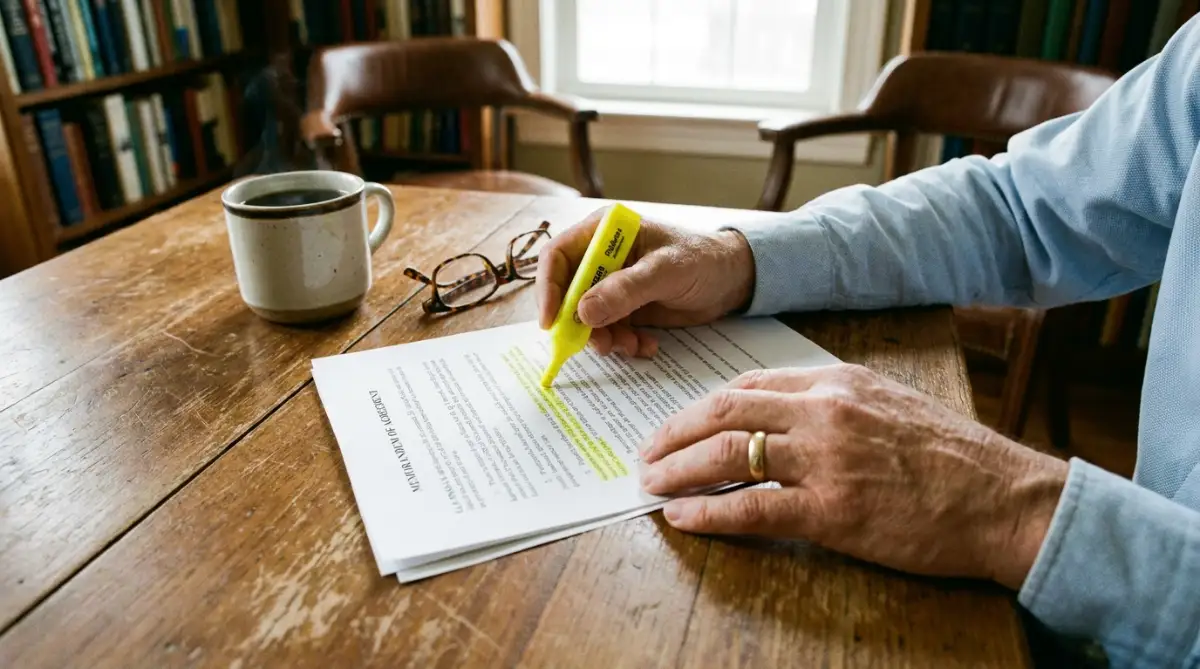
The opposing lawyer might sigh loudly or act impatiently while you read. Let them act annoyed. It is your sworn testimony, and you have the absolute right to read any document fully before you comment on it.
Understanding Your Lawyer's Objections
Throughout the day, you will likely hear your own lawyer suddenly interrupt the questioning by saying the word "Objection." They might say things like "Objection to form," or "Objection, assumes facts not in evidence."
When your lawyer speaks, you must immediately stop talking and close your mouth. Do not try to finish your sentence. Listen very carefully to what your lawyer is saying, because their objection is often a secret hint for you.
For example, if your lawyer says, "Objection, you are asking him to guess," they are literally warning you that you do not have personal knowledge of the topic. After the objection is officially stated on the record, the lawyer will usually turn to you and say, "You may answer the question if you understand it."
At that point, if you realize the question was indeed asking for a wild guess, you can confidently respond with, "I do not want to guess." Your lawyer is your shield, so you must always respect their interruptions.
The Tactical Advantage Of Taking Breaks
Many witnesses mistakenly believe they are trapped in the conference chair until the opposing lawyer decides they are finished. This is completely false. You are not a prisoner, and you have a massive amount of control over the pacing of the day.
A deposition is incredibly exhausting for your brain. You are processing difficult questions, maintaining high emotional control, and recalling distant memories. If you get overly tired, you will start giving sloppy, careless answers.
You have the absolute right to ask for a break at almost any time. If your mouth gets dry, ask for a break. If you need to use the restroom, ask for a break. If you feel a sudden wave of panic or confusion, ask for a break to speak privately with your lawyer in the hallway.
The only strict rule is that you cannot ask for a break while a specific question is actively pending. If the lawyer just asked a question, you must answer it before you can step out of the room. Plan your breaks strategically between topics to keep your mind sharp and completely focused.
Mastering The Mental Game: Insider Strategies From Top Attorneys
Now that you understand the physical layout and the basic rules of the room, it is time to level up your strategy. Surviving a legal interrogation is not just about knowing the facts of your case. It is actually a high-stakes psychological test of your endurance and discipline.
Opposing lawyers are highly trained professionals who know exactly how to push your emotional buttons. They want you to drop your guard, get comfortable, and start talking like you are having a casual chat with a friend. To completely protect yourself, you need to adopt the exact same mental frameworks that expert witnesses use.
Let's break down some advanced, real-world techniques that will keep you firmly in control of the conversation, no matter how aggressively they push you.
The "Awkward Silence" Weapon
One of the most effective tricks an opposing lawyer will use against you is completely invisible. After you finish answering a question, they will simply sit there and stare at you in total silence. They will not ask the next question immediately.
Human beings naturally hate awkward silence. Our brains are hardwired to fill quiet rooms with nervous chatter just to make the tension go away. If you fall for this trap, you will start adding unnecessary extra details to your original answer just to break the silence.
You must embrace the awkwardness. When you finish your short, truthful answer, simply close your mouth and wait. According to psychological research on how stressful interrogations manipulate memory recall, silence is deliberately used to create an artificial sense of guilt or inadequacy.
Do not let them play this mind game with you. Look calmly across the table, keep your face entirely neutral, and force them to ask the next question. You are entirely in charge of your own voice.
Defeating The Compound Question Trap
Lawyers love to ask sneaky questions that actually contain two or three different questions mashed together. They might say, "You left the office at 5 PM and immediately drove to the bar, correct?"
If you just say "yes," the court reporter records that you agreed to both statements. But what if you left at 5 PM, went to the gym first, and then went to the bar? Your simple "yes" just became a false sworn statement.
You must carefully unpack every single sentence they throw at you. If they ask a double question, politely ask them to break it down. Say, "You are asking me two different things, could you please ask them one at a time?"
Taking control of the pacing like this shows the opposing counsel that you are incredibly sharp. It signals that you cannot be easily bullied or tricked into agreeing with a twisted narrative.
Managing Your Physical Tells On Camera
In modern lawsuits, many depositions are visually recorded by a professional videographer. This completely changes the dynamic of the room. The paper transcript only records the exact words you say, but the camera records your sweat, your shifting eyes, and your angry facial expressions.
If your case actually goes to trial, a jury might watch this video tape. You want to look like the most reasonable, calm, and cooperative person in the world.
Keep your hands resting flat on the table to prevent nervous fidgeting. Do not roll your eyes, do not sigh heavily, and never point your finger aggressively at the opposing lawyer.
The "Echo" Technique For Absolute Clarity
Sometimes a lawyer will use incredibly dense, confusing legal terminology to purposefully confuse you. You might hear the words, but your brain simply cannot process what they actually mean.
Never answer a question that you do not understand with absolute, one-hundred-percent certainty. Instead, use the echo technique. Repeat their exact question back to them in your own simple words.
You can say, "Are you asking me if I saw the red car run the stop sign?" This forces the lawyer to clarify their confusing language on the official record. The Legal Information Institute at Cornell Law School specifically outlines that a witness has the absolute right to seek clarification before providing sworn testimony.

Dangerous Witness Traps That Quietly Destroy Strong Lawsuits
Even with weeks of excellent preparation, smart people still make terrible mistakes when the pressure gets high. A deposition is a highly unnatural environment, and our normal human instincts often betray us.
If you do not actively suppress these natural habits, you can single-handedly ruin a case that your lawyer has spent months building. These mistakes are rarely dramatic explosions; they are usually quiet, simple errors that look terrible when printed on paper.
Let's look at the absolute worst pitfalls you must actively avoid during your session.
The Sarcasm And Humor Disaster
When some people get incredibly nervous, they use humor or sarcasm as a defense mechanism. The opposing lawyer might ask a ridiculous question, and you might naturally reply with a sarcastic joke to relieve the heavy tension in the room.
This is a massive, catastrophic mistake. The court reporter's stenography machine cannot type sarcasm. It cannot record your funny tone of voice or the smirk on your face.
When the judge or jury reads that plain black-and-white paper transcript months later, your sarcastic joke will look like a completely serious, literal statement. A poorly timed joke can easily become a permanent confession. Leave your sense of humor at home and treat every single question with absolute, clinical seriousness.
Falling For The "Friendly Lawyer" Routine
Not every opposing lawyer is going to act like an aggressive bulldog. Some of the most dangerous lawyers in the industry use the "friendly neighbor" approach.
They will offer you coffee, ask about your children, and smile warmly while they question you. They want you to relax and drop your professional guard. They want you to feel like you are just chatting with a friend at a local diner.
Do not fall for this carefully crafted illusion. No matter how nice they seem, their only job is to dismantle your case and protect their client. Getting overly comfortable leads to careless, rambling answers that expose your weakest vulnerabilities.
The Deadly Trap Of Absolute Words
Lawyers love to push witnesses into using absolute words like "always," "never," "impossible," or "every single time." These words are incredibly dangerous because they leave absolutely zero room for normal human error.
If you testify that you "never" drive over the speed limit, the opposing lawyer just needs to find one single speeding ticket from ten years ago to prove you are a liar. Once they prove you lied about one small thing, they will argue to the jury that your entire testimony cannot be trusted.
Avoid absolute statements completely. Instead of saying "I never do that," you should say, "It is my general practice not to do that," or "To the best of my current recollection, I did not do that." These softer phrases protect you if new evidence suddenly appears later.
Refusing To Concede Obvious Facts
Sometimes, a witness becomes so defensive that they refuse to admit basic, undeniable facts. If the sky was blue that day, just admit the sky was blue.
If you fight the opposing lawyer on tiny, irrelevant details just to be stubborn, you will look incredibly uncooperative and highly suspicious. A jury will immediately wonder what else you are trying to hide.
You lose absolutely nothing by admitting obvious truths. Pick your battles wisely and save your mental energy for the questions that actually impact the core of your lawsuit.
Guessing What Documents Say
We touched on this briefly before, but it is the most common mistake witnesses make. When handed a document, people often try to summarize what they think the document says based on their memory.
Your memory is fundamentally flawed, especially under extreme stress. If a lawyer asks you what a specific email says, simply read the exact words printed on the page out loud.
Trying to paraphrase complex legal or technical documents often leads to accidental misrepresentation. This is exactly how people make mistakes that destroy your home insurance payout—by guessing the rules instead of reading the actual physical policy. Let the document speak entirely for itself.
Your Ultimate Deposition Survival Blueprint
We have covered a massive amount of intense psychological and legal ground today. The goal here is not to make you paranoid about every single word you speak.
The primary goal is to completely remove the paralyzing fear of the unknown. When you walk into that conference room, you will now understand exactly what the opposing lawyer is trying to do, and you will know exactly how to block their attacks.
You are not a helpless victim sitting in that chair. You have massive power over the pacing, the clarity, and the ultimate outcome of your testimony.
A Quick Mental Checklist For Your Big Day
Before you walk through the glass doors of the law firm, take a deep breath and run through this final mental checklist:
- Listen to the entire question without interrupting.
- Pause for three full seconds before you make a sound.
- Answer only the exact question asked, in the shortest way possible.
- Stop talking immediately when your lawyer objects.
- Never guess, and never be afraid to say "I do not know."
If you follow these simple, rigid rules, the opposing lawyer will quickly realize that you are an incredibly disciplined witness. They will likely give up their aggressive tactics and finish the session much earlier than expected.
Just like you need to take immediate steps to rescue your lost files before it s too late when a computer crashes, you must protect your legal rights the moment you swear the oath.
Trusting The Preparation Process
Your lawyer will likely schedule a lengthy preparation meeting with you a few days before the actual event. Treat this practice session incredibly seriously.
According to guidelines from the American Bar Association regarding witness preparation, practicing your answers out loud is the single best way to reduce physical anxiety. Your lawyer might even play the role of the "bad guy" to see how you handle sudden stress. Welcome this difficult practice, because it will make the real day feel surprisingly easy.
I was absolutely terrified before my first formal testimony, convinced I was going to ruin my own life with one wrong sentence. But because I strictly followed the "pause and think" rule, the entire four-hour session ended up feeling like a completely boring, repetitive business meeting. You absolutely have the inner strength to handle this pressure, and you will walk out of that room feeling incredibly proud of yourself.
Frequently Asked Questions About Giving Legal Testimony
Can I talk to my own lawyer privately during the deposition?
Yes, you absolutely can ask to speak with your lawyer in private, but there is one major catch. You cannot ask for a private break while a specific question is actively pending. You must first answer the question on the table to the best of your ability, and then you can request a quick recess to speak in the hallway.
What happens if I realize I made a mistake in my answer earlier in the day?
Do not panic, as human memory is imperfect. If you realize you gave an incorrect answer an hour ago, simply tell your lawyer during a break, or state it clearly on the record. You can say, "I want to clarify an answer I gave earlier about the timeline." The National Court Reporters Association ensures that your official transcript can reflect these honest corrections before you sign the final copy.
Do I have to dress up in a formal suit for a deposition?
You do not need to wear a tuxedo or a formal ballgown, but you should dress respectfully. Business casual is usually the best approach. Wear what you would wear to a serious job interview or a respectful religious service, as this shows the opposing counsel that you take the legal process highly seriously.
How long does a typical legal deposition usually last?
The length varies wildly depending on the complexity of your specific lawsuit. A simple car accident case might only take two hours, while a complex corporate fraud case could literally take multiple days. Your lawyer will give you a realistic time estimate beforehand, but always clear your entire schedule for that specific day just to be safe.
What happens if I refuse to answer a question that feels too personal?
You cannot simply refuse to answer a question because you find it annoying or slightly embarrassing. However, if a question violates legal privilege or is completely abusive, your lawyer will firmly object and instruct you not to answer. Always follow your lawyer's direct instructions on when to stay completely silent.
Disclaimer: The information provided in this blog post is strictly for educational and informational purposes only and does not constitute formal legal advice. Laws and deposition procedures vary significantly by jurisdiction and individual case circumstances. Reading this article does not establish an attorney-client relationship. Always consult directly with your own licensed attorney regarding the specific details of your lawsuit before providing sworn testimony.