How to Build a Minimum Viable Product (Without Wasting Months on Code)
Spending eight months and your entire savings building an app before showing it to a single customer is the fastest way to kill a startup. Most founders believe they need custom code, twenty features, and a flashy design to launch, but real customers only care if you can solve one specific headache today. In this guide, I will show you how to build a true Minimum Viable Product (MVP) without writing code, how to test real buying demand manually, and how to get your first paying users before you spend a dime on developers.
📌 The Real Rules of Building a Minimum Viable Product (MVP):
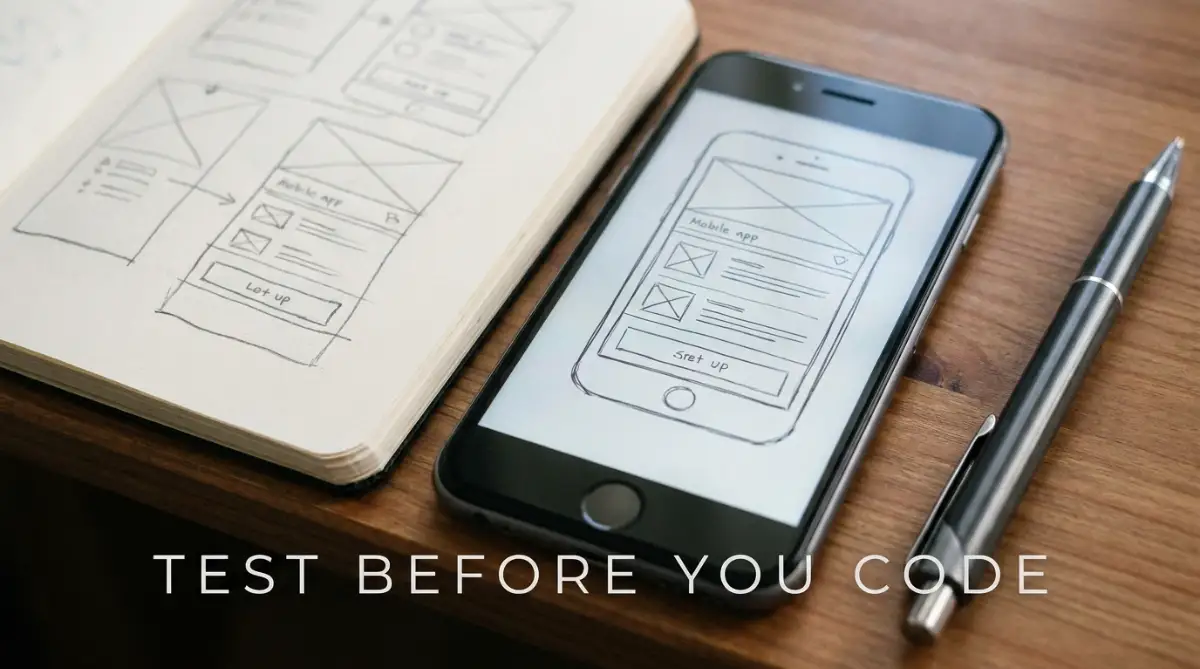
- Do not write code first: Use manual services, simple landing pages, or spreadsheets to prove people will actually pay before hiring developers.
- Charge money on day one: Free beta testers will tell you they love your idea, but real validation only happens when a customer pulls out their credit card.
- Solve only one painful problem: Kill feature creep immediately—if a feature does not directly solve the main customer headache, cut it from your MVP.
- Launch quietly to ten users: Forget massive launch parties; quietly test with a tiny target group so you can fix bugs and study user behavior in private.
Why Your Idea of "Minimum" is Completely Wrong
To understand why so many smart people fail at this process, we have to look closely at the actual definition of a Minimum Viable Product (MVP). When most founders hear the word "minimum," their brain automatically translates it to "a slightly smaller version of my giant, perfect dream."
They still want to build the entire car; they just plan to build it with cheaper tires and a smaller engine first. This is a massive, incredibly expensive misunderstanding.
An MVP is not a smaller version of your final product. It is a highly specific, totally ruthless experiment designed to answer exactly one question: "Will people actually pay money to solve this specific problem?"
If your core assumption is wrong, it does not matter how beautiful your software looks. Let us systematically destroy the biggest myths surrounding this concept and look at how smart founders actually test their ideas without going broke.
The Myth of Writing Code First
Let us tackle the most expensive myth right out of the gate. You have a brilliant idea for a new mobile app, so you immediately assume your very first step is to hire a software developer or start learning how to code.
You think an app has to physically exist on a phone before you can test it. This specific lie keeps thousands of non-technical founders from ever launching their businesses.
The harsh reality is that writing custom code is the absolute most expensive and time-consuming way to test a business idea. You should almost never write a single line of code for your very first MVP.
Instead, you need to use what the industry calls a "Wizard of Oz" test or a concierge service. This means you manually perform the service for the customer behind the scenes, making it look like a piece of software is doing the heavy lifting.
For example, if you want to build an AI app that automatically plans healthy weekly meals, do not spend fifty thousand dollars building an algorithm. Set up a simple, free landing page that says, "I will send you a custom meal plan for twenty dollars a month."
When someone pays you, you personally sit down, research the recipes on Google, type them into a PDF, and email it to the customer.
The customer gets exactly what they paid for, and you instantly prove that people are willing to spend money on this problem. You just validated your entire business model using a free landing page and your own manual labor.
🧪 The No-Code MVP Cheat Sheet: How to Validate Without Developers
My Golden Rule: If your test takes more than 14 days to put in front of a real human being, you are overbuilding. Cut the features in half and launch the manual test this weekend.
I actually wasted five thousand dollars paying a developer to build an automated email tool that nobody wanted. A year later, I tested a totally different idea using just a basic Google Form and a PayPal link. I made my first three sales in less than a week, and I realized that customers only care about the final result, not the fancy technology behind it.
🎬 Expert Masterclass: The 5-Step Lean MVP Blueprint
If you want to see how experienced founders test software ideas without wasting months on custom code, watch this step-by-step walkthrough from veteran startup creator Rob Walling. He breaks down the five stages of building a lean MVP that tests real market demand before you spend thousands on developers:
The Danger of Feature Creep
This is the psychological trap that catches incredibly smart, creative people. You start building your simple MVP, and suddenly your brain starts flooding you with amazing "what if" scenarios.
You think, "What if the user wants to share this on social media? I need to add a share button! What if they want a dark mode? I should build that right now!"
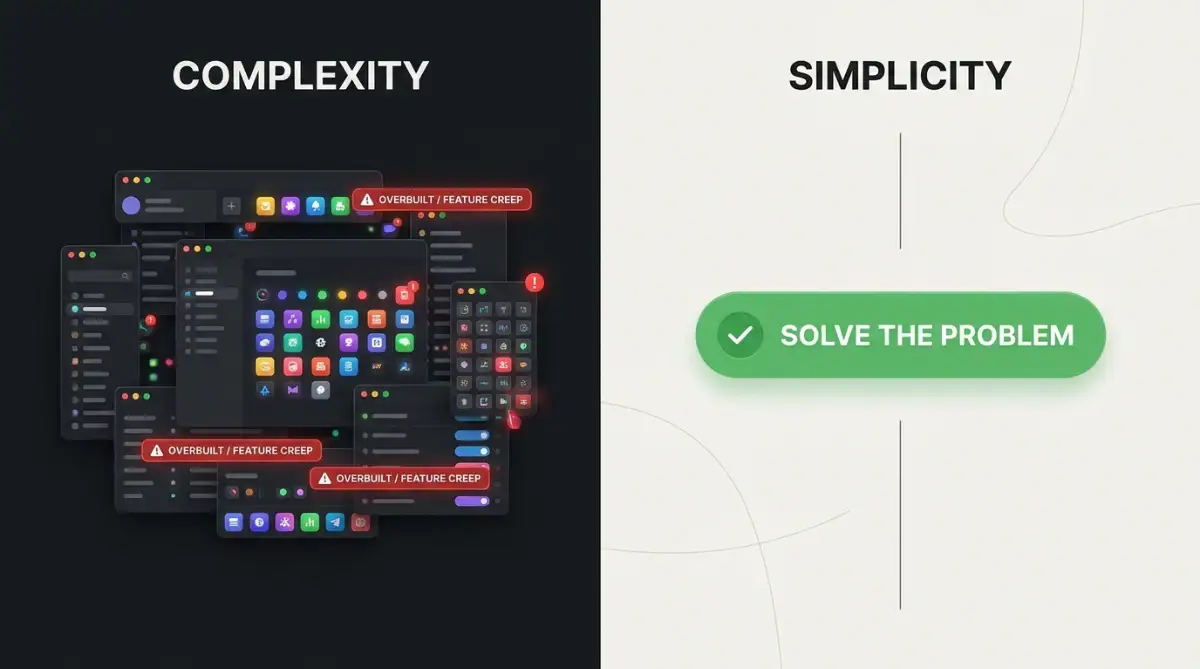
This deadly habit is called feature creep. It is a toxic disease that slowly forces your small, tight experiment to grow into a massive, unmanageable monster.
Every single time you add a new feature to your MVP, you are adding weeks of development time and hundreds of potential new bugs to fix. More importantly, you are completely muddying the waters of your experiment.
If you launch an MVP with ten different features and nobody buys it, you have absolutely no idea why it failed. Did they hate the core idea, or did they just get confused by the complicated menu system?
Your MVP must focus violently on solving one single, painful problem for one specific type of user. If you are building a tool to help freelance writers track their unpaid invoices, your MVP does not need a built-in calendar or a custom logo creator. It just needs a button that sends an invoice and tracks the payment. Nothing else matters.
The Fear of Being Ugly
Here is a truth that makes graphic designers completely panic. Your first MVP should probably look a little bit ugly.
Reid Hoffman, the famous founder of LinkedIn, famously said, "If you are not embarrassed by the first version of your product, you launched too late."
When you spend weeks polishing the drop shadows on your buttons and perfectly aligning your logo, you are completely missing the point of the experiment. You are wasting valuable time on cosmetic details before you even know if the house is built on a solid foundation.
Customers who are actively bleeding from a massive business problem do not care if the bandage you offer them has a pretty pattern on it. They just want the bleeding to stop immediately.
If your core solution is highly valuable, early adopters will happily use a clunky, ugly interface. In fact, if they use your ugly product and complain about the design, that is actually a massive victory. It means the core idea is so good that they are willing to fight through a bad interface just to get the result.
The Free Beta Testing Illusion
Many founders are terrified to ask for money on day one. They launch their minimum viable product completely for free, calling it a "private beta test." They convince themselves that they just want to gather user feedback before they turn the payment gateway on.
This sounds like a very nice, community-focused strategy. But from a pure validation standpoint, it is incredibly dangerous.
When you give something away for free, people will happily take it. They will sign up, click around for three minutes, tell you it looks great, and then completely forget about it.
Getting a hundred free signups does not validate your business model at all. It just proves that people like free things. The only feedback that actually matters in the startup world is the friction of a credit card transaction.
If someone is not willing to pull their wallet out and pay you ten dollars for your solution, your solution is not painful enough to build a business around. You must charge money from day one, even if you are doing the work manually behind the scenes.
The Myth of the Massive Launch Day
If you read major tech blogs, you constantly see headlines about massive companies coming out of "stealth mode" with million-dollar launch parties. This creates a deeply flawed expectation for normal, bootstrapped founders.
You assume you need a massive PR campaign, an explosive launch on Product Hunt, and thousands of eager followers waiting for your website to go live.
This is complete fiction for 99 percent of successful businesses. Your MVP launch should actually be incredibly quiet.
When you quietly launch to a very small, highly targeted group of ten or twenty people, you can actively watch exactly how they interact with your tool. If your server crashes or a major bug breaks the login page, you only disappointed ten people. You can quietly fix the bug, apologize personally, and move forward.
If you throw a massive launch party and push three thousand people to your broken MVP, you just permanently burned three thousand potential customers. Start small, break things quietly, fix them quickly, and slowly scale up as your confidence in the product grows.
Understanding the Target Audience Trap
We have talked extensively about how to build the product, but who are you actually building it for? One of the most silent killers of an MVP is defining the target audience entirely too broadly.
When you ask a new founder who their product is for, they often say something terrifyingly vague like, "It is for small business owners who want to save time."
That is not a target audience; that is basically the entire working population of the planet.
If you try to build an MVP that pleases a coffee shop owner, a freelance graphic designer, and a local plumber at the exact same time, you will end up with a confusing, watered-down product that nobody actually loves.
Your MVP must target a painful, highly specific niche.
Instead of targeting "small business owners," target "freelance wedding photographers who struggle to collect final payments before the event date."
When you narrow your focus down that aggressively, building the MVP becomes incredibly easy. You know exactly what features to include, and more importantly, you know exactly where to find your first ten customers to test the product.
If you are a freelancer trying to build a new tool, understanding your specific niche is just as critical as avoiding silent freelance profile mistakes that make you look like a generic amateur. Specificity always wins the early game.
Advanced Tactics: Mastering the Feedback Loop
Now that you know how to strip your idea down to its bare bones and target a specific group of people, it is time to look at the actual testing phase. Launching a stripped-down product is only half of the battle. The real magic happens when you put that product into the hands of real users and carefully watch how they react.
Many founders launch their MVP, get a few angry emails about missing features, and immediately panic. They assume the idea is a total failure and completely shut the project down.
This reaction completely misses the point. Angry feedback is actually incredibly valuable data. It proves that the customer cares enough about the problem to complain about your messy solution.
Let us dive into the expert-level strategies that professional product managers use to turn chaotic early feedback into a highly profitable roadmap.
The Concierge Testing Method
We touched on manual testing earlier, but let us look at a specific, highly advanced version called the Concierge MVP. In a standard software test, you might build a basic landing page and automate a few welcome emails.
With a Concierge MVP, you completely remove the software and act as a high-end personal assistant for your first few clients.
If your goal is to build an automated travel booking app, you do not build the app. You find three busy executives and offer to personally plan their next business trip for a flat fee. You use regular spreadsheets, standard email, and your own phone to book their flights and hotels.
According to product validation research from Harvard Business School, manually performing the service allows you to observe the customer's emotional reaction in real-time. You quickly discover that they do not actually care about saving money on flights; they care deeply about having flexible cancellation options.
This incredible, raw insight tells you exactly what feature you need to code first when you finally hire a developer. You skip building the cheap flight scanner entirely and focus your budget on building a flexible cancellation tool.
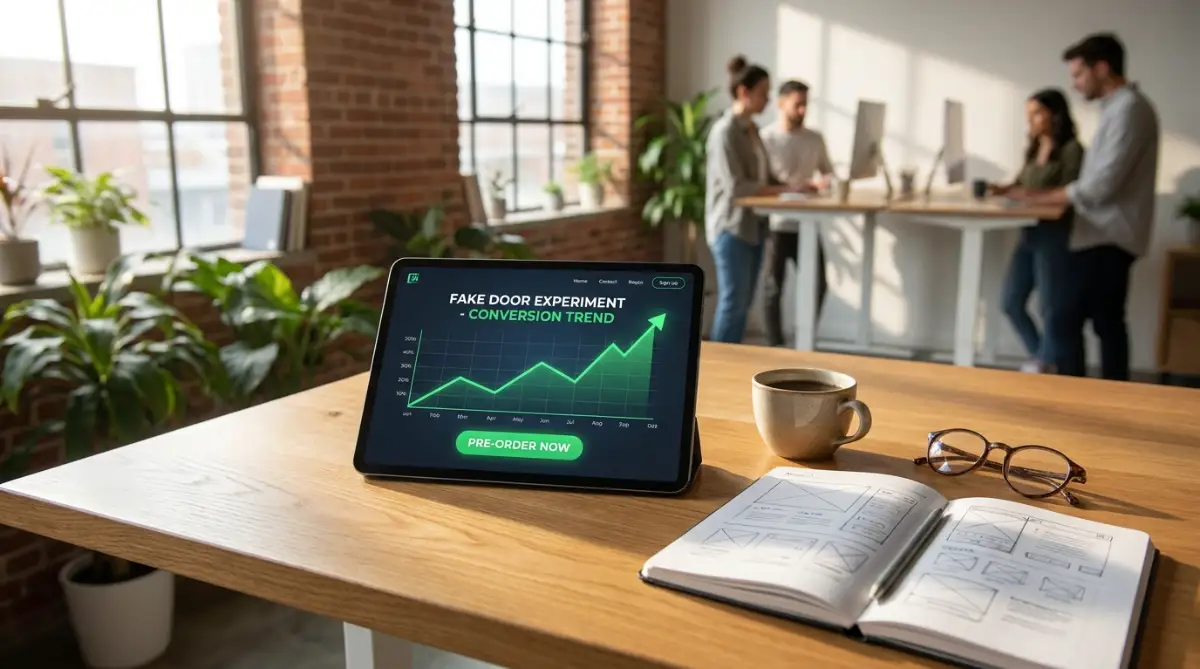
Creating the "Fake Door" Test
Sometimes you are not entirely sure if a specific feature is worth spending two weeks to build. Instead of guessing, you can use a brilliant psychological trick called a Fake Door test.
Let us say your MVP is currently a basic website that sells custom dog collars. You wonder if people would also pay extra for a matching dog leash.
Do not manufacture the leashes yet. Simply add a bright "Buy Matching Leash - $15" button to your checkout page.
When a customer clicks that button, a polite pop-up message appears saying, "We are currently out of stock, but please leave your email to get notified when they arrive!"
If fifty people click the button in one week, you have undeniable, data-driven proof that the demand is real. You can confidently go spend money manufacturing the leashes. If nobody clicks the button, you just saved yourself thousands of dollars in wasted inventory.
This simple button trick is a fantastic way to protect your limited capital. It is just as important as knowing how to spot and avoid overheating issues before they permanently fry your expensive gaming console. Always test the system before you fully commit the power.
Conducting Painful User Interviews
When you finally get your early version into the hands of real users, you have to talk to them. You cannot just look at an analytics dashboard and guess why they stopped using the app after three days.
You need to schedule fifteen-minute video calls with your earliest customers. But here is the secret: you cannot ask them if they like the product.
Human beings are naturally polite. If you ask, "Do you like my new app?" they will almost always say yes just to avoid hurting your feelings. This polite lying provides zero actionable data.
Instead, ask them to share their screen and watch them use the product in total silence. Watch where their mouse hovers when they get confused. Ask them extremely specific questions like, "What exactly were you trying to achieve when you clicked that blue button?"
Their actual behavior will reveal the hidden friction points in your design. You might realize your main checkout button is practically invisible, or your onboarding process is overwhelmingly long. Fixing these silent usability issues is often the only thing standing between a struggling MVP and a massively profitable business.
🗣️ The 5-Question Interview Script (Bypass Polite Lies)
Never ask friends or users if they "like" your app idea. Ask these five behavior-based questions to uncover real buying intent:
- 1. "When was the last time you ran into this specific problem?" (If they cannot name an exact time in the last 30 days, the problem is not painful enough).
- 2. "What tools or manual hacks are you currently paying for to solve it?" (If they currently spend $0, they will not pay for your app either).
- 3. "What sucks the most about the solution you use right now?" (This reveals the exact core feature your MVP must focus on).
- 4. "How much budget did your team set aside for this last quarter?" (Tests actual purchasing authority).
- 5. "Would you prepay $20 today to get early access when we go live next month?" (The ultimate truth test—credit cards do not lie).

The Catastrophic Mistakes That Kill Early Startups
Even when armed with the right testing strategies, the intense pressure of running a startup often pushes founders into terrible emotional traps. We become so deeply attached to our original vision that we completely ignore the reality screaming at us from the market data.
I have watched incredibly talented developers burn through their entire life savings simply because they stubbornly refused to accept that their initial assumption was wrong.
Let us walk through the most dangerous psychological and financial pitfalls you absolutely must avoid during your early testing phase.
Falling in Love with the Solution, Not the Problem
This is the absolute deadliest mistake a tech founder can make. You come up with a brilliant idea for a new mobile app that uses augmented reality to help people arrange their living room furniture.
You spend six months completely obsessed with the AR technology, trying to make the 3D couches look perfectly realistic on the screen. You fall totally in love with the cool technology.
But when you finally launch, nobody downloads the app. Why? Because most people only buy new furniture once every five years. It is not a painful, recurring problem that requires a dedicated app on their phone.
You built a beautiful, technically flawless solution for a problem that nobody actually cares about.
You must violently detach your ego from the specific software you are building. Fall deeply in love with solving the customer's actual pain. If they tell you they would rather have a simple PDF checklist instead of an expensive AR app, you must be willing to swallow your pride and pivot immediately to the PDF.
If you refuse to pivot because you love your code too much, your startup will die. This stubbornness is exactly the kind of dangerous morning routine mistake that ruins your focus; if you keep repeating bad habits just because they feel comfortable, you will never see real progress.
Ignoring the "Churn" Rate
When you launch an MVP, it feels incredibly exciting to see new people signing up every day. You stare at your growth chart, celebrating the fact that you hit one hundred active users in your first month.
But you completely ignore the fact that ninety of those users canceled their subscription before week three.
This metric is called "churn," and it is the silent assassin of subscription software businesses. It does not matter if your marketing is brilliant and you can attract thousands of new signups. If your product is broken or confusing, those users will pour right out the back door as fast as they came in.
You cannot fix a high churn rate by simply running more Facebook ads. You are just pouring expensive water into a bucket with a massive hole in the bottom.
When your early users start leaving, you must stop all marketing instantly. You have to email every single person who canceled and beg them to tell you exactly why they left. You must plug the hole in the bucket before you ever spend another dollar trying to acquire new users.
Overpromising and Underdelivering
In the desperate rush to get those first few paying customers, founders often turn into aggressive salespeople. A potential client asks, "Does your software integrate perfectly with my highly specific legacy accounting system?"
Because you desperately need the revenue, you panic and say, "Yes, absolutely! We can easily build that custom integration for you by next Friday."
This is a complete disaster. You just promised a complex technical feature that you have not even researched yet. You will likely spend the next three weeks ignoring your core product just to build a custom tool for one single, demanding client.
When you inevitably miss the Friday deadline, the client will get incredibly angry, demand a refund, and potentially ruin your reputation online.
You must be painfully honest about what your MVP can and cannot do. It is much better to lose a client today by saying, "We do not currently support that feature," than to destroy your brand by lying about your technical capabilities.
Maintaining strict professional honesty is just as important as securing your personal data from dangerous password management mistakes. If you break trust early in the relationship, you will never get it back.
Your Action Plan for a Successful Startup Launch
Building a new tech startup does not require a million-dollar seed round or a team of elite Silicon Valley engineers. You now possess the exact, reality-based mindset required to test your ideas cheaply and effectively.
You understand that an MVP is simply a ruthless experiment designed to prove that a customer is willing to hand over their hard-earned cash to solve a specific pain point. By avoiding feature creep, testing manually behind the scenes, and listening closely to early feedback, you completely eliminate the massive financial risk of building the wrong product.
Do not let the fake pressure of the tech industry convince you to hide your work in a dark garage for another six months. Stop polishing the drop shadows on your website buttons and start talking to real human beings today.
I wasted nearly a year of my life obsessing over a piece of code that literally nobody wanted. The day I finally swallowed my pride and launched an ugly, embarrassing, basic version of my next idea, I made my first real dollar on the internet. You have the absolute power to stop guessing and start proving your business model starting right now!
Common Questions About Startup Validation
How much money should I actually spend on my first MVP?
Your absolute goal should be to spend as close to zero dollars as physically possible. Utilize free landing page builders, standard email accounts, and your own manual labor to fake the automation until you secure actual paying customers.
What if someone completely steals my idea because I launched early?
This is the most common fear, and it is entirely unfounded. Ideas are basically worthless; flawless execution is everything. Even if a massive company sees your ugly MVP, they move too slowly to copy it effectively while you are actively iterating based on daily customer feedback.
How many paying customers do I need before I start writing custom code?
This depends heavily on your specific niche, but a solid baseline is finding ten people willing to pay you full price for the manual, non-automated version of your service. If you cannot manually convince ten people to pay you, writing expensive code will not magically convince them either.
Should I offer lifetime deals to get early traction?
Offering heavily discounted lifetime deals is incredibly dangerous for early-stage software companies. While it provides a quick spike in upfront cash, it completely destroys your future recurring revenue, leaving you with permanent server costs for users who will never pay you another dime.
How long should an MVP experiment actually take to run?
If you are spending more than three or four weeks preparing your first minimum viable test, your scope is entirely too large. You need to aggressively cut features until the core experiment can be launched and tested within a single month.
What do I do if my first MVP completely fails to get any sales?
First, take a deep breath and celebrate that you didn't waste fifty thousand dollars building it. Then, immediately reach out to the people who rejected it and ask them exactly why the offer wasn't compelling enough. Use that painful feedback to pivot your approach and launch a smarter, slightly different test next month.
Disclaimer: The information provided in this article is for educational, informational, and entrepreneurial purposes only and does not constitute official financial, legal, or business advisory services. Startup environments are highly volatile, and market validation strategies carry inherent financial risks. Always consult directly with a certified business mentor, a licensed legal professional, or a qualified financial advisor before formally incorporating a business, signing client contracts, or accepting investment capital. We are not responsible for any financial losses, failed product launches, or business complications resulting from the interpretation of this general guide.