
Why You Should Never Close Credit Cards Before Buying a House
When you are preparing to buy a home, your first instinct is to tidy up your finances by closing old, unused credit cards. It feels like the responsible, debt-free thing to do—until your mortgage broker tells you your credit score just tanked by thirty points. In this guide, I will show you why closing old accounts destroys your credit utilization math, why underwriters hate sudden account changes, and how to safely park your old cards so your dream home never slips away.
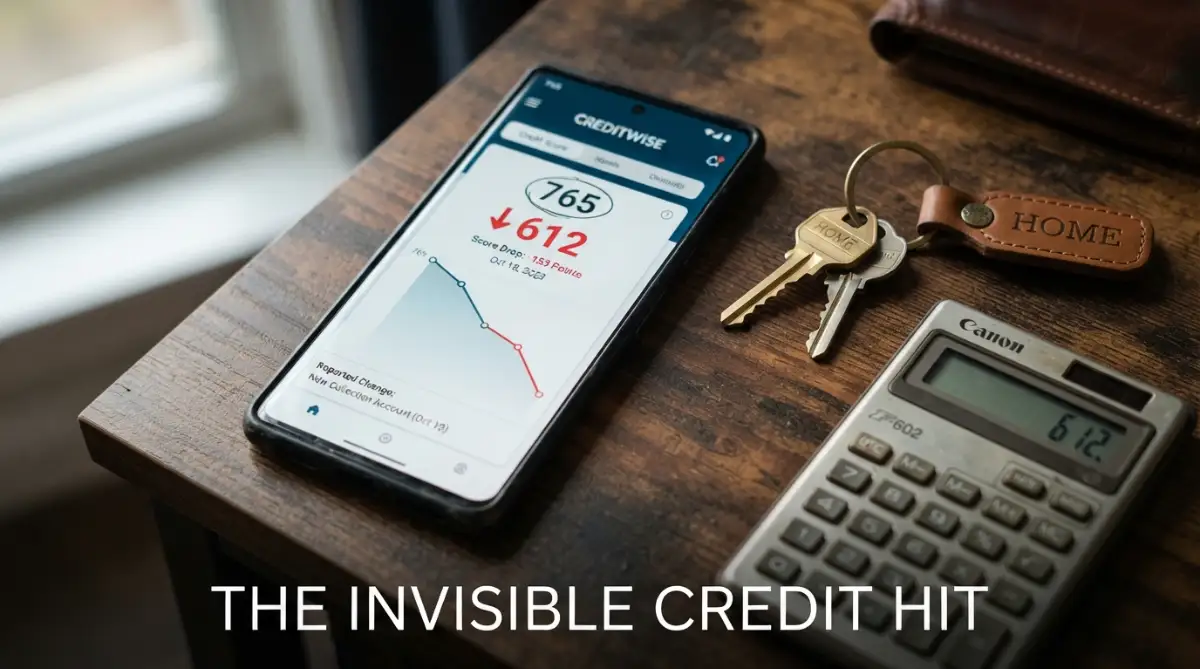
📌 What Homebuyers Must Know About Old Credit Cards:
- Closing cards spikes your utilization: Shutting down an account immediately slashes your total credit limit, which makes your active balances look twice as heavy on paper.
- Old accounts anchor your timeline: Fifteen percent of your score depends on credit age—closing your oldest cards gradually shortens your active history.
- Underwriters want boring files: Any sudden account closures or new inquiries right before closing will trigger red flags and delay your loan.
- Downgrade instead of canceling: If a card carries an annual fee, call and request a no-fee product switch so you keep your account age without paying a dime.
Decoding the Hidden Rules of the Credit Algorithm
To truly understand why a bank hates it when you close an account, you have to stop thinking like a normal human being and start thinking like a highly paranoid computer. Credit bureaus do not care about your personal feelings, your job title, or how clean your wallet looks.
They are massive risk assessment machines. They only care about predicting your future behavior based purely on cold, hard mathematical data from your past.
When you apply for a massive mortgage, the underwriter is essentially asking the algorithm one simple question: "If we give this person half a million dollars, how likely are they to panic and stop paying us back?"
To answer that specific question, the algorithm heavily relies on two incredibly important pillars of your financial history. By closing old accounts, you are taking a sledgehammer to both of these pillars at the exact same time. Let us break down exactly how you are accidentally breaking the math.
The Illusion of "Available" Credit (Utilization Ratio)
This is the absolute fastest way closing an account destroys your current score. Thirty percent of your entire FICO credit score is calculated based on something called your "Credit Utilization Ratio."
This is simply a math equation that compares how much money you currently owe against how much money the banks are willing to let you borrow.
Let us look at a basic example. Imagine you have two credit cards, and each card has a limit of five thousand dollars. Your total available credit is ten thousand dollars.
If you spend two thousand dollars on one card, your utilization ratio is exactly twenty percent (two thousand divided by ten thousand). The algorithm loves this. It sees that you have plenty of access to cash, but you are choosing to be highly responsible and not max everything out.
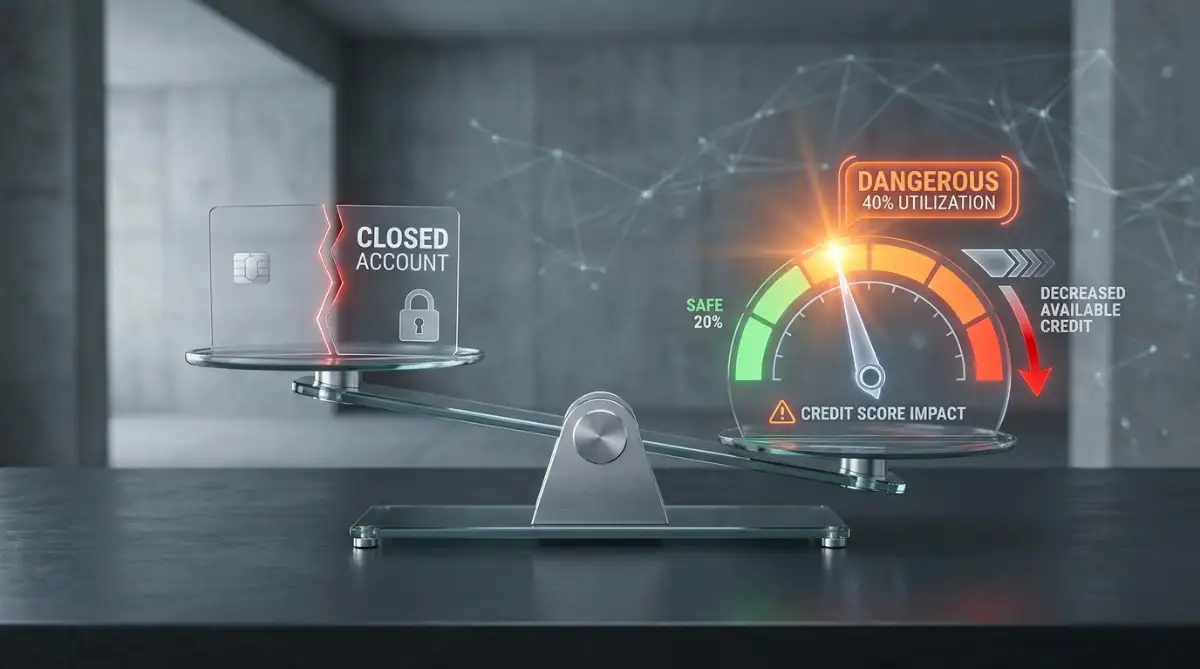
Now, imagine you decide to close the second card because you never use it. Suddenly, your total available credit drops from ten thousand dollars down to only five thousand dollars.
You still owe the exact same two thousand dollars on the first card, but your math just violently changed. Your utilization ratio instantly spikes from a healthy twenty percent to a highly dangerous forty percent (two thousand divided by five thousand).
Even though you did not spend a single extra penny, the algorithm immediately panics. It thinks, "Oh no, this person is suddenly using almost half of their available money. They must be desperate for cash!" Your score drops like a rock entirely because of the math illusion you created by shutting the door on available credit.
🎙️ Expert Debate: Should You Keep That Paid-Off Card Open?
If you are torn between cutting up an old card to stay debt-free or keeping it open to protect your credit score, you are asking the exact right question. Watch this straight-talking discussion from financial expert Dave Ramsey. He breaks down the real tension between wanting a clean wallet and keeping the banking system happy before a major loan:
The Slow Destruction of Your Financial Timeline
The second massive pillar you destroy by closing old accounts is the actual length of your credit history. Fifteen percent of your total score is dedicated to measuring exactly how long you have been actively managing borrowed money.
Banks inherently distrust brand-new borrowers. If you just got your very first credit card last month, the bank has zero proof that you know how to handle stress over a long period.
The algorithm takes the age of your oldest account, the age of your newest account, and calculates the average age across your entire profile.
If you are like most people, your oldest account is probably a basic student card or a store card you opened five or ten years ago. You might never use it today because the rewards are terrible, but that specific card acts as the heavy anchor for your entire financial timeline.
When you close that ten-year-old account during your "spring cleaning," that heavy anchor is completely cut loose.
While a closed account in good standing can stay on your report for up to ten years, it immediately stops aging and stops contributing positive active history to your overall mix. If your remaining active accounts are all relatively new, your average credit age will eventually plummet, making you look like a much riskier, inexperienced borrower to the mortgage underwriter.
Why the "Zero Balance" Myth is Dangerous
Many potential homebuyers assume that as long as an account has a perfect zero balance, it does not matter if it is open or closed. They think a zero balance is a zero balance.
This is a complete misunderstanding of how an underwriter reviews a file. An underwriter loves seeing open, active accounts with zero balances.
An open account with a zero balance proves massive restraint. It proves that a bank currently trusts you with thousands of dollars, and you have the absolute mental discipline to leave that money completely alone. It shows immense financial maturity.
A closed account proves absolutely nothing about your current discipline. It simply shows that the relationship ended.
I used to hate having five different credit cards open because I was terrified I would accidentally forget about an annual fee. I closed three of them in a panic right before I started house hunting. That one emotional decision completely erased thousands of dollars of available credit history from my active profile, dropping my score just enough to lose the preferred interest rate.
The Underwriter's Perspective on Sudden Changes
When you apply for a home loan, you enter a highly sensitive monitoring phase. The bank is going to pull your credit report when you get pre-approved, and they are going to pull it one final time just days before you officially sign the closing documents.
Underwriters are naturally paranoid people. They are trained to look for any sudden, unusual behavior in your financial life.
If they see that you suddenly closed three credit cards right before asking them for a massive half-million-dollar loan, their internal alarms go off.
They do not know why you closed them. They might assume you were forced to close them due to an argument with the bank, or that you are desperately trying to hide a massive financial problem.
Any sudden movement—whether opening new accounts or aggressively closing old ones—forces the underwriter to stop the process and demand long, annoying written explanations from you. The absolute best thing you can do when preparing for a mortgage is to make your financial profile look incredibly boring, stable, and completely unchanging.
🚦 The Mortgage Underwriter’s Cheat Sheet: What They Want to See
- 🚩 Red Flag (Triggers Delays): Closing 2 or 3 credit cards 60 days before applying. The bank assumes you are either disputing fees, hiding debt, or losing financial stability.
- 🚩 Red Flag (Triggers Delays): Opening a zero-interest retail store card to buy appliances or furniture while your loan is in underwriting review.
- 🟢 Green Flag (Smooth Approval): Old, boring credit cards sitting untouched with a $0 balance for twelve straight months.
- 🟢 Green Flag (Smooth Approval): Keeping your total revolving credit utilization below 10% across all open cards combined.
My Golden Rule: For the six months leading up to your closing day, make your credit report as dull and lifeless as possible. Boring credit profiles get approved; exciting ones get audited.
The Credit Mix Requirement
There is one more subtle factor that gets damaged when you aggressively close old accounts. Ten percent of your FICO score relies on a category called "Credit Mix."
The algorithm strongly prefers borrowers who can successfully juggle several different types of debt at the exact same time. They want to see that you can manage revolving debt (like credit cards) and installment debt (like student loans or car payments) simultaneously.
If you only have two credit cards, and you suddenly close one because you think it looks "cleaner," you are severely limiting the diversity of your active profile.
Having multiple healthy, open revolving accounts shows the bank that you are a highly capable juggler. If you remove the balls you are juggling, the bank assumes you can no longer handle the pressure of multiple financial responsibilities.
If you are a freelancer or small business owner trying to buy a house, maintaining this strong credit mix is even more critical. Underwriters already scrutinize self-employed income aggressively. You do not want to give them another reason to doubt your stability by closing credit accounts before applying for a major loan. Your professional profile and your personal credit must both look completely bulletproof.
Mastering Your Financial Profile Before Approaching a Lender
Now that we have completely destroyed the myth that less credit equals better credit, we need to talk about building a strategy. You cannot just leave old accounts open and hope for the best without actively managing them. An abandoned credit card is like an unwatered houseplant; it will eventually wither away and die without your intervention.
Banks regularly run massive digital sweeps of their customer databases to clean out dead weight. If you do not touch a credit card for twelve to eighteen months, the bank will quietly shut down the account due to inactivity. This automatic closure hits your score just as hard as if you had requested the cancellation yourself.
You must take proactive control of your financial ecosystem. Keeping these accounts safely active requires a very specific, low-effort routine that protects your timeline without tempting you to overspend.
Let us dive into the smartest ways to keep your oldest financial relationships alive and healthy without creating new stress in your life.
The Tiny Subscription Trick
The absolute easiest way to keep an old credit card active is by assigning it one single, boring monthly job. Do not carry this old card in your daily wallet where you might be tempted to use it for an impulse shopping spree.
Instead, log into your Netflix, Spotify, or gym membership account and set this specific card as the primary payment method. These are tiny, predictable expenses that you are going to pay every single month anyway.
Once the subscription is connected, log into the credit card portal and set up an automatic monthly payment that pulls directly from your main checking account. You have now completely automated the entire process.
The bank sees fresh, consistent activity every thirty days, which guarantees they will never close the account for inactivity. More importantly, this tiny transaction keeps your overall utilization ratio incredibly low while maintaining the heavy anchor of your oldest credit history.
Freezing Cards Instead of Closing Them
If you are dealing with a severe spending addiction and simply cannot trust yourself to keep a high-limit card open, there is a much safer alternative to closing it. You need to physically remove your access to the card without severing the digital relationship with the bank.
Log into your banking app and look for the "Freeze" or "Lock" security feature. When you freeze a card, the bank blocks any new purchases from going through.
If a hacker tries to buy a laptop online, or if you get tempted to buy expensive shoes at the mall, the transaction will instantly decline. However, freezing the card does not close the account on your official credit report.
The available credit limit still fully counts toward your utilization ratio, and the age of the account continues to grow older every single month. It is the ultimate safety net.
This smart digital lock acts just like taking steps to avoid dangerous password management mistakes by protecting your assets from both outside threats and your own impulsive behavior.
Negotiating Annoying Annual Fees
One of the most valid reasons people panic and close old accounts is to avoid paying a steep annual fee. If your oldest credit card charges you ninety-five dollars every single year just for the privilege of keeping it open, you naturally want to cut it up.
Before you hit that cancellation button, pick up the phone and call the customer service number on the back of the card. Tell the representative that you are considering leaving because of the heavy fee.
In many cases, the bank does not want to lose a long-term customer. You can specifically ask them to perform a "Product Change" or "Downgrade."
This process allows the bank to switch your expensive premium card into a basic, free version of their credit card. They change the plastic in your wallet, but they keep the original account number and the original opening date completely intact on your credit report.
According to data published by the Consumer Financial Protection Bureau, negotiating a product downgrade is one of the safest ways to eliminate fees while fully preserving your long-term credit history. You get to stop paying the fee without causing an unexpected thirty-point drop right before your mortgage application.
📞 Word-for-Word Script: How to Kill an Annual Fee Without Closing the Account
If your oldest card charges an annoying yearly fee, do not cancel it. Call the number on the back of the plastic and read this exact script:
"Hello! I am reviewing my budget and cannot justify the annual fee on this card anymore. However, I value my long relationship with your bank. Can you check if my account is eligible for a no-annual-fee product change or downgrade while keeping my original account age and credit line intact?"
Banks do this every single day. They send you a basic, free card in the mail, but your credit report keeps the exact same opening date from years ago. You save your money and your credit score at the exact same time.

Destructive Habits That Will Sabotage Your Home Loan
Even when you know the rules about keeping accounts open, the intense pressure of preparing for a home purchase often causes people to make extremely careless mistakes. The final few months leading up to a mortgage application are incredibly fragile.
I have watched brilliant, high-earning professionals completely destroy their chances of getting a house because they let their emotions override their basic financial logic. When you get close to the finish line, you must treat your credit report like a fragile piece of glass.
Let us walk through the absolute worst, most devastating mistakes you can make while an underwriter is actively watching your file.
The Furniture Financing Trap
This is arguably the most heartbreaking mistake in the entire real estate world. You finally get pre-approved for your mortgage, you find your dream house, and your offer is accepted. You are just waiting for the final closing day in three weeks.
You get so excited about the new house that you drive to a local furniture store to buy a brand-new living room set. The salesperson offers you a fantastic deal: zero percent financing for twenty-four months if you open a store credit card today.
You think it is a smart financial move because it saves your cash. You sign the paper, entirely forgetting that the bank is still monitoring you.
The exact second you open that new store card, the furniture company pulls a hard inquiry on your credit report. Furthermore, you just added a massive new monthly debt payment to your overall profile.
The mortgage underwriter will pull your credit one final time just hours before you sign the house papers. When they see that massive new furniture debt, your Debt-To-Income ratio changes instantly. They can and will deny your entire mortgage right on the spot, causing you to lose the house completely.
If you are already struggling with your financial profile, you need to understand how to secure unsecured loans with bad credit before you ever dream of applying for new store credit. Never touch your credit during the closing process.
Shuffling Massive Amounts of Cash
When you apply for a massive loan, the bank wants to know exactly where every single penny of your down payment came from. They are strictly bound by heavy federal anti-money laundering laws.
Many people make the terrible mistake of moving large chunks of cash between different checking and savings accounts right before they apply. They think they are just organizing their money, making it look nice and tidy for the bank.
To an underwriter, random cash movements look incredibly suspicious. If they see a sudden ten-thousand-dollar deposit hit your main checking account, they will halt the entire loan process immediately.
They will demand a long, frustrating paper trail to prove that the money is actually yours and not an illegal, undisclosed personal loan from a friend. If your parents gifted you money for the house, you must provide a signed legal letter proving it is a gift that never has to be paid back.
Keep your money completely boring and stationary for at least sixty days before you speak to a loan officer. Just like you should avoid dangerous morning routine mistakes that make your day chaotic, you must avoid chaotic cash movements that confuse the banking system.
Ignoring the Tiny Balance Transfers
Some smart homeowners try to game the system by transferring small balances between different credit cards to take advantage of zero-percent promotional offers. They think this shows the bank they are savvy with their interest rates.
While balance transfers are great for paying down heavy debt normally, doing it right before a mortgage application is a terrible idea.
When you move debt from one card to another, the credit bureaus often get confused during the reporting cycle. For a few weird weeks, your credit report might actually show the exact same debt existing on both credit cards simultaneously.
The underwriter will look at this temporary double-reporting and assume your total debt burden just doubled overnight. This can instantly derail your approval process until the system finally catches up and corrects the error next month.
When you are preparing to buy a house, you need your financial data to be perfectly clear and totally stable. Stop playing games with the algorithms and just let your balances sit quietly until the keys are in your hand.
Your Action Plan for a Flawless Mortgage Approval
Navigating the terrifying world of credit algorithms and strict banking rules does not have to feel like walking through a minefield blindfolded. You now possess the exact, insider knowledge required to protect your financial profile from accidental sabotage.
You understand that closing old accounts destroys your historical timeline and completely ruins your utilization ratios. You know that keeping a quiet, perfectly boring financial profile is the absolute best way to make an underwriter smile and approve your paperwork.
Your credit score is not a reflection of how clean your wallet is; it is a delicate mathematical machine that requires consistent, steady feeding. By throwing a tiny subscription on your oldest card and freezing the plastic, you get all the benefits of a long history with absolutely zero daily stress.
I remember the exact day I finally stopped trying to outsmart the credit bureaus and just let my old, boring accounts sit quietly in the background. My score slowly climbed higher every single month, and when I finally applied for my current home, the approval process was smoother than I ever thought possible. You have the exact same power to take total control of your financial destiny starting right now today!
Common Questions Before You Buy a House
Can I close a brand-new credit card if I hate the fees?
Closing a card you just opened last month will definitely hurt your overall available credit, but it will not destroy your historical timeline like closing a ten-year-old card would. However, you should still wait until after your mortgage closes to cancel any active accounts just to be safe.
Will paying off a car loan drop my score before I buy a house?
Yes, paying off an installment loan completely closes that account, which often causes a temporary point drop. If you are within six months of applying for a mortgage, it is usually safer to keep making the normal monthly car payments instead of aggressively paying it off early.
How long does an underwriter look at my bank statements?
Most standard mortgage lenders will demand exactly two full months of clean, unaltered bank statements from all of your active accounts. They review these strictly to verify your steady income and check for massive, unexplained cash deposits.
Does checking my own credit score hurt my mortgage chances?
No, checking your own score through a free app or your bank portal is considered a "soft pull." Soft pulls are completely invisible to lenders and do not drop your score by a single point, so you should monitor your numbers frequently.
What is the absolute minimum credit score needed for a house?
While certain specialized government programs like FHA loans might accept scores starting around 580, you generally need a score of 620 or higher for a standard conventional loan. However, the best interest rates are usually reserved for scores above 740.
Should I pay off a tiny collection account before applying?
This is tricky. Sometimes paying off an extremely old, ignored collection account actually updates the activity date, making the negative mark look brand new to the algorithm. Always consult directly with your mortgage broker before touching any old collections on your report.
Disclaimer: The information provided in this article is for educational and informational purposes only and does not constitute official financial, legal, or credit counseling advice. Credit scoring models and mortgage underwriting standards change frequently and vary wildly based on individual circumstances and specific banking institutions. Always consult directly with a certified financial planner, a licensed credit repair specialist, or your official mortgage broker before making any major decisions regarding your personal debt or credit accounts. We are not responsible for any denied applications, financial losses, or credit score fluctuations resulting from the interpretation of this general guide.