How Federal Student Loan Forgiveness Actually Works (Without the Myths)
Seeing a five-figure or six-figure student loan balance on your screen can feel paralyzing, especially when social media promises easy debt relief that never seems to arrive. The truth is that federal loan forgiveness is real, but it is never automatic, and one tiny paperwork mistake can set your progress back by years. In this guide, I will break down the exact federal rules, bust the most expensive internet debt myths, and show you how to protect your payments so you actually reach a zero balance.
📌 What You Need to Know About Federal Loan Forgiveness:
- Forgiveness never happens on autopilot: You must actively enroll in an official Income-Driven Repayment (IDR) plan and submit annual paperwork to prove your payments count.
- Who pays you matters most: For PSLF, your direct W-2 employer must be a government entity or a 501(c)(3) non-profit—private contractors do not qualify.
- Private loans are completely excluded: Federal relief bills have zero legal power over private lenders like Sallie Mae, Discover, or SoFi.
- Watch out for the tax bomb: While PSLF is 100% tax-free, remaining balances forgiven under standard 20- or 25-year IDR plans can be taxed as regular income by the IRS.
Why We Believe the Fairy Tales About Debt
To understand why the internet is completely flooded with bad advice about student loans, we have to look at how complicated the government actually makes things. When you sign a master promissory note at eighteen years old, nobody actually explains the fine print.
You just sign the paper so you can go to class. Fast forward four years, and you are suddenly thrown into a massive, bureaucratic system filled with acronyms like PSLF, IDR, and PAYE.
Because the system is so incredibly dense and boring to read, human beings naturally look for easy shortcuts. When someone on the internet posts a flashy video claiming you can wipe out your loans with one simple trick, your stressed-out brain desperately wants to believe it.
The government programs are actually real and highly effective, but they are not magic wands. They require specific, boring, and highly disciplined steps. Let us dismantle the most expensive lies you have been told about clearing your college debt.
Myth 1: Forgiveness Happens Automatically
Let us tackle the most dangerous and widely believed myth right out of the gate. Thousands of borrowers honestly believe that if they just ignore their loans for twenty years, or if a new president signs a bill, their debt will simply vanish from their credit report automatically.
They assume the government has a magical computer system that tracks everything perfectly and will just send them a congratulatory letter one day. This specific assumption completely ruins financial futures.
The truth is that absolutely nothing happens automatically when it comes to federal bureaucracy. The Department of Education does not proactively monitor your specific career path to see if you qualify for a break.
Every single forgiveness program requires aggressive, intentional action from you, the borrower. You have to actively enroll in specific repayment plans, submit complex certification forms every single year, and constantly hound your loan servicer to make sure they are counting your payments correctly.
I actually wasted two full years of eligible payments because I simply assumed the system knew I was working for a non-profit organization. When I finally called to check my status, the representative told me those twenty-four months did not count because I had never submitted the proper employer certification form. I lost two years of progress simply because I trusted the system to do the work for me.
🎬 Watch Out for the Tax Trap: Dr. Brittne Halford's Reality Check
Many borrowers celebrate getting their loans wiped out, only to get hit with an unexpected five-figure tax bill from the IRS. Before you settle on a repayment plan, take a quick break and watch this eye-opening guide by financial coach Dr. Brittne Halford. She breaks down the biggest student debt traps and shows you how to protect yourself from a surprise tax bomb:
Myth 2: Any Job in the Government Qualifies Instantly
The Public Service Loan Forgiveness (PSLF) program is arguably the most famous way to get your loans wiped out completely tax-free. Because of its popularity, the rumors surrounding it are completely out of control.
Many people believe that if they simply get a job anywhere near a government building, their loans will be forgiven in ten years. They think working as a private contractor for a state agency automatically puts them in the clear.
This is a massive, highly specific legal misunderstanding. The PSLF program does not care what your daily tasks are; it only cares about exactly who signs your paycheck.
You must be a direct W-2 employee of a qualifying federal, state, local, or tribal government organization, or a registered 501(c)(3) not-for-profit organization.
If you work as a security guard at a public high school, but your actual paycheck comes from a private, for-profit security company, you do not qualify for a single day of forgiveness. The tax status of your direct employer is the only metric the government cares about.
You must demand your HR department provide their specific Employer Identification Number (EIN) and run it through the official federal database before you ever accept a job based on the promise of loan forgiveness.
📋 The 4-Point PSLF Employer Sanity Check (Before You Sign an Offer)
- Check the Tax Form: Your paycheck must come from a registered 501(c)(3) or a government agency. Look at box "b" on your W-2 form for the Employer Identification Number (EIN).
- Avoid the "Contractor" Trap: If you work inside a public school or public hospital through a private staffing agency, your payments will count for exactly zero.
- Full-Time Threshold: You must work at least 30 hours per week (or meet your employer's definition of full-time, whichever is greater).
- Annual Verification: Submit an official PSLF Help Tool form within your first 90 days on the job so the government confirms your employer status in writing immediately.
Myth 3: You Can Pay Whatever You Want During the Waiting Period
Here is a trap that catches incredibly smart people who are bad at reading the fine print. To get forgiveness under almost every federal program, you have to make a specific number of on-time payments. For PSLF, it is exactly 120 payments.
Many borrowers assume they can just jump on the standard ten-year repayment plan, pay the normal bill every month, and the rest will be forgiven.
This completely defies basic math. If you make 120 payments on a standard ten-year plan, the loan is already completely paid off in full. There is absolutely nothing left for the government to forgive.
To actually benefit from these programs, you must forcefully switch your account over to an Income-Driven Repayment (IDR) plan. These specific plans calculate your monthly bill based purely on your current salary and family size, completely ignoring the total amount of debt you owe.
If your salary is low enough, your official IDR payment might be calculated at exactly zero dollars a month. And yes, a zero-dollar payment legally counts toward your 120 required payments for forgiveness.
However, you must actively re-certify your income every single year. If you forget to submit your tax returns by the annual deadline, your servicer will instantly kick you off the IDR plan, and your payments will skyrocket back to the standard amount.
Myth 4: Private Loans Are Included in the Big Programs
When a politician gets on television and talks about wiping out student debt, they almost always use the broad term "student loans." This generic phrasing creates a devastating level of confusion for families who used multiple different banks to pay for college.
Homeowners and graduates often assume that all of their educational debt is lumped together into one big bucket. They think the government can just wave a wand and clear out everything.
The harsh legal reality is that the federal government has absolutely zero legal authority over private banks like Sallie Mae, Discover, or SoFi.
Federal forgiveness programs apply strictly and exclusively to federal Direct Loans. If your parents co-signed a private loan with a massive commercial bank to cover your expensive out-of-state tuition, that debt will never, ever be forgiven by a federal program.
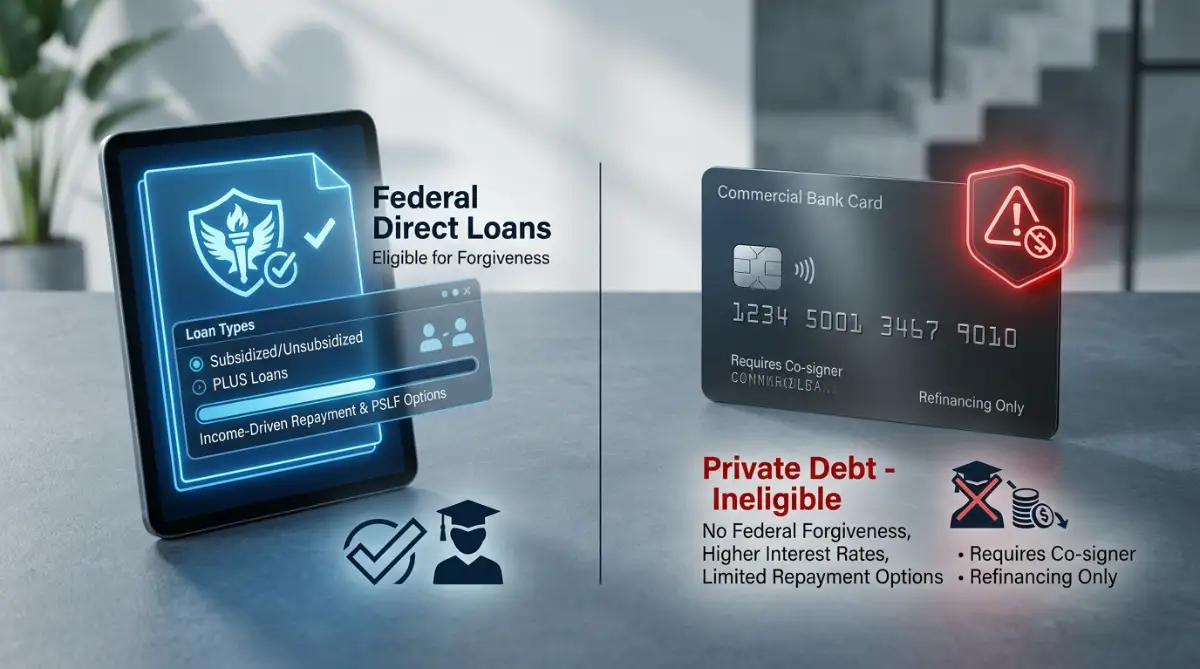
You are legally bound to private contracts until the balance hits zero. If you are drowning in high-interest private debt, you cannot wait for a political savior. You have to aggressively look into private refinancing options to lower your interest rate, taking control of the math yourself.
Myth 5: The "Tax-Free" Illusion on Income-Driven Forgiveness
While PSLF is the most famous program, millions of people who work in the private corporate sector rely on a different path. If you stay on an Income-Driven Repayment plan for twenty or twenty-five years, the government will automatically wipe out whatever balance is left over at the end of that massive timeline.
People celebrate this rule, thinking they can just pay a tiny amount for two decades and walk away completely clean.
They are missing a terrifying clause buried deep in the IRS tax code. While PSLF forgiveness is completely tax-free, the forgiveness granted at the end of a twenty-year IDR plan is currently treated as taxable income.
Let us look at the terrifying math. Imagine you pay the minimum for twenty years, and because of exploding compound interest, your remaining balance balloons to one hundred thousand dollars. When the government finally "forgives" that amount, the IRS treats that specific event exactly as if your boss handed you a one-hundred-thousand-dollar cash bonus.
You will suddenly owe the IRS a massive, immediate tax bill on money you never actually touched. This is often called the "tax bomb," and it catches older borrowers completely off guard just as they are trying to plan for retirement.
You have to proactively plan for this tax bomb by treating it like a future expense. You cannot just ignore the growing balance and hope the laws change before your twenty-year clock runs out.
PSLF vs. Standard 20-Year IDR: Know Your Tax Fate
My Rule of Thumb: If you work in the private corporate world and chase 20-year forgiveness, treat the IRS like an upcoming bill. Put away a small amount in a high-yield savings account each month so you are not ambushed by a sudden $15,000 tax bill when your remaining debt is cleared.
The Consolidation Confusion
Another massive area of misunderstanding revolves around the concept of loan consolidation. When you graduate, you usually do not have just one loan; you have eight or nine different small loans covering different semesters.
Many well-meaning financial advisors tell graduates to immediately consolidate all their loans together to get one simple, easy monthly payment. They make it sound like a basic housekeeping task.
What they fail to warn you is that if you consolidate your federal loans at the wrong time, you can instantly vaporize years of hard work.
When you formally consolidate federal loans, the government pays off all your old, small loans and issues you a brand-new, massive master loan.
If you had already made forty qualifying payments toward your PSLF forgiveness on those old loans, those payments are completely erased. The clock on your brand-new consolidation loan starts over at zero.
You must be incredibly careful and understand your exact timeline before you ever combine your federal debts. Sometimes dealing with multiple small payments is far safer than risking a complete reset of your forgiveness progress.
Pro-Level Tactics to Secure Your Loan Forgiveness
Now that we have smashed the most dangerous myths surrounding federal student debt, it is time to build a rock-solid, defensive strategy. You cannot simply cross your fingers and hope the government processes your paperwork correctly.
Getting your loans forgiven requires you to treat your debt exactly like a high-stakes business project. You have to become the absolute master of your own financial documentation.
Let us dive into the expert-level strategies that successful borrowers use to guarantee their forgiveness timeline never gets derailed by bureaucratic red tape.
Create an Unbreakable Digital Paper Trail
The Department of Education and their private loan servicers are notorious for losing paperwork, miscounting payments, and randomly transferring accounts to new companies. If you do not have hard proof of your payment history, you are entirely at their mercy.
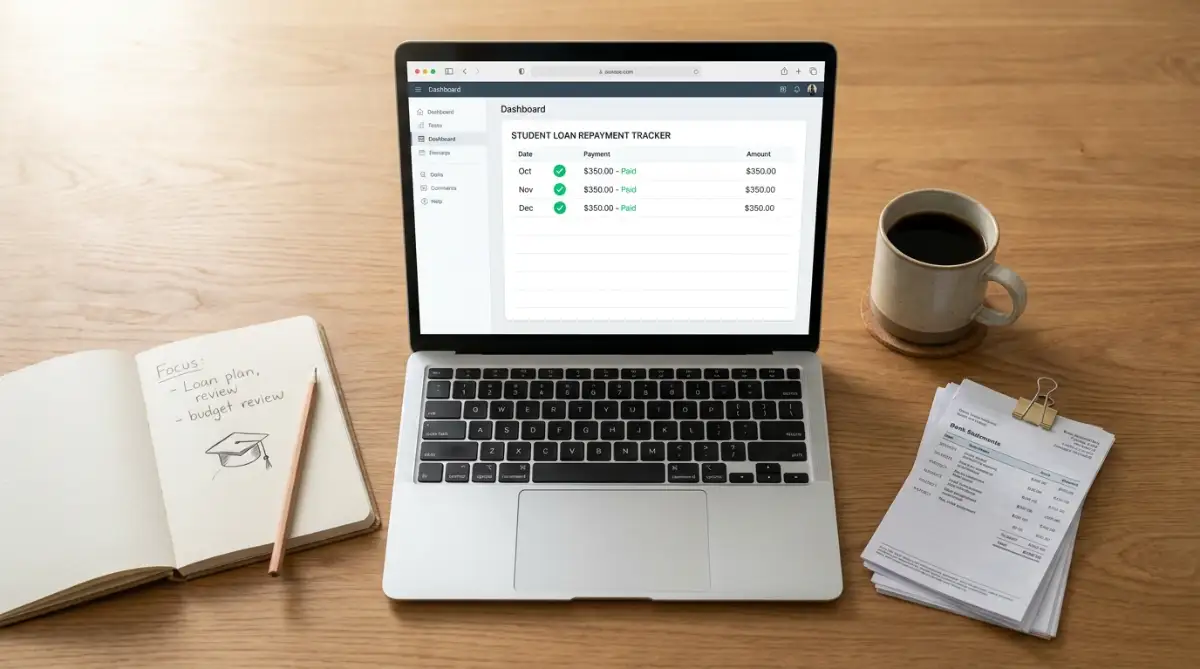
You must build a personal, completely independent digital archive of your student loan journey. Every single time you make a monthly payment, take a screenshot of the confirmation page and save the emailed receipt to a dedicated cloud folder.
When you submit your annual employer certification form, never rely on standard mail. Always submit it digitally through the official portal, and save the confirmation PDF.
If you ever need to fight a miscalculated payment count, having a perfectly organized digital folder makes the dispute process incredibly fast. Protecting your financial data requires the same level of care you would use to avoid dangerous password management mistakes that could expose your bank accounts.
Annual Tax Return Strategy
We discussed earlier that Income-Driven Repayment (IDR) plans calculate your monthly bill based on your official salary. However, the government specifically looks at your Adjusted Gross Income (AGI) from your most recent tax return, not your gross salary.
This means you can legally lower your monthly student loan payment by aggressively lowering your AGI.
If you contribute heavily to a pre-tax retirement account, like a traditional 401(k) or a traditional IRA, that money is subtracted from your gross income before the government calculates your loan payment. You are essentially paying your future self while simultaneously shrinking your current monthly debt obligation.
This strategy is highly effective, but you must ensure your tax returns are filed perfectly every single year. According to the Internal Revenue Service (IRS), simple mathematical errors on your return can delay your official AGI calculation for months, throwing your entire IDR recertification schedule into total chaos.
Forcing the Annual Recertification
Your loan servicer will usually send you an email reminding you to recertify your income a few weeks before your deadline. Do not wait for this email.
Set a loud, recurring calendar alert on your smartphone exactly one month before your annual recertification date. If you miss this deadline by even a single day, the servicer will instantly kick you off the income-driven plan and place you on the standard ten-year plan.
This means your monthly payment could suddenly quadruple overnight. It can take months of fighting on the phone to get your account properly adjusted back to the IDR plan.
Missing deadlines is a classic sign of burnout and poor planning, much like dangerous morning routine mistakes that ruin your daily focus. Treat your recertification date like the most important meeting of the entire year.

The Catastrophic Mistakes That Reset Your Progress
Even when borrowers understand the basic rules, the sheer complexity of the federal loan system causes many people to make emotional, rushed decisions. A single wrong click on a government website can literally vaporize years of hard work.
I have spoken with devastated professionals who thought they were months away from total forgiveness, only to discover a careless mistake had completely reset their timeline back to zero. Let us look at the most painful, expensive pitfalls you absolutely must avoid.
The Refinancing Trap
When interest rates drop, your email inbox will be flooded with flashy advertisements from private banking companies offering to refinance your student loans. They promise you a significantly lower interest rate and a simplified monthly payment.
For the average consumer, this sounds like a brilliant financial move. But for someone chasing federal loan forgiveness, it is financial suicide.
The exact second you sign a refinancing contract with a private bank like SoFi or Earnest, your federal loans are paid off and closed forever. You now hold private debt.
Private banks do not care about Public Service Loan Forgiveness, and they do not offer Income-Driven Repayment plans. You have permanently locked yourself out of every single federal protection program. If you are struggling with bad credit and considering private options just to survive, you must deeply understand how to get unsecured loans safely before you accidentally sign away your federal rights.
Forbearance Abuse
When money gets tight, it is incredibly tempting to call your loan servicer and ask for a temporary pause on your payments. This is called forbearance or deferment.
While pausing your payments feels like instant relief, it completely stops your progress toward forgiveness. Months spent in general forbearance do not count toward your required 120 PSLF payments or your 20-year IDR timeline.
Worse yet, during most forbearance periods, heavy compound interest continues to grow on your account. When the pause finally ends, your total balance will be significantly higher than when you started.
If you lose your job, do not ask for forbearance. Instead, immediately ask to recalculate your Income-Driven Repayment plan. If your income drops to zero, your required payment will drop to zero dollars, and that zero-dollar payment still legally counts toward your forgiveness progress.
Assuming Your Employer Qualifies
I mentioned this briefly before, but the devastation it causes requires a deeper warning. Thousands of nurses, doctors, and teachers assume their job automatically qualifies for PSLF simply because they help the public.
They work for a hospital for ten years, making every single payment on time, only to be denied forgiveness at the finish line.
Why? Because they worked for a "for-profit" hospital system, not a registered 501(c)(3) non-profit organization. The government strictly looks at the tax status of the employer, not the nobility of your daily tasks.
If you are changing jobs, you must use the official Employer Certification Tool on the Federal Student Aid website before you accept the offer. Treating your career moves casually is just like making silent freelance profile mistakes that completely ruin your professional reputation. Always verify the math before you commit your time.
A Clear Path to Eliminating Your College Debt
Navigating the massive maze of federal student loans feels incredibly unfair and exhausting. But you now possess the exact knowledge required to avoid the expensive traps that catch millions of uneducated borrowers every year.
You understand that forgiveness is never automatic, consolidation can be dangerous, and you have to aggressively protect your digital paper trail. By treating your student debt like a serious business project, you take all the power back from the loan servicers.
Remember, these government programs are absolutely real, and they do wipe out billions of dollars in debt every single year. You just have to be incredibly stubborn, highly organized, and completely unwilling to take bad advice from the internet.
I used to lose sleep staring at my massive loan balance, wondering if I would be paying it off until I retired. But once I sat down, learned the actual rules, and created a bulletproof tracking folder, the anxiety completely vanished. You have the exact same power to take absolute control of your financial future starting right now!
Common Questions About Federal Loan Forgiveness
Do I have to pay taxes on Public Service Loan Forgiveness?
No, if you successfully complete the 120 qualifying payments under the PSLF program, the forgiven amount is completely tax-free at the federal level. You will not receive a massive tax bill for the wiped-out balance.
Can I get forgiveness if I am on the standard 10-year repayment plan?
Technically yes, but mathematically no. If you stay on the standard 10-year plan, you will completely pay off the entire loan balance in exactly 120 payments. There will be absolutely zero debt left over for the government to forgive.
What happens if I change jobs while pursuing PSLF?
Changing jobs is perfectly fine, as long as your new employer is also a qualifying government or non-profit organization. You do not have to work at the same place for ten straight years; the 120 payments simply need to be made while working for any approved employer.
How often should I submit the PSLF employer certification form?
You should submit the official certification form annually, and immediately whenever you leave an employer for a new job. Submitting it yearly forces the loan servicer to officially update your payment count, preventing massive calculation errors at the end of your ten-year journey.
Are Parent PLUS loans eligible for these forgiveness programs?
Parent PLUS loans are notoriously difficult to forgive. They are not directly eligible for most Income-Driven Repayment plans. To access forgiveness, the parent must jump through complex legal hoops, such as executing a Direct Consolidation Loan to gain access to the Income-Contingent Repayment (ICR) plan.
Does being married affect my income-driven payment calculation?
Yes, it can dramatically change your required payment. If you file your taxes jointly, the government uses both your income and your spouse's income to calculate your monthly bill. If your spouse has a high salary, you might need to file taxes separately to keep your student loan payment manageable.
Disclaimer: The information provided in this article is strictly for educational and informational purposes and does not constitute official legal, financial, or tax advice. Federal student loan policies, tax laws, and forgiveness program requirements change frequently due to new legislation and court rulings. Always consult directly with a certified financial planner, a licensed tax professional, or your official federal loan servicer before making major decisions regarding consolidation, repayment plans, or tax filing status. We are not responsible for any denied forgiveness applications, unexpected tax liabilities, or financial losses resulting from the interpretation of this general guide.