The 25-Minute Trap: Why Strict Timers Are Ruining Your Creative Focus
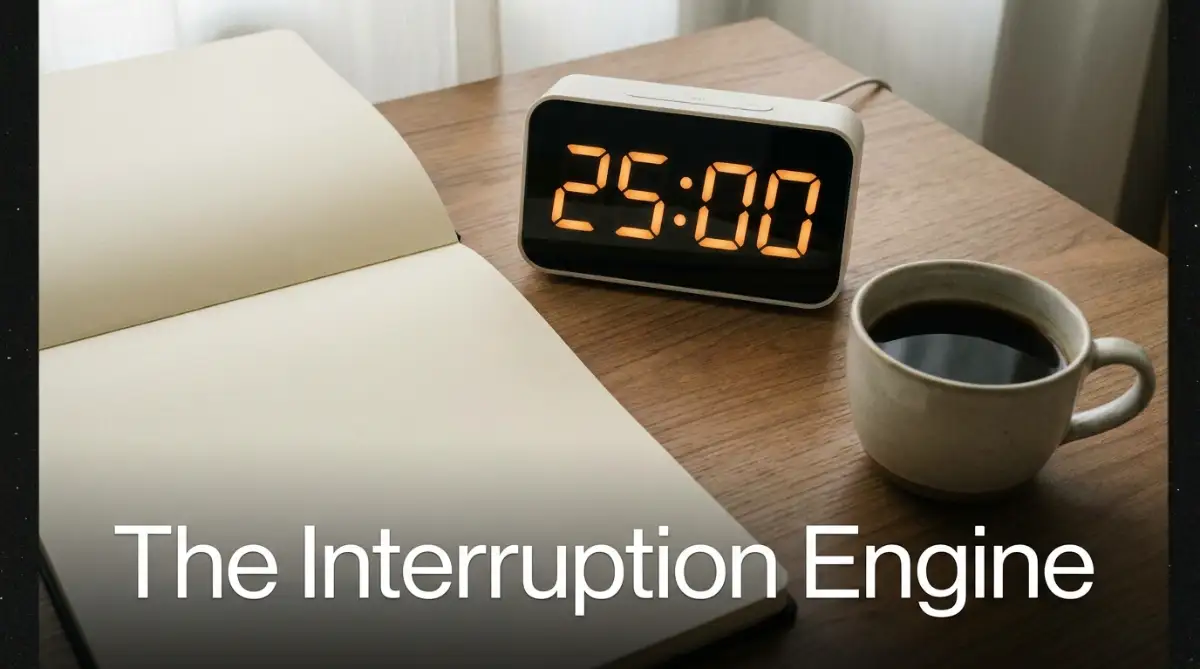
Ever sat down to write or design, spent twenty minutes just getting into the groove, and had a loud digital timer rip you right out of your creative zone? It is maddening. Productivity gurus swear by the 25-minute Pomodoro method, but for creative workers, forcing your brain into rigid little boxes only leads to frustration and burnout. Let me show you why the traditional rules fail creative minds, and how flexible time blocks can rescue your daily focus.
📌 Quick Summary: Why the Pomodoro Method Fails Creatives
- Flow Takes Time: It takes roughly 15 to 20 minutes just to warm up your brain; a 25-minute timer cuts you off right when your best ideas start flowing.
- Context Loss is Expensive: Stepping away mid-thought forces your brain to rebuild its mental house of cards from scratch every time you sit back down.
- Switch to 90-Minute Blocks: Give yourself 90 to 120 minutes of protected, uninterrupted time for serious creative work.
- Save Timers for Admin: Bring the tomato timer back only for boring, repetitive chores like clearing your inbox or organizing files.
Decoding the Mechanics of the Human Mind
To understand why this famous system completely falls apart for us, we need to look at how different types of work actually require different types of mental energy. The original Pomodoro technique was invented in the late eighties by a university student named Francesco Cirillo.
He created it to help himself study dry, boring textbook chapters and complete basic, repetitive administrative tasks. For these kinds of shallow tasks, the system is absolutely brilliant.
If you need to reply to fifty boring emails, organize a massive spreadsheet, or clean out your digital file folders, a twenty-five-minute sprint gives you a sense of urgency. The ticking clock forces you to stop procrastinating and just push through the pain of doing something you hate.
But creative work is not shallow. It is not repetitive, and it certainly cannot be forced by a ticking clock.
When you sit down to write a complex chapter for a novel, design a brand new logo, or write a difficult piece of computer code, your brain has to perform incredibly heavy lifting. You have to pull abstract ideas from thin air, organize them logically, and connect them in ways that make sense to other people.
This heavy lifting requires your brain to enter a highly specific psychological state.
The Fragile Architecture of the Flow State
Psychologists call this deep mental zone the "Flow State." You probably know exactly what this feels like. It is that magical moment when the rest of the world completely disappears.
You forget to check your phone. You forget that you are hungry. You are entirely absorbed in the work right in front of you, and time seems to move completely differently.
Getting into this flow state is not like flipping a light switch. You cannot just command your brain to be deeply creative the second a timer starts.
According to cognitive research, it usually takes the average human brain about fifteen to twenty minutes of focused, uninterrupted struggle just to enter the edges of a flow state. During this warm-up period, your brain is slowly loading all the necessary information, context, and creative tools into your short-term memory.
If you are using a traditional twenty-five-minute timer, the alarm is going to ring exactly when your brain is finally ready to do its best work.
Quick Guide: Shallow Tasks vs. Deep Creative Work
If you want to understand the exact science behind how your brain enters deep focus, this quick breakdown explains it perfectly.
The Devastating Cost of the Forced Break
When that alarm goes off, the traditional Pomodoro rules demand that you step away from the keyboard for five minutes. The philosophy behind this break is to rest your brain and prevent mental fatigue.
But for a creative worker, this forced interruption is completely devastating.
When you walk away while you are in the middle of a complex thought, your brain instantly dumps all that carefully loaded context out of your short-term memory.
Think about building a massive, complicated house of cards. You spend twenty minutes carefully balancing the bottom rows, getting everything perfectly stable. Just as you are about to place the final, glorious top card, someone blows a whistle and tells you to walk away.
When you come back five minutes later, the wind has knocked half the cards down. You have to spend another twenty minutes just rebuilding the foundation before you can make any real progress.

This constant rebuilding of mental context is exhausting. It is why you can work for eight hours using strict timers and still feel like you accomplished absolutely nothing of real value.
The Anxiety of the Ticking Clock
Beyond just interrupting your flow, the physical presence of a timer creates a massive amount of low-level anxiety. When you know you only have a few minutes left before the alarm rings, your brain shifts its focus away from the creative task.
Instead of thinking deeply about the beautiful painting you are working on, a small part of your brain starts constantly checking the clock.
"I only have five minutes left. I need to hurry up and finish this section. Am I working fast enough? What if the alarm goes off before I get this right?"
This internal panic completely kills creativity. True creative problem-solving requires a relaxed, open mind that is free to explore weird ideas and make mistakes. You cannot explore weird ideas when you feel like you are running a high-stakes race against a machine.
Breaking Free from the Factory Mindset
The harsh reality is that the traditional twenty-five-minute sprint was built for an industrial, factory-worker mindset. It was designed to maximize the output of predictable, repetitive tasks by treating the human brain like a predictable, repetitive machine.
But you are not a machine. You are a highly complex, creative individual whose best ideas often come when you are not actively forcing them.
Trying to use a rigid timer to force creativity is like trying to use a stopwatch to force yourself to fall asleep faster. The harder you watch the clock, the more impossible the task becomes.
If we want to do our best, most meaningful work, we have to throw the tiny tomato timer in the trash. We need to build a completely new system that actually respects how the creative brain functions in the real world.
Building a System That Actually Respects Your Brain
So, if we completely abandon the traditional rules, how do we actually get anything done? How do we stop ourselves from just scrolling on social media all day if we don't have a ticking clock to keep us honest?
The secret is not to abandon structure entirely. The secret is to stretch the structure out and make it highly flexible. We need to create a working environment that protects our deep focus while still giving our brains the natural rest they actually need.
Here are the exact strategies you can use starting tomorrow morning to rebuild your productivity without killing your creative soul.
Strategy 1: The Concept of Time Blocking
Instead of chopping your day into tiny, stressful twenty-five-minute pieces, you need to start thinking in massive blocks of time. This concept is often called Time Blocking, and it is the absolute holy grail for writers, artists, and developers.
When you look at your calendar for tomorrow, block out a solid ninety minutes to two full hours for your most important creative task.
Do not call it "Work on Project." Call it "Deep Creative Focus."
During this large block of time, you do not set any alarms. You simply sit down and start working. You give your brain the absolute luxury of taking twenty full minutes just to warm up, knowing that you still have over an hour of protected time left to actually enjoy the flow state.
I used to feel incredibly guilty if I spent the first thirty minutes of my workday just staring out the window and sketching bad ideas. I realized later that this "wasted" time was actually my brain actively loading the context it needed for deep work. Giving myself permission to warm up slowly completely changed my daily output.
When you use large blocks of time, the pressure of the clock completely disappears. You can finally sink deeply into the work without constantly looking over your shoulder.
Strategy 2: Protecting the Block at All Costs
A ninety-minute time block is completely useless if you allow the outside world to poke holes in it. Your flow state is incredibly fragile, and a single ping from your smartphone can instantly destroy it.
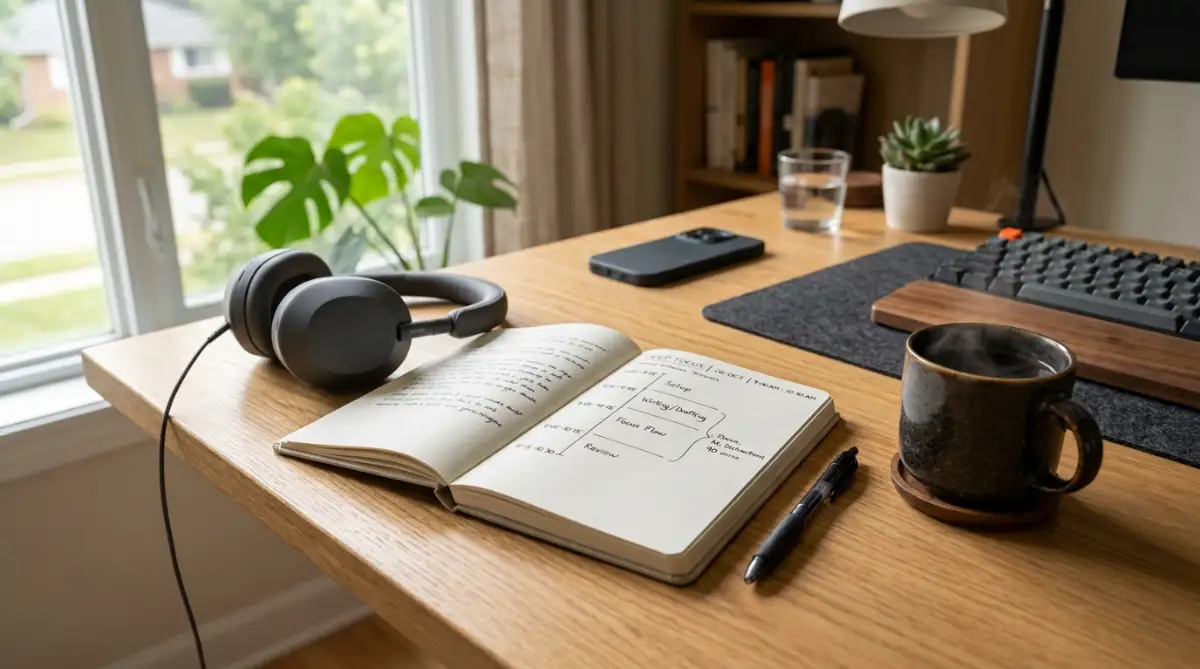
Before you start your large creative block, you have to build a fortress around your attention.
First, take your phone, put it on silent, and physically place it in another room. If you can see the screen light up from the corner of your eye, your brain will break its focus, even if you do not pick the phone up.
Second, close every single tab on your computer that is not directly related to the task at hand. Close your email client. Close your team messaging apps. Close the news websites.
If you are worried that your boss or your clients might need you urgently, you have to manage their expectations. Tell your team, "I am going into deep focus mode for the next two hours. I will not be checking messages, but I will reply to everything as soon as I am done."
Setting these firm boundaries feels terrifying the first few times you do it. But you will quickly realize that almost nothing in the digital world is a true emergency that cannot wait ninety minutes.
Strategy 3: The Natural Break Method
One of the best things about the traditional Pomodoro technique is that it forces you to take breaks. Sitting at a desk for six hours straight is terrible for your physical health and your mental energy.
We still need to take breaks, but we need to take them naturally, not artificially.
Instead of letting a loud alarm dictate when you stop working, you need to learn how to listen to your own brain. When you are deep in a flow state, keep working until you naturally hit a logical stopping point.
Maybe you just finished writing a really difficult chapter. Maybe you finally solved a complex bug in your code. Maybe you finished the rough sketch of your new painting.
When you reach one of these natural milestones, your brain will naturally exhale. You will feel a slight drop in your focus and a sense of completion. This is the exact perfect moment to step away from the desk.
Do not look at the clock to see how long you worked. Just get up.
Walk to the kitchen, pour a fresh glass of water, and look out the window for ten minutes. Let your eyes adjust to looking at things far away. This natural break recharges your mental batteries without destroying the delicate context of an unfinished thought.
The "Park on a Downhill" Rule:
Never stop working when you are completely stuck or right at the end of a big milestone. Instead, step away when you know the exact next sentence or design tweak you need to make. When you come back, jumping right in will feel effortless because your brain already has momentum!
Strategy 4: The 50/10 Modified Rhythm
If the idea of working for two solid hours without any structure at all sounds terrifying to you, there is a comfortable middle ground. Many creatives find massive success by simply doubling the standard Pomodoro numbers.
Instead of doing twenty-five minutes of work and a five-minute break, try working for fifty solid minutes followed by a ten-minute break.
This simple mathematical adjustment changes everything. Fifty minutes gives your brain plenty of time to get past the painful warm-up phase. You have a full thirty minutes to actually exist inside the flow state and produce high-quality work.
When the fifty-minute mark finally hits, the break does not feel like a brutal interruption. It feels like a well-deserved rest after a solid period of heavy lifting.
If you find that your attention span naturally fades around the forty-five-minute mark anyway, this modified rhythm aligns perfectly with your body's natural energy cycles.
Strategy 5: Batching the Shallow Work
We have talked extensively about how to protect your deep, creative work. But the reality of modern life is that we all still have boring, shallow tasks that absolutely must get done.
You still have to pay your bills, reply to client emails, and organize your digital files.
If you try to mix these shallow tasks into your large creative blocks, you will completely ruin your focus. You cannot write a brilliant poem and then instantly switch gears to answer an angry email from a client. The context switching will give you mental whiplash.
The secret is to violently separate your deep work from your shallow work.
Take all those tiny, annoying administrative tasks and push them into one specific corner of your day. Most creatives find that their brain power naturally dips in the late afternoon.
Save all your emails, invoices, and scheduling for a one-hour block right before you finish working for the day.
Ironically, this is the exact perfect time to actually bring the traditional tomato timer back out of the trash can. When you are sitting down to crush fifty boring emails, set that twenty-five-minute timer and race against the clock. Use the factory-worker tool for the factory-worker tasks, and save your protected blocks for the work that actually matters.
Pro-Level Focus: Hacking Your Daily Environment
Now that we have officially retired the tiny twenty-five-minute timer, it is time to build a surrounding environment that naturally protects your new, massive blocks of creative time. You cannot just expect your brain to switch into deep focus mode while sitting in the middle of a chaotic room.
The secret to holding a flow state for hours is strictly controlling exactly what your senses process. You have to remove every possible physical and digital distraction before you even sit down in your chair.
Let us dive into the actual habits that top-tier writers and designers use to lock themselves into a creative bubble without feeling completely isolated from the real world.
Designing a Physical Trigger for Your Brain
Your brain loves routines and easily recognizable patterns. You can actually train your mind to drop into deep focus mode instantly by creating a specific physical trigger before you start working.
This could be as simple as putting on a specific pair of noise-canceling headphones, even if you are not playing any music. It could be lighting a specific candle that you only use when you are writing.
I personally use a very specific instrumental playlist that I only listen to when I am designing. Within a few days of doing this, my brain learned that hearing the first song meant it was time to shut out the world and get serious. This small physical trigger cut my daily warm-up time in half.
According to cognitive researchers at Stanford University, these small environmental cues create strong neural pathways that help shift your brain from a state of distraction directly into a state of high performance.
The Blank Page Strategy
One of the biggest momentum killers for any creative worker is the terrifying blank page. If you start your morning by staring at a completely empty document, your brain will naturally panic and try to find an easier distraction.
The absolute best trick to avoid this panic is to leave yourself a breadcrumb trail the night before. When you finish your workday, do not finish your exact thought.
Stop writing right in the middle of a sentence. Stop designing right before you add the final background color.
When you sit down the next morning, you do not have to invent something completely new from thin air. You just have to finish the very obvious sentence you left waiting for yourself. This easy win builds instant momentum and effortlessly slides you right back into the deep flow state.
Managing the Digital Chaos
We live in an era where everyone expects an instant reply. If you are a freelancer or work remotely, you probably feel an intense pressure to stay green on your team messaging apps all day long.
This constant digital availability completely destroys your ability to do meaningful work. You have to take control of your digital identity and set extremely clear boundaries with your clients and coworkers.
You should specifically set your status to "Deep Work - Replies Delayed" during your large time blocks. You can even create an automated email response that lets people know you only check your inbox at 11 AM and 4 PM.
The Notebook Dump Technique
Even if you perfectly isolate your physical and digital environment, your own brain will eventually try to distract you. While you are deep in the middle of a complex coding project, you will suddenly remember that you need to buy dog food or call your mother.
If you stop working to go order dog food online, your entire flow state shatters into a million pieces.
To prevent this, you need to keep a cheap, physical paper notebook right next to your keyboard. When a random, urgent thought pops into your head, quickly write it down on the paper and immediately return to your work.
This simple action gets the distracting thought out of your working memory. Your brain feels satisfied that the idea is safe on paper, allowing you to seamlessly maintain your intense creative focus without dropping the ball on your real-life responsibilities.

The Hidden Traps That Destroy Creative Momentum
Even when you abandon rigid timers and adopt flexible time blocking, things can still go horribly wrong. When we try to fix our broken systems, we often overcompensate and accidentally create entirely new problems for ourselves.
I have watched so many brilliant artists and writers completely burn themselves out because they misunderstood how flexible deep work is actually supposed to function. Let us look at the most dangerous mistakes you need to avoid when transitioning away from the traditional Pomodoro rules.
The Marathon Work Session Trap
When you finally experience the magic of a two-hour flow state, it feels absolutely incredible. You get so much done that you naturally think, "If two hours is great, then working for six straight hours must be amazing!"
This is the fastest path to total mental collapse. You cannot sprint a marathon.
Deep creative work requires a massive amount of glucose and mental energy. If you try to hold a flow state for four or five hours without taking a natural break, your brain will physically shut down.
You will start making terrible mistakes, your writing will become sloppy, and you will wake up the next morning feeling like a complete zombie. This kind of severe mental exhaustion is exactly why people make dangerous morning routine mistakes like drinking three cups of coffee just to feel normal again.
You must respect your natural limits. Two solid blocks of deep work per day is generally the absolute maximum limit for any healthy creative professional.
Treating Shallow Work as Important
We discussed earlier how you must separate your deep work from your shallow administrative tasks. But a very common mistake is treating those shallow tasks like they actually matter.
We often use shallow work to trick ourselves into feeling productive. You spend three hours color-coding your email inbox and making a beautiful spreadsheet of your weekly goals. You feel incredibly busy, but you have not actually created anything of real value.
Shallow work is simply the tax you pay to run your life. It is not the actual work.
You need to become completely ruthless about minimizing your shallow tasks. Reply to emails with short, polite sentences instead of long paragraphs. Automate your monthly bills. Do not let the easy, boring tasks steal energy away from the difficult, meaningful projects that actually move your career forward.
If you spend your best morning hours on low-priority administrative chores, you are simply avoiding the deep work that actually moves your career forward.
Ignoring Your Physical Health
You cannot separate your creative brain from your physical body. If your body is exhausted, dehydrated, or sitting in a terrible chair, your brain will absolutely refuse to enter a deep flow state.
Many creatives think that drinking energy drinks and eating junk food while staring at a screen for hours is just part of the artistic process. It is a completely toxic mindset.
If you are not sleeping seven hours a night, your short-term memory will not function properly. If you are dehydrated, your ability to focus drops significantly. You need to treat yourself like a high-performance athlete.
Drink plenty of water during your natural breaks. Stretch your neck and shoulders to keep the blood flowing to your brain.
Forgetting to Actually Rest
The absolute biggest mistake people make when they abandon the Pomodoro technique is that they forget to take breaks altogether. When you do not have a loud alarm screaming at you every twenty-five minutes, it is very easy to accidentally work straight through lunch.
Taking a natural break means stepping completely away from your workspace.
Scrolling through social media on your phone while sitting in your office chair is not a break. Your brain is still processing heavy digital information.
You have to physically change your environment. Walk outside and feel the sun on your face. Play with your dog on the floor. Wash the dishes in the sink. Give your brain a chance to process simple, physical tasks so it can recharge its creative batteries for the next deep block.
If you keep your brain constantly redlined without cooling down, you will experience severe mental overheating issues just like a broken piece of hardware.
A New Framework For Unstoppable Creativity
Breaking free from rigid productivity rules is one of the most liberating things a creative worker can do. You no longer have to feel like a failure just because a tiny digital tomato timer does not match the way your unique brain operates.
You now understand that true creative magic cannot be forced into a twenty-five-minute box. It requires patience, a quiet environment, and the freedom to let your thoughts wander and connect naturally.
By embracing flexible time blocking, building physical triggers, and ruthlessly protecting your attention from digital noise, you will get more meaningful work done in two hours than most people do in an entire week. You stop fighting against the clock and start working in harmony with your own mental rhythm.
I used to end every single workday feeling completely exhausted, scattered, and deeply frustrated by my lack of progress. But the day I finally threw away my digital timers and started trusting my natural flow state, everything changed. You have the exact same power to take control of your time and your mind starting right now today!
Common Questions About Creative Focus
Does the Pomodoro technique actually work for anything?
Yes, it is a fantastic tool for getting through boring, repetitive administrative work. If you need to fold a massive pile of laundry or organize a spreadsheet, setting a quick timer can motivate you to push through the boredom. It simply falls apart when used for complex creative problem-solving.
How long should my deep work blocks be?
Most cognitive experts suggest aiming for blocks of ninety minutes to two hours. This gives your brain plenty of time to warm up, enter the flow state, and actually produce high-quality work without reaching complete mental exhaustion.
What if I cannot focus for more than ten minutes?
If your attention span is completely broken, you have to slowly train it back like a muscle. Start with forty-minute blocks and slowly increase the time each week. You must also remove your smartphone from the room, as the constant dopamine hits are likely destroying your ability to focus.
Do I really need to take breaks if I feel great?
Yes, you absolutely must take breaks. Even if you feel amazing during a long flow state, your brain is burning a massive amount of energy. Taking a ten-minute natural break to drink water and stretch prevents you from crashing aggressively later in the afternoon.
How do I stop getting interrupted by coworkers?
You have to communicate your boundaries very clearly. Use a "Do Not Disturb" sign on your office door, set your digital status to away, and tell your team exactly when you will be available to answer their questions again.
What if I get a great idea while doing a shallow task?
Always keep a physical paper notebook nearby. If a brilliant creative idea hits you while you are doing emails, quickly write the idea down on paper. This gets it out of your head so you can finish the boring work and explore the idea later during your protected creative block.
Disclaimer: The information provided in this article is for educational and motivational purposes only. Productivity systems and psychological responses vary wildly from person to person. What works perfectly for one creative professional may not work at all for another. Always listen to your own body and mind, and consult with a certified professional if you are struggling with severe burnout, chronic stress, or serious attention disorders. We are not responsible for any personal, professional, or financial outcomes resulting from the implementation of these general guidelines.