The Toxic Trap of Modern Homes: How Energy-Efficient Houses Ruin Indoor Air
Ever wake up with a dry, scratchy throat and a dull headache, even though you live in a clean, modern home? We seal our houses tight to cut down on energy bills, but we end up trapping microscopic pollutants, chemical fumes, and plastic fibers inside with us. The air in your living room might actually be five times dirtier than the air outside. Let me show you how your sealed sanctuary is secretly working against your health, and the simple habits you need to clear the air for good.
📌 Quick Summary: How to Detox Your Indoor Air
- The Cross-Breeze Habit: Open two windows on opposite sides of your house for just fifteen minutes a day to flush out trapped chemical gases.
- Ditch Synthetic Scents: Plug-in air fresheners and paraffin candles coat your lungs with chemicals; switch to stovetop simmer pots with real fruit instead.
- Upgrade to True HEPA: Cheap furnace filters only catch hair. Use a standalone True HEPA filter with an activated carbon layer to soak up VOCs and fine dust.
- Watch New Gadgets: Let brand-new electronics and flat-pack furniture air out in a spare room or near an open window for their first two weeks.
The Airtight Trap of Modern Construction
To completely understand why we are feeling so sick, we have to look at how homes are built today compared to the past. Fifty years ago, houses were extremely drafty. They had gaps around the wooden windows, spaces under the doors, and walls that naturally allowed outside air to flow through.
While those old drafty houses were terrible for your heating bill, they were actually fantastic for your lungs. The house could naturally breathe. It constantly replaced stale, polluted indoor air with fresh, oxygen-rich outdoor air.
Today, the building industry is obsessed with extreme energy efficiency. We wrap our new houses in thick plastic vapor barriers. We install heavy double-pane windows that seal like a submarine door. We use expanding foam to fill every single tiny crack in the foundation.
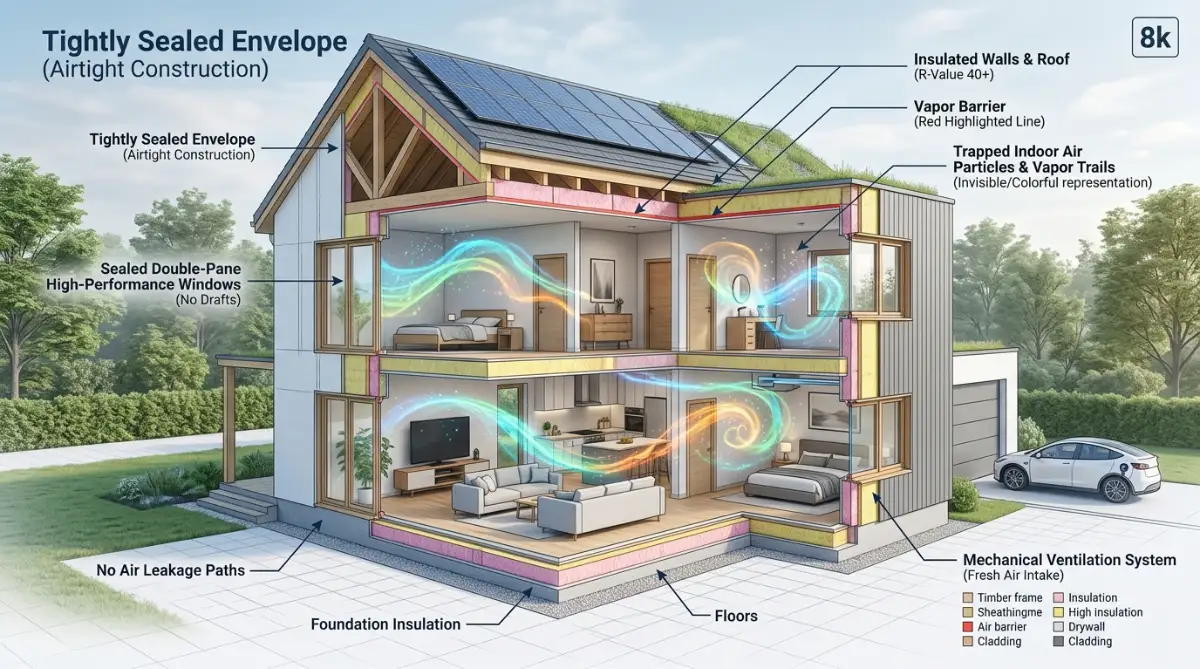
This modern building technique does an amazing job of keeping the expensive cold air from your air conditioner inside. But it also creates a massive, unintended consequence.
When a house is sealed this tightly, nothing can escape. Every single chemical, odor, and dust particle that is created inside your home gets permanently trapped. Without mechanical help, the air inside a modern smart home just sits there, getting dirtier and more toxic with every passing hour.
You are essentially breathing recycled, polluted air over and over again. The Environmental Protection Agency often states that indoor air can be two to five times more polluted than the air outside, even in highly industrialized cities.
The "New Electronics Smell" is Actually Poison
If you love smart home technology, you probably love unboxing new gadgets. Think about the last time you bought a large smart TV, a new Wi-Fi router, or an automated robotic vacuum. When you pull the plastic wrap off, you get hit with that distinct "new electronics" smell.
Most people love that smell. But that scent is not just a harmless odor. It is a massive cloud of Volatile Organic Compounds, commonly known as VOCs.
VOCs are harsh industrial chemicals that slowly turn into gases at room temperature. The manufacturers use heavy chemical solvents, strong plasticizers, and toxic flame retardants to build the plastic casings and internal circuit boards of your favorite gadgets.
Quick Look: The Hidden Indoor Pollutants
When you plug these smart devices in, they naturally generate heat. This warmth actually speeds up the chemical release process. This is called "off-gassing." Your brand-new smart speaker is quietly off-gassing harmful chemicals directly into your living room air for many months after you plug it in.
Over time, inhaling these VOCs can cause severe eye irritation, breathing difficulties, and chronic headaches. Because your smart home is sealed so tightly, these chemicals have nowhere to go. They simply build up in the air until they enter your lungs.
The Shocking Truth About Synthetic Fragrances
One of the biggest mistakes we make in our modern homes is trying to cover up stale air with artificial smells. We buy expensive plug-in air fresheners, automatic smart scent dispensers, and deeply scented wax candles. We think we are making our homes clean and welcoming.
In reality, these products are some of the worst offenders for indoor air pollution. Most commercial air fresheners do not actually remove bad odors from the air. Instead, they use heavy synthetic chemicals to simply coat your nasal passages, deadening your sense of smell.
These fake fragrances are packed with phthalates and benzene derivatives. When you spray them into a tightly sealed room, they hang in the air for hours.
I used to buy those popular plug-in air fresheners thinking they made my house smell amazing. My biggest realization was that I was literally spraying chemical pollutants directly into my family's lungs every single day. Now, I just boil a small pot of water with fresh lemon slices and cinnamon sticks, and the house smells naturally incredible without any toxic side effects.
When you combine synthetic fragrances with the VOCs from your smart gadgets and new furniture, you create a highly toxic chemical soup. Your body has to work overtime just to filter out these poisons, which is exactly why you feel so incredibly tired all the time.
Watch this eye-opening demonstration of how quickly everyday household products pollute your indoor air.
Microplastics Floating in Your Living Room
When we think of microplastics, we usually picture the ocean or marine life. But the highest concentration of microplastics is actually floating right inside your modern smart home.
Take a good look around your living room. Chances are, your comfortable sofa is made from polyester or nylon. Your beautiful area rug is likely woven from synthetic fibers. Even your heavy blackout curtains are probably made from petroleum-based materials.
Every single time you sit heavily on your couch, you launch thousands of invisible plastic fibers into the air. When you walk across your synthetic rug, the friction breaks off tiny microscopic pieces of plastic.
Because your home is so perfectly sealed against the outside weather, these microplastics just float around the room continuously. They eventually settle into the dust on your shelves and floors.
When your robotic vacuum drives around to clean up, it often kicks these ultra-fine plastic particles right back up into the breathing zone. We end up inhaling these microscopic synthetic fibers every single day.
These plastic particles can lodge themselves deep inside your lung tissue, causing long-term inflammation. It is a completely invisible problem that directly stems from filling our airtight homes with cheap, synthetic materials.
Why Your Smart Thermostat Cannot Save You
Many people believe that because they have a high-tech smart thermostat, their air quality is perfectly fine. The shiny digital screen looks highly advanced, so we naturally assume the system is doing everything needed to protect us.
However, a smart thermostat is just a fancy temperature switch. It tells the HVAC system when to turn on and off based on the temperature you set. It does absolutely nothing to bring fresh air inside.
Most standard home heating and cooling systems simply pull the existing air from your hallway, heat it or cool it, and push it back out into the bedrooms. They do not pull fresh air from the outside.
If your indoor air is full of chemical VOCs, pet dander, and microplastics, your expensive HVAC system just blows that exact same dirty air around in circles. It is basically a giant recycling machine for indoor pollutants.
To make matters worse, most homeowners buy the cheapest, thinnest fiberglass filters at the hardware store. These cheap filters are only designed to stop large clumps of dust and dog hair from breaking the furnace motor. They are completely useless against microscopic toxins, chemicals, and fine smoke particles.
The Hidden Mold Factory in Energy-Efficient Homes
We always associate mold with old, leaky, rundown houses. But highly modern, energy-efficient homes are actually perfect breeding grounds for hidden fungal growth.
This happens because of a basic rule of physics regarding moisture and temperature. When you take a hot shower, boil pasta on the stove, or run your dishwasher, you release a massive amount of heavy moisture into the air.
In an older, drafty house, this wet air would easily escape through the gaps in the walls. But in your modern, sealed smart home, the thick moisture gets completely trapped inside.
When this warm, humid air hits a cold surface—like a highly insulated exterior wall or a tightly sealed window frame—it instantly turns back into liquid water. This process is called condensation.
This hidden condensation slowly drips down behind your drywall and underneath your expensive window sills. It creates tiny, hidden pockets of moisture that you can never see. Within a matter of days, toxic black mold begins to grow in these dark, damp spaces.
As the mold colony expands, it releases millions of invisible spores into your indoor air. You might not see the mold, but your immune system definitely feels the spores. This is a massive reason why so many people experience chronic sinus issues in newly built houses.
Furniture Off-Gassing: The Silent Roommate
We talked about the chemical smells coming from new electronics, but your modern furniture is actually a much bigger problem. When you buy a new memory foam mattress or a cheap engineered-wood dining table, you are bringing a chemical factory right into your bedroom.
Engineered wood, like MDF or particleboard, is heavily used in almost all affordable modern furniture. These cheap boards are held together with extremely strong, industrial-grade glues.
These glues are packed with formaldehyde. Formaldehyde is a known human carcinogen that slowly turns into a gas and leaks out of the wood for years.
When you set up a new bedroom set, close the heavy doors, and turn on the air conditioner, you trap all of that formaldehyde inside the room. You spend eight hours every single night sleeping heavily in that exact room, breathing in those harsh chemical vapors.
Memory foam mattresses are equally guilty. They are made from polyurethane foam, which requires a heavy dose of flame-retardant chemicals by law. These chemicals constantly off-gas into your sheets and the surrounding air.
This is exactly why you might wake up feeling groggy, irritated, and exhausted, even after sleeping for a full nine hours.
The Gas Stove Controversy in Modern Kitchens
There has been a massive debate recently about the safety of cooking with natural gas inside the home. For decades, we were told that gas stoves were the absolute best option for serious home cooks.
But modern air quality sensors have revealed a very dark truth about those blue flames. When you turn on a gas burner, it does not just produce heat. It instantly creates a large burst of nitrogen dioxide and carbon monoxide.
Nitrogen dioxide is a highly irritating gas that deeply affects your lungs. It is the exact same chemical found in heavy car exhaust on the highway.
In a tightly sealed smart home, boiling a simple pot of water on a gas stove can push the nitrogen dioxide levels well past the legal safety limits set for outdoor air.
Most people do not even turn on their overhead exhaust fans when they are just boiling water. They think the fan is only for greasy frying or heavy smoke. But failing to vent that invisible gas outside means it simply spreads into your living room and stays there for hours.
This repeated daily exposure to combustion gases is strongly linked to the development of childhood asthma and chronic breathing issues in adults. It is a completely silent pollutant that we happily invite into our kitchens every single night.
Dangerous Cleaning Chemicals We Mistake for Cleanliness
We have a very strange relationship with the concept of cleanliness. Many of us believe that if a room does not smell strongly of heavy bleach or artificial pine, it is not truly clean.
This massive misconception leads us to buy highly toxic, industrial-strength cleaning sprays for our daily chores. We spray harsh chemical glass cleaners on our windows, heavy bathroom foams in our showers, and toxic polish on our wooden tables.
These heavy cleaning agents leave behind a chemical residue on every single surface they touch. As the water in the spray evaporates, the active chemicals launch right into the indoor air.
When sunlight hits these floating chemicals through your windows, a chemical reaction actually occurs. They can combine with the natural ozone in the room to create even more dangerous secondary pollutants, right inside your living room.
You are actively trying to make your house safer by scrubbing away the germs. But in reality, you are just replacing harmless natural dust with highly aggressive chemical vapors.
It is incredibly ironic that the exact products we buy to protect our family's health are often the main things making us feel sick, dizzy, and constantly fatigued. We have completely forgotten how to clean simply and naturally.
The Reality of Pet Dander in Airtight Spaces
If you share your modern smart home with a furry friend, you have another major air quality hurdle to jump over. We love our dogs and cats, but they are walking dust factories.
Pets constantly shed microscopic flakes of dead skin, which is known as dander. They also track in a massive amount of dirt, pollen, and outdoor bacteria on their paws every time they go out into the yard.
In a drafty old house, a lot of this pet dander would eventually blow away or settle out harmlessly. But in an airtight modern home, this sticky dander gets trapped in the enclosed air loop.
It gets sucked into your HVAC return vents and blown deeply into your carpets. Because dander is incredibly light and microscopic, it floats in the air for hours after your dog simply walks across the room.
Even if you do not have severe pet allergies, inhaling a high volume of animal dander every single day puts a massive workload on your immune system. Your body has to constantly fight off these foreign particles.
This constant immune response leaves you feeling generally tired, sluggish, and slightly congested, even if you never fully break out in hives or sneezes. It is a quiet, constant drain on your daily energy levels.
The Simple Power of Cross-Ventilation
You might be feeling entirely overwhelmed by all these invisible threats hiding in your beautiful home. But the solution to this massive problem is actually incredibly simple and completely free.
The absolute best way to fight indoor air pollution is to introduce natural cross-ventilation. You have to force the toxic air out and bring the fresh air in.
You do not need an expensive mechanical system to do this. You simply need to open your windows correctly. Opening just one window in the living room does not do much. The air will just sit there.
To create real cross-ventilation, you need to open two windows on completely opposite sides of the house. If the wind is blowing from the east, open an east-facing window to let the fresh air push inside. Then, open a west-facing window to give the dirty, polluted air an easy escape route.

This creates a natural wind tunnel straight through your house. Doing this for just fifteen to twenty minutes a day can completely replace the stale, chemical-filled air with a fresh breeze.
It is the fastest, cheapest, and most effective way to flush the invisible toxins right out of your life. Even in the dead of winter, opening a few windows for five quick minutes makes a massive difference in your health.
Taking Full Control of Your Daily Air Quality
Now that you know the invisible threats floating around your living room, it is time to actively take your home back. You do not have to live in fear of your own furniture or your smart technology. There are several highly effective ways to clean the air you breathe every single day without spending a fortune.
The smartest thing you can do is start bringing elements of the outdoors back inside. We spent so much time sealing our homes up that we completely forgot how nature naturally cleans the air.
Houseplants are not just pretty decorations for your coffee table. Certain plants are actually aggressive air scrubbers. Spider plants, peace lilies, and snake plants naturally pull VOCs right out of the air and turn them into harmless byproducts.
My 3-Plant Air Cleaning Arsenal:
Grab a snake plant for your bedroom because it releases fresh oxygen at night while you sleep. Place a spider plant near your home office to soak up formaldehyde from furniture, and put a peace lily in your living room to help filter out stubborn chemical fumes naturally.
According to research from the National Institute of Environmental Health Sciences (NIEHS), keeping a healthy variety of indoor plants can significantly reduce the concentration of chemical pollutants in small spaces. The more plants you have, the cleaner your breathing zone becomes.
Investing in the Right Type of Air Purifier
If you want to completely guarantee that your air is safe, you need to buy a high-quality, standalone air purifier. But you have to be very careful about which one you choose.
Do not fall for cheap purifiers that claim to use "ozone" or "ionizing" technology. These machines actually create ozone gas as a byproduct, which is a known lung irritant that makes asthma much worse. You are literally paying money to add a new pollutant to your room.
You need to look specifically for a machine that uses a True HEPA filter combined with an activated carbon layer. The HEPA filter catches all the tiny microplastics, pet dander, and mold spores. The activated carbon layer works like a sponge to soak up the chemical VOCs and off-gassing odors from your electronics.
Put this purifier right in your bedroom. You spend eight solid hours sleeping there every single night. Giving your lungs perfectly clean air while you sleep is the ultimate form of health protection, allowing your body to heal and recover naturally.
The Vacuum Filter Upgrade You Keep Ignoring
Most people think that vacuuming their floors makes the air cleaner. But if you are using an old or cheap vacuum, you are actually making the air quality significantly worse.
Standard vacuums suck up the big pieces of dirt, but their exhaust fans blow all the microscopic dust, dander, and microplastics right back into the air at high speed. You are essentially aerosolizing the worst toxins in your house.
You must upgrade your vacuum cleaner to a model that features a sealed HEPA filtration system. A sealed system guarantees that once a tiny particle gets sucked up, it stays trapped inside the machine.
This simple upgrade stops you from constantly breathing in the exact same dust you just tried to clean. It is a tiny change that makes a massive difference in how clean your house actually feels and smells.
Managing Humidity to Kill Hidden Mold
We discussed earlier how tightly sealed homes trap heavy moisture, leading directly to hidden mold growth inside your walls. Controlling this moisture is non-negotiable if you want a healthy living space.
You should aim to keep the overall humidity in your house firmly between thirty and fifty percent. If the air gets any wetter than that, mold spores will find a dark corner and start growing wildly.
Buy a cheap digital hygrometer for your main living area and check it daily. If you notice the number creeping past fifty percent during the summer, you need to run a continuous-drain dehumidifier.
Make sure you are also properly venting the moisture from your daily routines. Always turn on your bathroom exhaust fan for at least twenty minutes after you finish taking a hot shower. Keeping the house dry stops the fungal spores before they ever have a chance to take root.

Toxic Habits That Make Your Indoor Air Worse
Even with the best intentions, I constantly see smart homeowners accidentally poisoning their own living spaces. When people get obsessed with having a perfectly clean or sweet-smelling house, they often make emotional choices at the grocery store that backfire terribly.
I have watched so many friends unknowingly sabotage their family's health simply because they believed the marketing on the back of a brightly colored plastic bottle. Let us walk through the most dangerous daily habits you need to drop right now to protect your lungs.
The Synthetic Candle Obsession
There is nothing quite as relaxing as lighting a scented candle after a long, stressful day at work. But this seemingly innocent habit is actually one of the worst things you can do in a tightly sealed modern house.
Most popular, inexpensive candles are made directly from paraffin wax. Paraffin is a heavy sludge byproduct of the petroleum refining process. When you burn it, you are quite literally burning fossil fuels right on your living room table.
As the paraffin melts, it releases highly toxic chemicals like toluene and benzene into the air. These are the exact same dangerous chemicals you find in diesel exhaust fumes.
Worse yet, the cheap metal-core wicks often contain heavy metals, which you then inhale as fine soot. If you burn these candles every single night to relax, you are quietly filling your lungs with industrial waste.
If you absolutely must have candles, only buy ones made from one hundred percent pure beeswax or natural soy wax, scented exclusively with essential oils. They cost a little bit more, but they burn completely clean without dumping toxins into your breathing space.
Mixing Household Cleaning Chemicals
We all want a sparkling clean kitchen and bathroom. But in our rush to kill every single germ, we often use way too many products at the exact same time.
I know people who will spray bleach on their shower tiles, and then immediately spray a different ammonia-based glass cleaner on the shower doors. This is a terrifying and incredibly dangerous mistake.
When bleach and ammonia physically mix together, or even just mix in the air, they create chloramine gas. This is a highly toxic, corrosive gas that can instantly burn your eyes, throat, and lungs.
Even mixing simple white vinegar with bleach creates chlorine gas, which is incredibly dangerous. In a modern airtight home, these chemical reactions have nowhere to go. The toxic cloud just sits in your bathroom until you breathe it in.
You need to dramatically simplify your cleaning routine. You do not need ten different neon-colored sprays. Warm water, a little bit of natural dish soap, and a good microfiber cloth can safely clean almost anything in your house without leaving a chemical bomb behind.
Ignoring Your Smart Device Placement
We buy all these amazing smart devices and plug them in wherever they look the best. We put the new Wi-Fi router on the nightstand right next to our pillow. We place the new smart speaker on our home office desk, less than two feet from our face.
This is a massive mistake because of the intense chemical off-gassing we talked about earlier. When these devices are brand new, the concentration of VOCs is highest right around the plastic casing.
If you place a brand new router on your nightstand, you are breathing in the heaviest concentration of those chemicals for eight straight hours while you sleep.
This can easily lead to a scratchy throat, morning headaches, and severe brain fog because you wake up feeling completely exhausted .
When you buy a new electronic gadget, do not put it right next to your head. Plug it in near an open window or in a spare room for the first two weeks. Let it get warm and naturally off-gas those harsh industrial chemicals in an area where you are not constantly breathing.
Falling For The "Air Freshener" Lie
I know we covered this briefly, but it is a mistake so incredibly common it deserves a deeper warning. If your house smells like wet dog or stale cooking grease, spraying a cheap aerosol can of "spring breeze" does not clean the air.
You are just layering heavy synthetic phthalates directly on top of the bad odor. Now you are breathing in the wet dog smell plus an artificial chemical that disrupts your body's natural hormones.
The only true way to get rid of a bad smell is to remove the physical source of the smell or completely replace the air.
If your kitchen smells terrible after cooking fish on the gas stove, do not spray chemicals. Turn on your overhead exhaust fan, open the kitchen window, and let the old air physically leave the house. Proper ventilation is always the safest and most effective air freshener.
Forgetting to Clean Your AC Coils
Most people remember to change their cheap fiberglass air filters once in a while. But they completely forget about the actual cooling coils sitting inside their central HVAC system.
During the hot summer months, these dark, cold coils are constantly dripping with condensation. Because they are always wet and completely hidden in the dark, they become the absolute perfect breeding ground for massive, slimy mold colonies.
When your air conditioner kicks on, the fan blows air directly across these moldy coils, sending millions of toxic spores straight into your living room vents. You are literally paying the electric company to pump allergens into your face.
You should hire a professional to deeply clean and sanitize your indoor AC coils at least once a year. If you refuse to maintain the actual machine that moves your air, you will never have a truly healthy home.
A Fresh Start for Your Smart Home
Dealing with invisible indoor toxins feels incredibly overwhelming at first. But now that you can actually understand how these pollutants get trapped in your modern house, you hold all the power to fix it.
You do not need to tear down your energy-efficient walls or throw away your favorite smart gadgets. You simply need to become much more intentional about how you let your house breathe.
By upgrading to a real HEPA vacuum, ditching the toxic synthetic candles, and making cross-ventilation a daily habit, you instantly change the environment you live in. You stop being a victim of chemical off-gassing and start becoming a proactive homeowner who demands a safe, clean space.
I used to wake up every single morning feeling foggy and congested, blaming it on random allergies. Once I threw away my plug-in air fresheners and started opening my windows for just ten minutes a day, the difference was absolutely mind-blowing. I finally feel energetic and healthy inside my own house, and I know taking these simple steps today will do the exact same for you.
Questions About Clearing Your Indoor Air
How do I know if my indoor air is actually polluted?
The most common signs are waking up with a scratchy throat, experiencing chronic morning headaches, or feeling unusually tired while you are at home. You can also purchase a smart indoor air quality monitor to physically track VOCs and humidity levels on your phone.
Will regular house plants really clean the air?
Yes, certain plants are fantastic natural air scrubbers. Spider plants, aloe vera, and peace lilies actively pull harmful VOCs like formaldehyde and benzene directly out of the air and safely store them in their roots.
Are all scented candles toxic to burn?
No, not all candles are bad. The danger comes from cheap paraffin wax candles that create petroleum soot. If you want a safe scent, only buy candles made from pure beeswax or natural soy wax, scented with real essential oils.
How often should I open my windows in a smart home?
You should aim to open your windows for at least ten to fifteen minutes every single day, regardless of the weather outside. Creating a quick cross-breeze flushes out the trapped off-gassing chemicals and drastically lowers the indoor pollutant levels.
Do air purifiers actually remove bad smells?
A basic HEPA purifier only traps solid dust and pet dander. To remove cooking smells, chemical odors, and VOCs, you must buy an air purifier that specifically includes a thick layer of activated carbon, which acts like a sponge for gases.
Why does my brand new furniture smell so strange?
That strong chemical smell is called off-gassing. Most affordable modern furniture is built with engineered wood and heavy industrial glues that slowly release toxic formaldehyde gas into your room over several months.
Disclaimer: The information provided in this article is for educational and informational purposes only and does not constitute official medical or professional environmental advice. Indoor air quality can be affected by numerous unique factors, including local climate and specific building materials. If you are experiencing severe, chronic health issues, always consult directly with a licensed medical professional or a certified indoor environmental expert. We are not responsible for any health conditions or property damage resulting from the interpretation of this general guide.