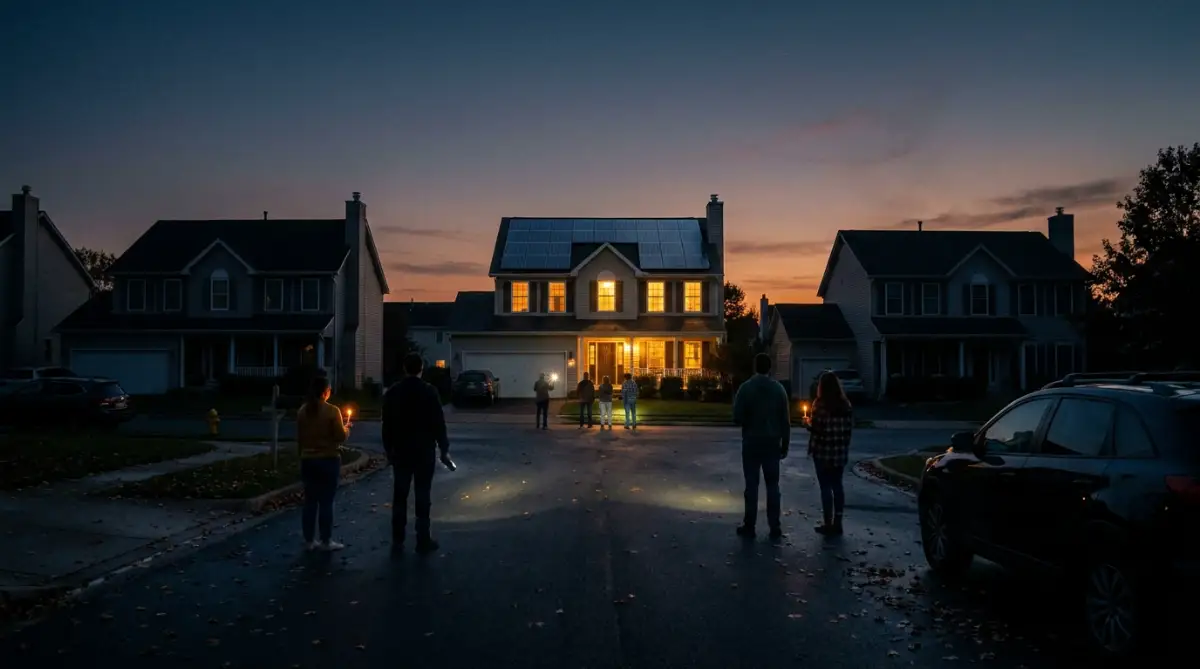
I felt so smart when I installed my solar panels—until a massive winter storm knocked out our neighborhood grid. I assumed my panels would keep my house warm and bright, but my lights went out just like everyone else's. I was freezing in the dark, wondering why my expensive solar system wasn't working. Let me explain the ugly truth about why standard solar panels shut down during blackouts, and how you can fix it.
My 60-Second Blackout Prep Checklist
- Standard grid-tied solar panels will NOT work during a blackout without a battery and an Automatic Transfer Switch.
- Do not try to power your whole house on a single battery; create a sub-panel just for your fridge and Wi-Fi.
- Never install your solar battery in a freezing or boiling garage—temperature swings destroy lithium-ion cells.
- Unplug all TVs and microwaves during an outage to stop "vampire loads" from silently draining your battery.
The Solar Disconnect: Why Standard Solar Fails in a Blackout
To understand how a battery keeps your lights on during an outage, you first have to understand why standard solar panels fail. Almost ninety percent of residential solar systems are "grid-tied," meaning they are directly connected to your local utility company's power lines.
When your panels produce more electricity than your home needs, you send that excess power back into the grid for credits. But when the grid goes down, your utility company must send human utility workers to physically climb the poles and fix the broken lines.
If your solar panels kept pushing electricity into those broken lines while the workers were trying to fix them, the workers would face immediate, fatal electrocution. To protect these workers, international safety laws require all grid-tied solar inverters to automatically shut down within milliseconds of a power outage.
The Train Track Analogy:
Think of your local utility grid as a massive railway system, and your solar power as a train. If a massive storm destroys the bridge ahead, the transit authority must halt all trains immediately.
If they let your train keep rolling down the tracks, it will crash directly into the workers trying to rebuild the bridge. Your solar inverter acts exactly like that emergency train brake, shutting down your power automatically to keep the workers safe.
If you want to keep your train moving safely during a bridge collapse, you need a private, closed loop of track. That is exactly what a solar battery storage system provides for your home.
The Automatic Transfer Switch: The Instant Brain
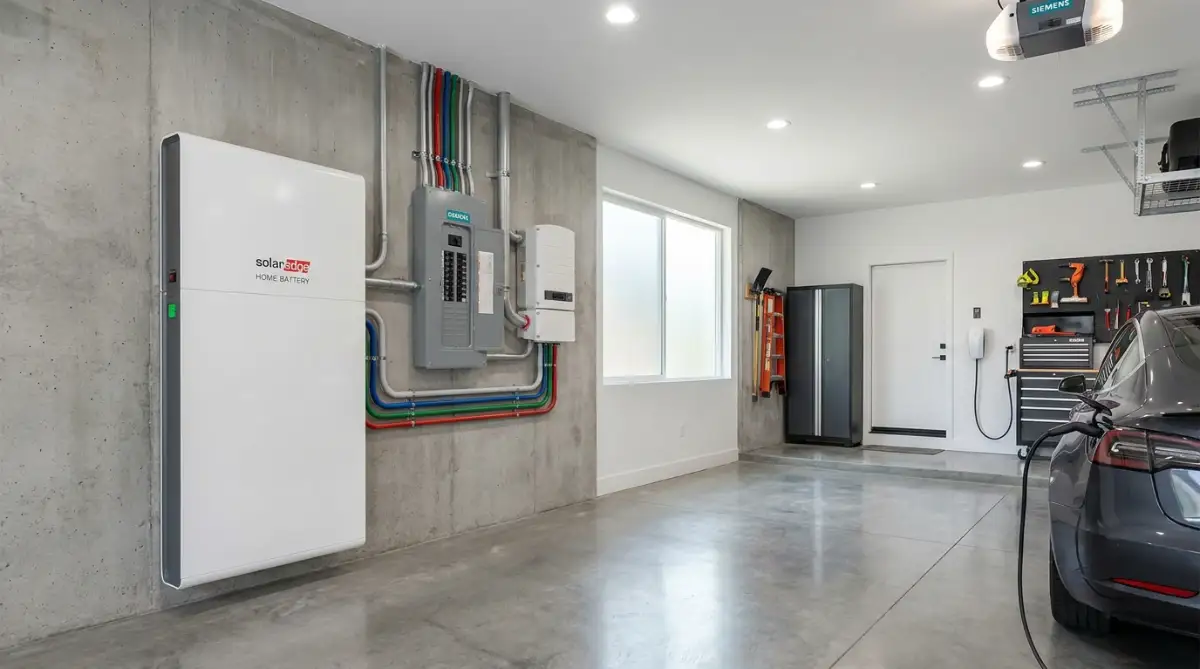
When you add a solar battery to your system, your installer will connect a highly intelligent device called an Automatic Transfer Switch (ATS). I made the huge mistake early on of thinking my solar battery could effortlessly power my entire house, which drained my backup energy in less than two hours during a test outage. Once my installer set up a separate critical load panel for my fridge and essential lights, my backup management completely transformed. Do not try to power everything at once; isolating your absolute essentials is the only way to survive a multi-day storm.The ATS is the actual brain of your emergency backup system.
The moment a blackout occurs, the ATS detects the sudden drop in grid voltage. In less than a fraction of a second, it physically disconnects your home from the main utility grid.
Once your home is safely disconnected, the ATS opens up a private, closed electrical loop between your roof, your battery, and your household appliances. This split-second physical separation is called islanding.
Because your home is now a self-sustaining island, your solar panels are legally allowed to turn back on and start producing electricity again. They can safely power your home and recharge your battery while your neighbors are still sitting in the dark.
The Protective Bouncer Analogy:
Think of the ATS like a highly protective bouncer standing at the front door of your house. The moment a riot starts in the street, the bouncer immediately slams the heavy front door shut and locks it tightly.
He then opens up a secret back door to your private, secure indoor garden where you have plenty of fresh water and food. The bouncer keeps the outside chaos completely away from your family, allowing you to live comfortably inside.
Myth vs. Reality: The Islanding Effect
- The Myth: If the grid goes down, I can just flip a manual breaker switch and use my solar panels.
- The Reality: No. By federal law, unless your system has an official, permitted Automatic Transfer Switch (ATS) installed to "island" your house, your inverter will physically refuse to turn on.
DC vs. AC Coupled Batteries: The Internal Plumbing
When you shop for a solar battery, you will hear your installer use the technical terms "DC Coupling" and "AC Coupling." Do not let this engineering language confuse you; it is simply a description of how the electricity flows through your system.
Solar panels produce Direct Current (DC) electricity, but your home appliances require Alternating Current (AC) electricity to function. Your system must use an inverter to translate the DC power into usable AC power.
Your Actionable Strategy:
If you are building a brand new solar system, always ask your installer for a DC Coupled configuration. Because the solar power stays in DC form until it actually reaches your home's outlets, it only has to pass through the inverter once.
Every time electricity passes through an inverter, some of the energy is lost as waste heat. A DC coupled system is highly efficient, ensuring you save as much of the sun's raw power as possible for the cold winter nights.
If you want to see a clear visual breakdown of how DC and AC coupled solar batteries actually work inside your home, watch this short, simple video below before you talk to your installer!
Critical Load Panels: Managing Your Energy Budget
Many homeowners make the terrible mistake of assuming that a solar battery will power their entire home exactly like the utility grid does. They expect to run their central air conditioning, their electric clothes dryer, and their hot tub all at the same time during a massive blackout.
This is a dangerous expectation that will drain your battery to absolute zero in less than two hours. A standard home solar battery typically holds between ten and fifteen kilowatt-hours (kWh) of usable energy.
To make this energy last for a multi-day outage, you must create a Critical Load Panel. This is a secondary electrical sub-panel that your installer will set up next to your main breaker box.
The Water Rationing Analogy:
Imagine your main municipal water line gets completely cut off during a natural disaster, leaving you with only a fifty-gallon emergency water tank. You would never use that precious water to wash your car or water your grass.
You would strictly save every drop for drinking, cooking, and basic hygiene. Your critical load panel acts exactly like that emergency water rationing plan.
Your installer will physically move the breakers for your most important appliances—like your refrigerator, your internet router, a few essential lights, and your well pump—into this secondary panel. When the grid goes down, the battery will only send power to these essential devices, keeping your family safe and comfortable for days while ignoring the non-essential, heavy energy drains.
Advanced Tactics to Double Your Battery's Lifespan
You now understand the basic differences between AC and DC coupled systems and why you need a dedicated critical load panel. But we are not going to stop there.
According to energy consumption data shared by the U.S. Energy Information Administration (EIA), the frequency and duration of power outages have been steadily increasing over the last decade. To protect your home during these long-term blackouts, you must learn how to manage your storage system like a professional engineer.
Managing your home's backup energy requires a highly proactive, tactical mindset. If you try to install this complex electrical system yourself without professional help, you risk causing massive structural damage.
You must avoid the silent DIY solar mistakes that destroy your home insurance payout to protect your property and your wallet. Let us explore the advanced, pro-level secrets that will help you keep your lights on and double your battery's lifespan.
The Climate Control Secret
Your solar battery is not a simple piece of metal that you can hang on an outdoor wall and forget about. Inside its sleek plastic shell sits a highly sensitive chemical ecosystem.
Most modern home batteries use lithium-ion technology, which is incredibly sensitive to temperature extremes. If your battery gets too hot or too cold, the chemical reactions inside will slow down dramatically.
Researchers at the International Energy Agency (IEA) have documented that extreme heat is the single biggest cause of permanent battery degradation. If you install your battery in a garage that reaches over one hundred degrees in the summer, you will lose years of valuable battery life.
Your Actionable Strategy:
Always ask your installer to mount your battery pack in a temperature-controlled area of your home, like a basement or a finished utility closet. Keep the ambient temperature between fifty and eighty degrees Fahrenheit.
By protecting your battery from extreme weather, you ensure that the lithium ions can move smoothly through the internal cells. This simple choice prevents premature battery aging, keeping your storage system strong for years.
Mastering the Depth of Discharge (DoD)
Every time you drain your battery and recharge it, you are putting a small amount of physical stress on the internal cells. This stress is measured by a metric called the Depth of Discharge (DoD).
DoD simply refers to the percentage of the battery's total capacity that you actively use before recharging it. For example, if you use eight kilowatt-hours of a ten-kilowatt-hour battery, your DoD is exactly eighty percent.
Most modern lithium-ion batteries are designed to handle an eighty to ninety percent DoD safely. But if you constantly drain your battery down to an absolute zero percent, you will cause permanent chemical damage.
The physical balloon analogy:
Think of your battery's chemical cells like a rubber balloon. If you blow a balloon up to its maximum capacity and then let the air out completely every single day, the rubber stretches out and loses its elasticity.
To keep your battery healthy, set your system's minimum reserve limit to twenty percent. This small buffer ensures that even during a massive blackout, your battery cells are never completely starved of energy.
Hidden Blackout Traps That Will Leave You in the Dark
When a massive storm hits your area and the power grid goes down, your first human instinct is to run around and turn on every light in the house to feel safe. This natural, emotional reaction is the absolute fastest way to drain your backup battery to zero in less than two hours.
Many amateur homeowners trust popular television myths instead of actual engineering guides. Just as relying on television leads to surprising Miranda rights misconceptions from TV dramas when dealing with real-world law, relying on simple default settings leads to massive power failures.
Let us look at the silent traps you must avoid to keep your home safely illuminated when the world goes dark.
DO's and DON'Ts For Emergency Power Management:
- DO unplug all high-draw appliances like electric space heaters and clothes dryers immediately during a blackout.
- DO NOT ever try to run your central air conditioning on a single, standard home battery.
- DO set your smartphone to low-power mode to conserve your charging reserves.
- DO NOT let your battery level sit at zero percent during a long, freezing winter storm.
The Vampire Load Threat
Even when you think you have turned off all your non-essential appliances, your home is secretly draining massive amounts of power in the background. This hidden energy drain is known as Vampire Load or Phantom Load.
Devices like your microwave clock, your smart television, and your phone chargers draw small amounts of electricity even when they are turned off or on standby. During a normal week, you do not notice this tiny drain on your utility bill.
But during a multi-day blackout, fifty different vampire loads running at the same time can easily drain twenty percent of your battery's total capacity overnight.
Your Immediate Action Plan:
Walk through your house the moment the grid goes down and physically unplug any non-essential electronics from the wall outlets. This simple, free habit stops the silent energy leaks completely, saving your precious backup power for the refrigerator and essential medical devices.
My Quick Blackout Triage List:
The Solar Production Guessing Game
Another massive mistake people make during a winter blackout is assuming that their solar panels will easily recharge the battery the next day. They wake up in the morning, see a cloudy sky, and assume they can use power freely because the sun is technically up.
But if your panels are covered in a thick layer of snow or dense clouds, their energy production will drop to less than ten percent of their normal capacity. You cannot afford to play a guessing game with your emergency power reserves.
Your Immediate Action Plan:
Always monitor your solar system's active production app on your phone during an outage. If the app shows that your panels are only producing five hundred watts of power, you must adjust your household consumption to match that exact number.
Never spend more energy than your panels are actively creating during the daytime. This simple, disciplined habit guarantees that your battery remains fully charged and ready to power your home through the long, freezing night.
A Word from the Expert: Your Roadmap to Energy Freedom
Navigating the world of home energy storage does not have to be a scary or overwhelming experience. You now hold the exact same strategic knowledge that professional solar engineers use to design multi-million dollar micro-grids.
By taking a few short hours to audit your critical load panel and understand your battery's chemical limits, you completely remove the fear of sudden power outages. You are no longer crossing your fingers and hoping the utility company fixes the power lines quickly.
Instead, you are confidently directing your own private power plant from the comfort of your living room. This simple change in your daily routine gives you incredible power over your entire household's safety and comfort.
Your Emergency Power Checklist:
- Audit Your Critical Loads: Verify that your absolute essentials—like your refrigerator and medical devices—are connected to your backup sub-panel.
- Set Your Charge Reserve: Change your battery’s setting to maintain a twenty percent minimum reserve limit to prevent cell damage.
- Unplug the Vampires: Keep a clear mental map of non-essential appliances to physically unplug the moment a blackout begins.
- Monitor the Weather: Adjust your energy usage based on real-time solar production data during cloudy or stormy days.
Your home should be your ultimate safe zone, a place where your family can remain warm, safe, and comfortable during any crisis. Do not let basic procrastination or fear of technology keep you in the dark.
Check your battery settings, organize your critical load panel, and take complete, fearless control of your home's energy future starting right now.
Securing your home against unexpected blackouts gives you a wonderful peace of mind that is truly priceless during a crisis. You no longer have to stress when the wind starts howling and the lights flicker outside your window. Take charge of your household safety today, talk to a certified professional, and keep your family warm and safe no matter what happens!
Common Questions About Home Solar Battery Backup Systems
Why do standard solar panels automatically shut down during a power blackout?
Standard grid-tied solar panels are legally required to shut down milliseconds after a grid failure to protect utility line workers from fatal electrocution. If they kept pushing electricity into broken lines while crews were repairing them, it would cause severe safety hazards.
Can a single standard home solar battery power my entire house during an outage?
A standard home solar battery cannot run heavy appliances like your central air conditioner or electric clothes dryer all at once without draining to zero in two hours. You must connect only essential items like your refrigerator and router to a dedicated critical load sub-panel.
What is the difference between a DC coupled and an AC coupled solar battery system?
A DC coupled system keeps solar electricity in its native form until it reaches your home inverter, making it highly efficient for brand new installations. An AC coupled system converts the power twice, making it better suited for retrofitting existing solar setups but slightly less efficient.
Why is extreme heat dangerous for a home solar storage battery?
Most modern home batteries use lithium-ion technology, which is highly sensitive to extreme temperatures and can experience permanent degradation in hot environments. Installing your battery pack in a climate-controlled area like a basement keeps its chemical reactions stable and extends its lifespan.
How do "vampire loads" drain my solar battery during a multi-day blackout?
Vampire loads are hidden power draws from appliances like microwave clocks, standby televisions, and phone chargers that consume electricity even when turned off. During a multi-day outage, running fifty of these phantom draws at once can quietly drain twenty percent of your battery capacity overnight.
Disclaimer: The information provided in this article is for educational and general informational purposes only and does not constitute professional electrical, engineering, or financial advice. Solar battery systems, automatic transfer switches, and high-voltage wiring vary heavily by manufacturer, brand, and local electrical codes. Always consult with a licensed electrical contractor or a certified solar installation professional regarding the exact safety requirements, capacities, and installation rules of your personal home energy system.