
"Your doctor ordered an MRI."
Did your doctor just order an MRI scan for you? If your palms are sweating and your stomach is tying itself in knots, please take a slow, deep breath. I know exactly how terrifying it feels to think about sliding into that tight, loud plastic tube. But I am going to show you that an MRI is not a torture chamber—it is actually just a safe, clever machine that uses a giant magnet to listen to the water inside your body.

📌 Your Quick Guide to a Stress-Free MRI
- Cotton is King: Wear loose, metal-free cotton clothes to prevent accidental skin irritation from hidden athletic wear metal threads.
- Keep Your Eyes Shut: Close your eyes before the table starts moving and do not open them until the scan is completely over.
- Breathe from Your Belly: Slow, deep stomach breathing triggers a calming reflex that instantly lowers your heart rate.
- Use Your Safety Lifeline: Keep the rubber squeeze ball in your hand—you always have the power to stop the scan at any second.
Decoding the Giant Magnet: How the Machine Actually Functions
Before you put on a hospital gown, you need to understand what this massive machine actually does. MRI stands for Magnetic Resonance Imaging.
Unlike a standard X-ray or a CT scan, an MRI does not use a single drop of dangerous radiation. This makes it an incredibly safe diagnostic tool for your body.
A Simple, Practical Analogy:
Think of your body as a massive collection of tiny water balloons. Since humans are made mostly of water, we have billions of hydrogen atoms floating inside our tissues.
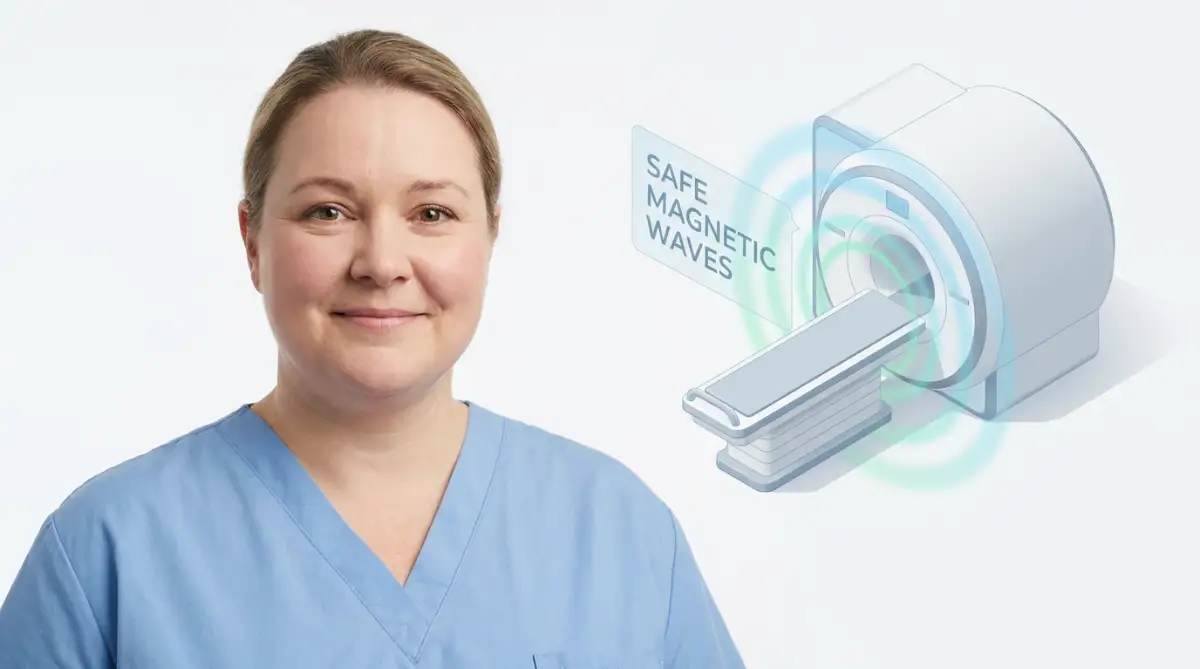
The MRI machine is essentially a massive, highly powerful, donut-shaped magnet. When you slide into the center of the tube, that heavy magnetic field forces all those tiny hydrogen atoms to line up in the exact same direction.
The machine then sends a specific radio wave into your body, which briefly knocks those atoms out of alignment. When the radio wave turns off, the atoms snap back into their original position, releasing a tiny burst of energy.
The machine's computer captures those tiny energy bursts and translates them into a beautiful, highly detailed 3D picture of your internal organs. It is essentially using a strong magnet to safely listen to the water inside your body.
The Pre-Scan Security Checkpoint
The journey begins the moment you check in at the front desk. Because the MRI uses a magnet that is thousands of times stronger than a refrigerator magnet, the safety rules are incredibly strict.

A radiology technician will hand you a very detailed questionnaire. They will ask you about any hidden metal inside or outside of your body.
This is not a casual survey; it is an absolute safety requirement. You must be completely honest about past surgeries, metal plates, artificial joints, or cardiac pacemakers.
Even tiny metallic fragments from an old welding job can cause problems. The massive magnet will aggressively pull on any loose magnetic metal, which is why the room must remain perfectly clean.
Expert Insight:
Many everyday clothing items contain hidden metallic threads. Popular athletic wear brands often weave silver or copper fibers into their yoga pants to prevent bad odors. If you wear these inside the machine, the magnetic field can heat those hidden metals up, causing a painful skin burn. This is exactly why technicians will always ask you to change into a safe, boring cotton hospital gown.
You will be asked to remove all your jewelry, your smartwatch, your hearing aids, and even your hairpins. Once you are completely clear of metal, the technician will walk you into the heavily shielded scanning room.
Navigating the Physical Machine and the Bizarre Noises
Before you walk into your appointment, watch this highly helpful video that shows you exactly what the scanning room looks like and what the machine sounds like. It visually breaks down the entire process so you know exactly what to expect, helping you stay completely relaxed from start to finish!
Walking into the MRI room for the first time is definitely an intimidating experience. The room is usually kept very cold to prevent the massive computer systems from overheating.
In the center of the room sits the scanner, which looks like a giant, thick plastic donut with a narrow sliding bed in the middle. The technician will ask you to lie down flat on your back on the padded table.
Depending on what body part needs scanning, they might place a hard plastic frame around your head or over your chest. This frame is called a "coil," and it acts like a dedicated antenna to catch the specific signals coming from your body.
Once you are securely positioned, the technician will hand you a small rubber squeeze ball. This is your ultimate safety lifeline.
The Power of the Panic Button:
If you ever feel a sudden wave of extreme panic, you simply squeeze that rubber ball. The machine will immediately stop, and the technician will pull you straight out of the tube.
Knowing that you have a physical "stop button" in your hand instantly drops your anxiety levels. You are never fully trapped; you always have complete authority over the entire situation.
After giving you the safety ball, the technician will offer you thick foam earplugs or a heavy pair of specialized headphones. You must accept these earplugs without hesitation.
When the sliding bed slowly moves you into the center of the tube, the machine will start taking pictures. This is when the bizarre, highly aggressive noises begin.
Why is the machine so incredibly loud?
Inside the plastic walls of the scanner, massive metal coils are constantly shifting and vibrating as heavy electrical currents run through them. These heavy vibrations create a loud, rhythmic banging sound.
It sounds exactly like someone aggressively hitting the side of a metal washing machine with a heavy wooden hammer. The noises will constantly change pitch and speed.
Sometimes it sounds like a loud, rapid clicking, and other times it sounds like a heavy electronic buzzing alarm. These scary noises are completely normal and mean the machine is functioning perfectly.
What to Expect: The MRI Sound & Movement Log
Just close your eyes, focus entirely on the steady rhythm of the banging, and let the noise wash over you.
Myth vs Reality: Exposing Common MRI Fears
When we allow fear to control our thoughts, we easily believe terrible rumors. Let us shatter some of the most common myths surrounding this medical procedure.
- The Myth: The tube is sealed shut on both ends, and you are locked in a dark box.
- The Reality: The MRI scanner is shaped exactly like a simple pipe. Both the front end and the back end are completely open to the room, and there is a bright light shining directly inside the tube. You can always see the outside environment if you look toward your feet.
- The Myth: The machine will physically touch you or crush you.
- The Reality: The plastic walls of the scanner will never physically touch your skin. There is several inches of breathing room between your face and the ceiling of the machine. The scanning process is completely contactless and completely painless.
- The Myth: You will be left entirely alone and ignored during the scan.
- The Reality: The technician is sitting behind a glass window just a few feet away, actively watching you on a camera. There is a two-way microphone inside the machine, so the technician will constantly talk to you, giving you updates on how many minutes are left.
The Contrast Dye Injection (Seeing the Invisible)
About halfway through your appointment, the loud knocking noises might suddenly stop. The sliding bed will gently pull you back out into the open room.
Do not be alarmed by this sudden pause. For many specific medical conditions, the radiologist needs a much sharper, highly highlighted image of your blood vessels or internal organs.
To get this clear picture, the technician will need to inject a safe medical liquid called "contrast dye" directly into your arm vein. The most common type of dye used in an MRI is called Gadolinium.
The technician will gently clean your arm and insert a very tiny, temporary IV line. When they push the clear liquid into your bloodstream, you will experience a few very strange, but perfectly safe, physical sensations.
The Physical Sensations of Contrast Dye:
First, you will feel a sudden, icy cold rush of liquid traveling up your arm. This cold sensation is entirely normal and usually fades away in about thirty seconds.
Second, many patients suddenly taste a sharp, metallic flavor in the back of their mouth. It tastes exactly like holding a copper penny on your tongue.
This metallic taste happens because the chemical compound briefly interacts with your sensory nerves as it travels through your system. It is absolutely nothing to worry about.
Finally, you might feel a very brief, warm sensation in your pelvic area, almost making you feel like you accidentally peed your pants. Rest assured, you did not have an accident; it is just the warm dye passing through your sensitive blood vessels.
Once the contrast dye is fully injected, the technician will slide you back into the magnetic tube to finish the second half of the pictures.
💡 My Personal Pro-Tip for Contrast Dye:
When the technician pushes the contrast dye into your IV, you will feel a sudden cold rush up your arm. I found that if I slowly squeeze my toes or wiggle my other hand while it is happening, my brain completely ignores the weird metallic taste in my mouth!
The Golden Rule of Medical Imaging: Absolute Stillness
While the loud banging noises are happening, your only job is to remain completely, absolutely still. This is actually the hardest part of the entire medical experience.

As humans, we naturally want to scratch an itchy nose, wiggle our toes, or shift our heavy shoulders. You must fight every single urge to move your body.
A Photography Analogy:
Imagine trying to take a clear, beautiful photograph of the night sky using a highly sensitive camera. If you shake your hands even slightly while pressing the button, the stars become a blurry, messy streak of light.
The MRI scanner is taking thousands of highly sensitive photographs of your internal anatomy. If you take a deep, heavy sigh or wiggle your hips, the images turn out completely blurry.
If the radiologist cannot read the blurry images, the technician will have to restart that specific segment of the scan. Moving your body literally adds an extra five or ten minutes to your overall time stuck inside the noisy tube.
Find a comfortable resting position before the bed slides into the machine. If you feel a random itch on your face, try to mentally distract yourself by counting backward from one hundred.
Your strict discipline and absolute stillness guarantee the highest quality images, ensuring your doctor gets the exact answers they desperately need.
Master-Level Strategies to Conquer Scan Anxiety
Many patients mistakenly believe they just have to lie down and suffer through the heavy mental panic. They think fear is a mandatory part of the medical imaging experience.
You actually have massive, measurable control over your body's physical stress response. When you hear the loud banging noises start, your heart rate will naturally spike as an evolutionary defense mechanism.
You must take immediate control of your nervous system to stop the biological panic cycle in its tracks. Let us explore the expert psychological tricks that completely neutralize medical anxiety.
The Tactical Breathing Protocol
If you feel your chest tightening inside the tube, you must change how you pull air into your lungs. When we panic, we naturally take very short, shallow breaths from the top of our chest.
This shallow breathing actually signals your brain that you are actively choking, which creates even more intense claustrophobia. You must force yourself to breathe entirely from your deep stomach.
How to execute this perfectly: Inhale very slowly through your nose for four solid seconds, letting your belly expand like a balloon. Hold that air inside for two seconds, and then exhale slowly through your mouth for six full seconds.
This specific rhythmic pattern sends a powerful physical safety signal directly to your vagus nerve. It physically forces your brain to slow your pounding heart rate back down to a calm, manageable resting pace.
Constructing Your Mental Escape Room
The machine is going to be incredibly loud, so you cannot rely on quiet, silent meditation to stay calm. You need to build a highly detailed, extremely loud mental movie inside your own head.
Before the bed even slides into the tube, picture yourself walking through your favorite childhood home or a beautiful beach you visited recently. Do not just see a blurry picture; you must actively engage all of your imaginary senses.
Try to remember the exact peeling paint on the front door or the specific salty smell of the ocean air crashing against the rocks. Imagine the exact feeling of hot sand pressing against the bottom of your bare feet.
By forcing your brain to recall tiny, highly specific sensory details, you leave absolutely no mental room for panic. Your mind gets entirely too busy painting a beautiful memory to care about the plastic walls surrounding your body.
Taking Absolute Control of Your Environment
Never be afraid to ask the radiology technician for special physical accommodations. They scan highly nervous patients every single day and have amazing tricks to help you stay comfortable.
Ask the technician if they can play your favorite music playlist or a familiar podcast through the heavy safety headphones. Listening to songs you know by heart easily drowns out the aggressive mechanical banging of the scanner.
If seeing the close plastic ceiling scares you, ask the staff for a dark washcloth to place gently over your eyes before you slide into the machine. If you literally cannot see the machine, your brain easily forgets how close the walls actually are.
My absolute biggest mistake was keeping my eyes wide open as the bed slowly slid into the narrow tube. Seeing that plastic ceiling just inches from my nose triggered an instant wave of claustrophobia that almost made me squeeze my safety ball. Once I learned to close my eyes tightly before the table even started moving and kept them closed the entire time, my brain completely forgot how tight the space actually was.
The Radiological Society of North America (RSNA) provides excellent guidelines explaining that patient comfort directly results in much higher quality diagnostic images. When you feel physically relaxed, your muscles stop twitching involuntarily, which gives your doctor the sharpest possible picture on the very first try.
Dangerous Habits That Will Sabotage Your Imaging Test
Even the smartest, most logical patients make terrible decisions because they are too nervous to think clearly on the morning of their appointment. The heavy dread of a medical test often makes us abandon our basic common sense.
If you make these quiet, highly common mistakes, you can easily ruin the expensive images or actually cause yourself severe physical harm. Let us break down the exact behaviors that will actively sabotage your time inside the machine.
The Early Morning Caffeine Trap
You wake up feeling completely exhausted because you were stressing all night about the upcoming appointment. To wake yourself up, you drink three massive cups of strong black coffee before driving to the hospital.
This is a massive, highly destructive disaster waiting to happen. Caffeine is a heavy central nervous system stimulant that makes your body incredibly sensitive to sound, light, and touch.
When you lie down inside a loud, vibrating machine, that excess caffeine will make your legs twitch and your heart race uncontrollably. You will feel highly jittery, making it absolutely impossible to remain perfectly still for thirty minutes.
Always drink plain water on the morning of your scan to keep your nervous system as calm and sluggish as possible.
Wearing Hidden Metals in Everyday Cosmetics
Most everyday people know they have to take off their wedding rings, metal belts, and heavy necklaces. But they completely forget about the dangerous heavy metals hiding directly inside their daily morning makeup routine.
Many popular liquid foundations, dark mascaras, and shiny eyeshadows contain tiny micro-particles of iron oxide to create their rich pigment. When the giant hospital magnet turns on, it actively pulls on these microscopic metal flakes sitting directly on your delicate skin.
This intense magnetic pull can cause the makeup to heat up rapidly, leading to a highly painful skin burn right around your sensitive eyes. Always arrive at the imaging center with a completely bare, freshly washed face to protect your skin.
Medical experts at the Food and Drug Administration (FDA) heavily warn patients about the severe burn risks associated with hidden metals in modern cosmetics and medical patches. You must respect the invisible power of this machine at all times.
Q&A: The Tattoo and Permanent Makeup Fear
Question: "I have a massive dark tattoo on my arm and permanent tattooed eyeliner. Will the machine rip the ink out of my skin?"
Answer: The machine will not rip your skin off, but you absolutely must tell your technician about your body art. Some older tattoo inks and cheap permanent makeup pigments heavily rely on iron-based metallic dyes.
While severe burns are rare, the magnetic waves can cause the tattooed area to feel warm, tingly, or slightly irritated during the active scanning process. If your tattoo suddenly starts burning like a hot iron, squeeze your safety ball immediately so the technician can place a cold, wet towel over the art to protect you.
Hiding Your True Medical History Out of Embarrassment
Sometimes, patients feel deeply embarrassed about past cosmetic procedures, or they simply forget to mention an old, minor surgery. This lack of honesty is the absolute most dangerous mistake you can possibly make.
If you have an old metal splinter hidden in your eye from a garage welding accident, or a tiny metal clip from a past brain surgery, you must tell the staff. If you stay quiet, the giant magnet can physically pull and move that sharp metal right through your internal tissues.
This invisible movement can cause permanent internal bleeding, blindness, or even instant death depending on where the metal is currently located.
Making a careless mistake during a powerful imaging test is incredibly risky for your physical health. It is very similar to making dangerous post-surgery recovery mistakes that secretly delay your healing when you return home.
Absolute honesty with your medical team and strict rule-following are your only shields against serious, permanent bodily harm.
Holding Your Breath to Force Stillness
When the machine starts making heavy, aggressive banging noises, human nature makes us instantly tense up. We lock our shoulders, clench our jaws, and completely hold our breath to prevent our bodies from shaking.
Holding your breath actually deprives your sensitive brain of oxygen, which instantly triggers a massive wave of dizziness and severe claustrophobia. Your chest will eventually have to heave aggressively to catch up on the missing air.
That sudden, aggressive chest movement completely ruins the delicate image quality, forcing the technician to restart the entire sequence. You must practice breathing slowly, gently, and consistently, letting your stomach rise and fall without forcing your chest to expand.
Your Personal Action Plan For Scan Day
Walking into an advanced medical imaging center does not have to be a dark, terrifying experience filled with heavy panic. You now hold the exact same psychological knowledge that professional radiology technicians use to calm their most anxious patients.
By deeply understanding how the giant magnet safely listens to the water in your body, you completely remove the heavy fear of the unknown. You are no longer crossing your fingers and guessing if the machine is going to trap you or hurt you.
Instead, you are confidently partnering with the technology to get the specific medical answers you and your doctor desperately need. This simple shift in your mental approach gives you incredible power over your own medical journey.
Your Final Pre-Flight Safety Checklist:
- Audit Your Morning Routine: When you wake up on the morning of your appointment, skip the heavy coffee entirely. Drink a simple glass of plain water to keep your heart rate completely stable.
- Strip the Chemicals: Scrub your face completely clean of all makeup, heavy lotions, and thick sunscreens. Wear the most comfortable, baggy, metal-free cotton clothing you own to the clinic.
- Address Your Outside Stress: If heavy financial stress about the hospital bill is adding to your panic, take a deep breath and look for safe solutions later.
- Command Your Environment: When you finally lie down on that padded table, ask for your earplugs immediately. Close your eyes the exact second your head hits the pillow and refuse to look at the plastic ceiling.
- Start the Mental Movie: Begin building your beautiful mental escape room before the loud banging noises even have a chance to start.
You have the total biological ability to handle this noisy medical test smoothly and intelligently. Your body is strong, and this machine is simply a safe, harmless camera taking pictures of your internal engine.
Trust the heavy protective safety protocols, communicate openly with your kind technician, and take complete, fearless control of your health starting right now.
Looking back, getting through that scary imaging test actually taught me how incredibly strong my own mind can be when I take control. You can absolutely survive your upcoming scan calmly and get the exact answers your body needs, so please do not let the worry steal your peace today. Just practice your deep breathing exercises tonight, shut your eyes before you go in, and watch how easily you conquer your MRI!
Common Questions About Surviving Your MRI Scan
Why does an MRI machine make such loud banging and knocking noises?
The massive machine makes those aggressive sounds because heavy electrical currents are constantly shifting through internal metal coils, causing them to vibrate rapidly. These rhythmic noises mean the machine is functioning perfectly as it takes detailed pictures of your internal anatomy.
Can I wear athletic clothing or everyday garments into the MRI scanner?
You should avoid wearing everyday athletic wear because many modern brands weave microscopic silver or copper fibers into the fabric to prevent odors. The powerful magnetic field can heat these hidden metal threads up and cause a painful skin burn, which is why clinics provide safe cotton hospital gowns.
What should I do if I feel a sudden panic attack starting inside the tube?
If you feel overwhelmed by claustrophobia, you can instantly squeeze the rubber safety ball given to you by the technician before the scan. This alerts the staff immediately, and they will pause the machine and pull you out of the tube right away.
Will the MRI machine physically touch my skin or crush me?
No, the scanner is shaped like an open tube, and its plastic walls will never physically touch your skin as you lie on the sliding table. There is several inches of breathing room between your face and the ceiling, and both ends of the machine remain completely open to the room.
Can I wear makeup on the morning of my MRI appointment?
You must arrive with a completely bare, freshly washed face because many liquid foundations and mascaras contain micro-particles of iron oxide pigment. The magnetic field can pull on these tiny metal flakes, causing them to heat up and irritate your sensitive skin around the eyes.
Disclaimer: The information provided in this article is for educational and informational purposes only and is strictly not intended as a substitute for professional medical advice, diagnosis, or treatment. Always consult with your physician, radiologist, or a qualified healthcare provider regarding any specific medical questions, imaging concerns, or safety protocols before undergoing an MRI scan.