
Have you ever stayed up all night cramming for a major exam, only to stare blankly at the test paper the next morning? I know exactly how that heartbreaking moment feels. We stay up drinking cups of instant coffee and painting our textbooks in neon yellow ink, convinced we are doing the right thing. But the truth is, these exhausting study habits are actually stopping your brain from storing any real memory. Let me show you how to study less and remember more by working with your brain instead of against it.
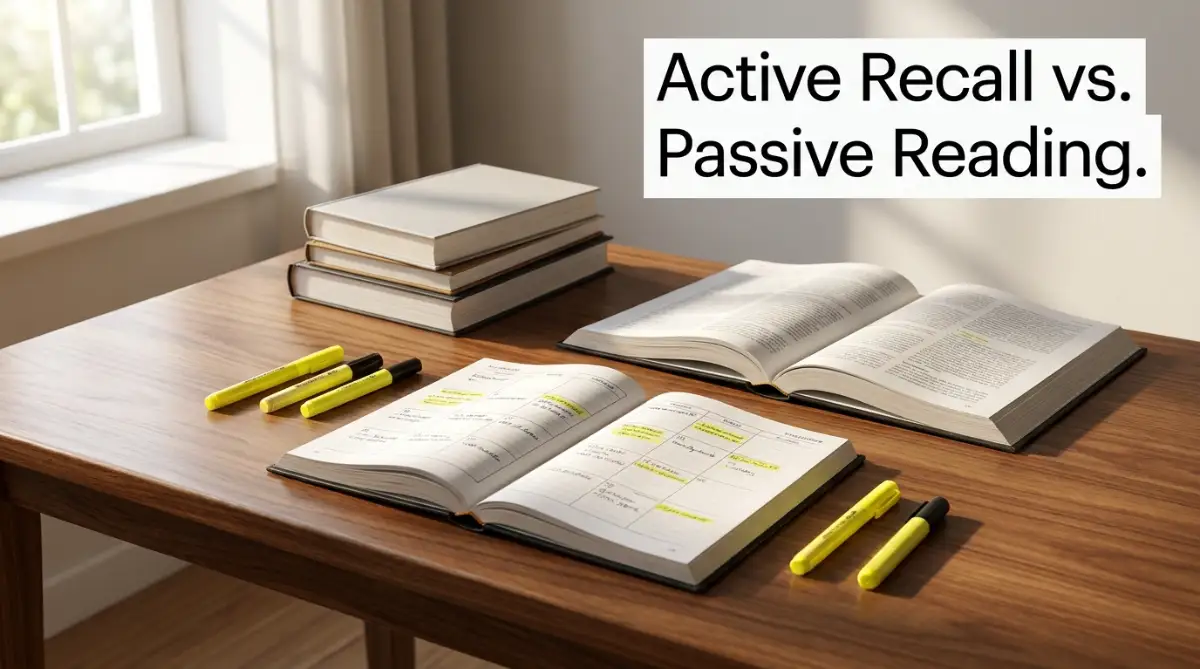
📌 Quick Summary: How to Study Smarter
- Ditch Re-reading: Passive reading only creates recognition, not recall. Practice pulling facts from your memory instead of just looking at them.
- Highlight Less: Highlighting is just labeling information. It does not do the biological work of moving concepts into your permanent memory.
- Sleep to Remember: Your brain needs deep sleep to file away the day's notes. All-nighters fire the "sorting crew" and leave your mind messy.
- Space it Out: Break long study sessions into small, spaced blocks over several days to beat the forgetting curve and build permanent pathways.
The Illusion of Competence: Why Re-reading Is a Trap
The single most common study habit in the world is also the most scientifically useless. When a test is approaching, most students open their notes and simply read the pages over and over again.
As your eyes glide over the familiar words for the fourth or fifth time, your brain experiences a false sense of ease. You tell yourself, "Yes, I know this, this makes perfect sense," and you confidently close the book.
Psychologists call this dangerous phenomenon the illusion of competence.
Your brain is confusing recognition with actual reconstruction.
Recognizing a sentence on a page requires almost zero brainpower because the information is physically sitting right in front of your eyes. But when you sit down to take an exam, that page is gone, and your brain is forced to reconstruct that information from scratch without a visual cue.
If you have never practiced retrieving the information from your memory, your brain simply does not know how to find it under stress. Re-reading is a completely passive activity that keeps the information floating on the surface of your temporary memory, ensuring it evaporates the moment you get distracted.
The Coloring Book Mistake: The Truth About Highlighting
Many students treat their expensive textbooks like children's coloring books. They buy pack after pack of colorful neon highlighters, believing that painting the text makes the information stick to their brain.
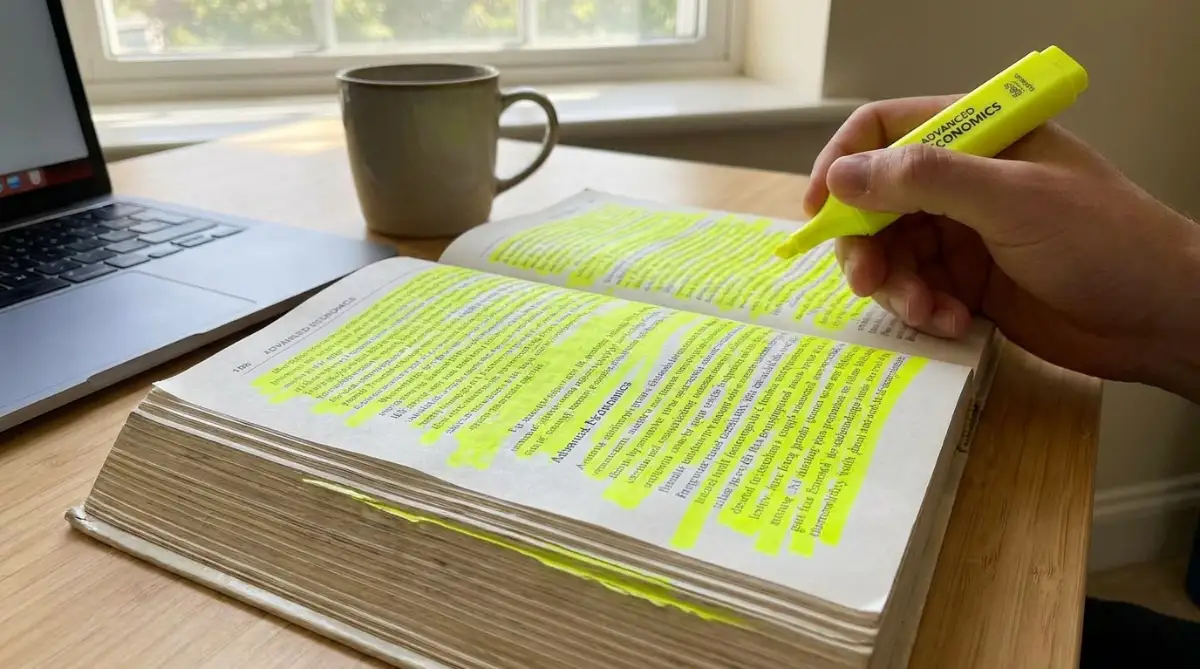
When you highlight a sentence, you are making an immediate decision about what is important. However, once that mark is made, your brain completely stops processing the information.
Let us look at a real-life analogy.
Imagine you are packing cardboard boxes to move to a brand new house. If you simply write the word "kitchen" on the outside of a box but never actually place any dishes inside, writing the label does not help you unpack.
Highlighting is merely labeling the box. It does not do the heavy biological work of moving the concepts into your permanent memory banks.
In fact, research shows that heavy highlighting actually reduces your ability to connect different concepts because your eyes only jump to the colored text, completely ignoring the surrounding context.
The Midnight Oil Fallacy: How All-Nighters Destroy Your Brain
We have all seen the movie scenes where the genius student drinks energy drinks, stays up for forty-eight hours straight, and then easily scores a perfect grade. This is a highly dangerous Hollywood myth.

Your brain is not a static computer hard drive where you can simply save files and expect them to remain perfect forever. It is an organic, biological organ that requires a highly specific chemical environment to function.
When you deprive your body of sleep to cram for an exam, you are actively poisoning your short-term memory system.
During the deepest stages of sleep, your brain performs a highly important maintenance process called memory consolidation.
A Clear Scientific Analogy:
Imagine your brain as a busy post office. Throughout the day, hundreds of loose letters and packages are thrown onto a messy counter.
When you fall into a deep sleep, the mail sorting crew finally wakes up. They take all those loose letters from the counter and neatly file them into organized post office boxes so they can be easily retrieved tomorrow.
If you pull an all-nighter, you are essentially firing the mail sorting crew. The loose letters remain piled on the messy counter in a chaotic heap.
The next morning, when the exam asks you to find a specific package, you cannot locate it in the giant pile of physical mess.
Pro Tip / Expert Insight:
Studying for four hours on a full eight hours of sleep will always produce a significantly higher exam score than studying for twelve hours with zero sleep. Your brain cells literally lose their ability to communicate with each other when they are sleep-deprived.
The "Block Studying" Strategy Error
Many students organize their exam prep by dedicating one massive block of time to a single subject. They will study history for eight hours on Saturday, biology for eight hours on Sunday, and math for eight hours on Monday.
While this makes you feel incredibly organized, it is a highly inefficient way to learn. This bad habit is known as massed practice, and it completely ignores how human memory naturally fades over time.
In the late nineteenth century, a famous psychologist named Hermann Ebbinghaus discovered the Forgetting Curve.
His research proved that humans lose up to seventy percent of new information within just twenty-four hours of learning it if they do not actively review it.
When you study biology for eight hours on Sunday and then ignore it until the exam on Thursday, the forgetting curve has already wiped out almost all your hard work. You are essentially forced to re-learn the information from scratch during the test.
Your Actionable Time-Blocking Adjustment:
You must stop using block studying and switch to a method called spaced repetition.
Instead of studying biology for eight hours in a single day, break that time down into four separate two-hour sessions spread across two weeks.
Every time you revisit the material after a brief break, your brain is forced to work hard to recall the half-forgotten concepts. This physical act of struggling to remember is what actually triggers your brain to build permanent, unshakeable neural pathways.
My biggest mistake back then was treating study sessions like a race to the finish line, trying to cram eight hours of biology into a single Sunday. I quickly realized that waiting for my brain to slightly forget a topic before testing myself again was the only way to build strong, long-lasting memories. Try spacing your reviews across several days—it forces your brain to work harder, which is exactly how information finally sticks.
Cognitive Secrets to Force Information to Stick
You now understand why late-night cram sessions and neon highlighters are holding your academic progress back. It is time to look into the advanced, cognitive methods that top scientists use to store information permanently.
To transform your study routine, you have to move beyond simply looking at your notes. You need to actively train your brain to retrieve information under intense pressure.
According to cognitive research published by the learning strategies shared by Harvard University's academic guide, your physical state and immediate surroundings act as hidden memory triggers during exams. If you study while lying in a warm bed with loud music playing, your brain associates the facts with that comfortable environment.
When you sit in a silent, cold exam room, your brain struggles to locate those memory triggers. You must match your study environment to your actual testing environment to secure the best results.
Your Action Plan for Space and Mind Setup:
Always study sitting upright at a clean desk in a quiet room. Try to mimic the exact silent conditions of your school's testing center.
Preparing your brain for an intense test requires a systematic approach. It is exactly like following a complete guide to calibrating your drone compass before flight; if your internal sensors are not set correctly before takeoff, you are guaranteed to crash.
The Power of Simple Teaching (The Feynman Technique)
One of the most effective ways to build a deep understanding of any subject is a strategy called the Feynman Technique. This method requires you to take a complex topic and explain it in simple terms, as if you were talking to an eight-year-old child.
When you try to explain a hard concept without using fancy academic jargon, you immediately discover the limits of your own understanding. You cannot hide behind complicated words that you do not truly comprehend.
Imagine you are trying to learn a difficult history concept or a complex biological process. Write the name of the topic at the top of a blank sheet of paper and write a simple explanation using basic, everyday sentences.
If you get stuck or find yourself using confusing definitions, open your textbook and review the material again. Simplify your written explanation until a child can easily understand it.
This active translation process forces your brain to build strong, logical connections between different ideas. It moves the information from passive memory into your active, working intelligence.
Did You Know? The Child-Test Rule
The easiest way to check if you actually understand a concept is the "Child-Test." If you cannot explain the main idea of your topic to an eight-year-old child in under sixty seconds without using complicated academic jargon, your brain does not fully own the information yet. You are just memorizing definitions without understanding the underlying logic.
Creating Olfactory Memory Anchors
Another highly effective pro-level trick is using your sense of smell to trigger memory recall during a test. Your olfactory system is directly connected to the amygdala and hippocampus, which are the emotional and memory centers of your brain.
This means smells are incredibly powerful at unlocking forgotten information. You can use this biological connection to build an artificial memory bridge.
How to implement this trick:
Buy a specific flavor of herbal tea, like peppermint, or a unique scent of essential oil, like lavender.
Only consume that tea or use that scent while you are actively studying a specific subject at your desk. When you walk into the exam room, put a tiny drop of that same essential oil on your wrist or chew a piece of peppermint gum.
The familiar scent will immediately trigger your brain to access the memory folders you created while studying. This simple sensory trick completely bypasses mental blocks and helps you retrieve hard facts smoothly.
Your Quick Sensory Anchor Guide
- Study Phase: Brew a hot cup of lemon-ginger tea. Spray a single mist of peppermint oil on your study desk.
- Exam Phase: Chew a piece of lemon-ginger gum or apply a tiny drop of peppermint oil to your wrist right before walking into the test room.
- The Result: The familiar scent instantly signals your brain to open up the exact memory folders you built at your study desk.

Hidden Psychological Pitfalls That Cost You Straight A's
Even when students try to use active recall, they often make quiet mistakes that slowly destroy their progress. These pitfalls are highly emotional because they trick us into thinking we are being productive when we are actually wasting energy.
Before you read through these sneaky habits that are quietly draining your focus, watch this highly helpful video that explains why your current study methods are not working. It breaks down the mistakes in a simple, visual way, so check it out and then read the rules below!
Let let us look at the essential Do's and Don'ts of modern cognitive training.
The Distracted Studying Trap
Many students believe they can study effectively while keeping their smartphone sitting right next to their notebook. They think, "I am only looking at my phone for five seconds to check a message."
This is a dangerous cognitive illusion. Every single time your phone buzzes, your brain experiences a phenomenon called attention residue.
Even after you put the phone down, a portion of your active focus remains stuck on that message. It takes your brain up to twenty minutes to regain its original level of deep concentration after a single distraction.
Staring at your textbook while checking notifications is like trying to drive a car while constantly tapping the brakes. You waste massive amounts of mental gas but never actually travel any distance.
The Study Spot Myth
Question: "Should I find one perfect quiet study spot and stay there forever?"
Answer: Surprisingly, no. While you want your environment to be quiet, studying in the exact same chair every day can actually limit your memory.
Changing your physical location actually helps your brain build multiple retrieval paths for the same information. If you study biology in your bedroom, then review it in the kitchen, and finally look at it in the library, your brain attaches the information to three different background cues. This makes the facts significantly easier to recall during a stressful exam.
A Word from the Expert: Your Academic Reset
Transitioning your academic life does not have to be a scary or overwhelming experience. You now hold the exact same scientific knowledge that professional learning coaches use to guide top-performing university students.
By replacing lazy, passive habits with active recall and spaced repetition, you completely remove the fear of exam day. You are no longer crossing your fingers and hoping for a lucky test paper.
Instead, you are confidently walking into the classroom knowing that your brain has already neatly organized the answers. This simple shift in your study routine gives you incredible power over your own future success.
Your Action Plan for Tomorrow Morning:
- Teach a Friend: Spend ten minutes explaining today's hardest concept to someone else in simple terms.
- Ditch the Lyrics: Swap your pop playlist for pure instrumental sounds to free up your language processing center.
- Vary Your Location: Move to a new desk or library table to build multiple memory paths.
Your mind is an incredibly brilliant machine that is fully capable of storing massive amounts of data. It just needs you to provide a safe, calm environment and get out of its way.
Take a deep breath and start practicing these exact steps before your very next test. Protect your mental peace, trust the science of active retrieval, and take complete control of your academic journey starting right now.
Looking back, changing the way I studied did not just raise my grades—it completely saved my mental health and gave me my weekends back. You do not have to spend long, painful nights drowning in stress to be a top student, so please do not give up on yourself just yet. Change one simple study habit tonight, get some restful sleep, and walk into your next test with total confidence!
Common Questions About Effective Study Habits and Memory
Why does my mind go blank during an exam even after studying all night?
Your mind goes blank because re-reading your notes over and over is a passive activity that only creates temporary recognition, not actual memory retrieval. When you don't practice pulling facts from your brain under pressure, your memory evaporates the moment you face a test.
Is pulling an all-nighter before a big test actually effective?
Pulling an all-nighter is scientifically destructive because your brain needs deep sleep to process and file away information. Depriving yourself of sleep damages your short-term memory and prevents your brain cells from communicating properly during the exam.
What is the Feynman Technique and how does it help me learn?
The Feynman Technique is a study method where you explain a difficult topic using simple, everyday language as if talking to an eight-year-old child. This active translation exposes gaps in your understanding and forces your brain to build strong, logical connections.
Why does changing my study location help me remember things better?
Studying in different physical locations helps your brain attach the information to multiple background cues instead of just one room. This variety makes the facts much easier to retrieve and remember when you sit in a brand-new testing center.
How does the Forgetting Curve affect my study routine?
The Forgetting Curve proves that humans lose up to seventy percent of new information within twenty-four hours if they don't actively review it. Breaking your study time into spaced sessions over multiple days stops this natural curve and builds permanent memory pathways.
Disclaimer: The information provided in this article is for educational and general informational purposes only and does not constitute professional psychological, cognitive therapy, or academic counseling. Always consult with a certified education specialist, school counselor, or mental health professional regarding any severe test anxiety, learning difficulties, or academic stress.