
The Silent Tragedy of Spending Hours Studying for Failing Grades
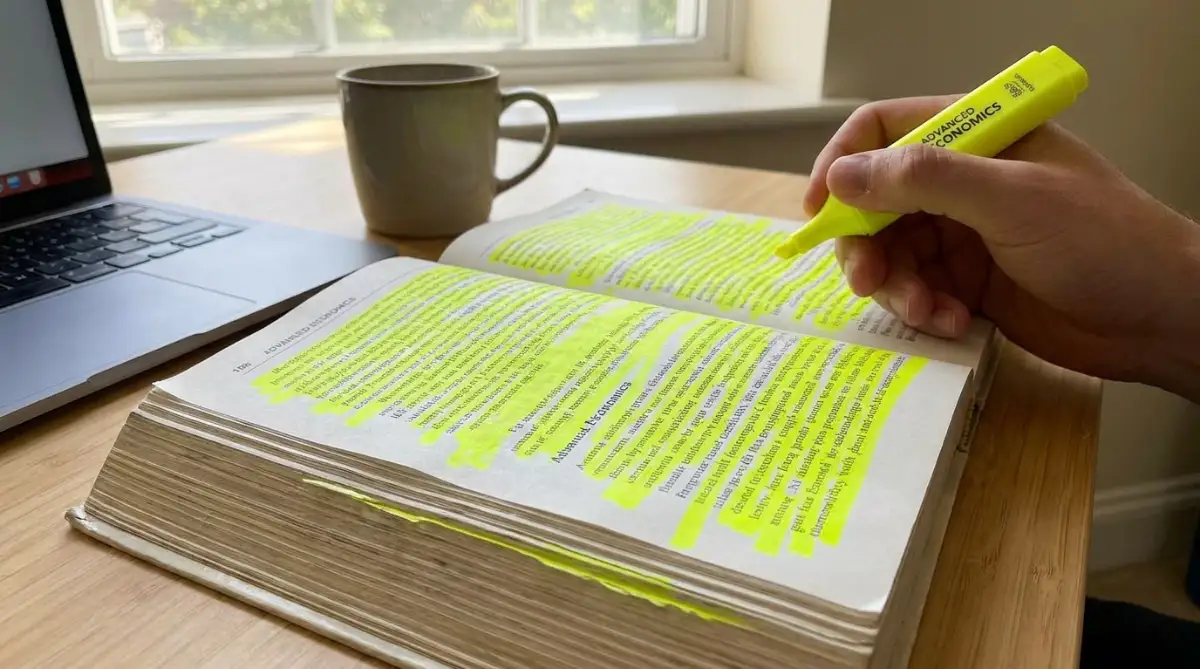
Have you ever stayed up until four in the morning cramming for an exam, only to stare blankly at the test paper the next morning? I know exactly how that crushing feeling weighs on you. We spend hours highlighted in yellow ink, convinced our hard work will save us, but we are actually just wasting our energy. Let me show you how to study less, remember more, and get the grades you actually deserve.
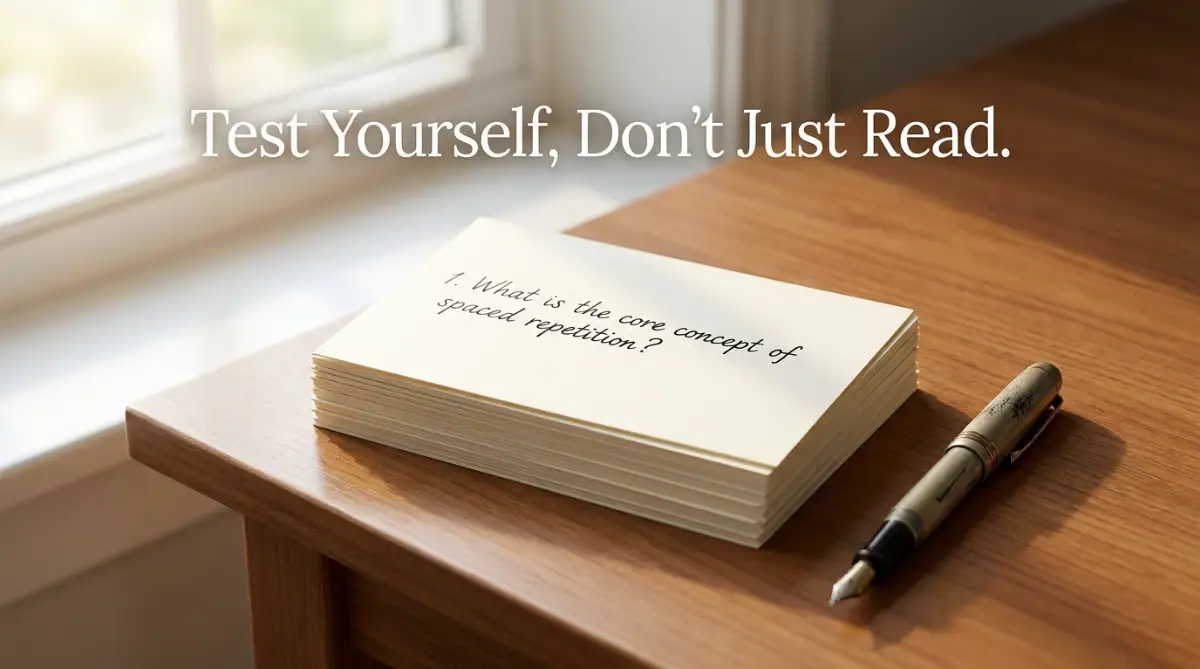
📌 Quick Summary: How to Study Smarter
- Ditch Re-reading: Passive reading only creates recognition, not recall. Practice pulling facts from your memory instead.
- Highlight Less: Highlighting is just labeling information. It does not move concepts into your long-term memory.
- Sleep to Remember: Your brain needs deep sleep to file away the day's notes. All-nighters fire the "sorting crew" and leave your mind messy.
- Space it Out: Break long study sessions into small, spaced blocks over several days to beat the forgetting curve.
The Biology of Memory: Recognition vs. Retrieval
To understand why passive studying fails, we must look at how the brain actually builds memories. Your brain is wired to forget almost everything you see and hear to keep itself from overloading.
When you read a textbook chapter, the information enters your temporary memory buffer. If you do not interact with that information, your brain assumes it is garbage and clears it out overnight.
The Forest Trail Analogy:
Imagine your brain is a thick, overgrown forest. When you read a page of notes once, you are like a person walking through the tall grass one time.
You leave a tiny, temporary path behind you. But if you do not walk that same path again quickly, the grass grows back, and the trail vanishes completely.
Active recall is the physical act of walking back and forth on that same path over and over again. You are forcing your brain to dig a permanent dirt road.
By trying to remember the facts without looking at your book, you tell your brain, "This information is essential for survival." Your brain responds by building permanent neural pathways.
Transforming Your Textbook into an Active Testing Ground
Many students open their textbook to chapter one and simply read from the top of the page to the bottom. This is a massive waste of your cognitive energy.
Instead, you must turn your reading into a game of hide-and-seek. Before you read a single paragraph, look closely at the bold subheadings on the page.
The Question-Conversion Trick:
If the subheading says, "The Causes of the French Revolution," do not just read the text underneath. Immediately take a blank index card and write: "What were the three main causes of the French Revolution?"
Now, read the text specifically to find the answers to your own question. Once you find the answers, write them in short, simple bullet points on the back of your card.
A Real-Life Scenario:
Imagine a student named Leo who is studying for a highly difficult human anatomy exam. He used to spend four hours reading his notes over and over, only to score a C on his tests.
Now, he uses the question-conversion trick. He reads a section, closes his notebook immediately, and forces himself to write down everything he just read on a blank sheet of paper.
He is struggling to remember, and that struggle is exactly where the learning happens. His brain is working hard to rebuild the pathway, raising his score to an A in less than a month.
The Index Card Revolution: Flashcards Done Correctly
Almost every student has used flashcards at some point in their life. But sadly, most people use them completely wrong, which leads to massive frustration and memory confusion.
The biggest mistake is writing too much information on a single card. If you write a giant paragraph on the back of an index card, your brain will simply memorize the pattern of the text instead of the actual facts.
The Rule of One Concept:
Every single flashcard must contain exactly one simple question and one short, specific answer on the back. Keep your cards clean, simple, and incredibly focused.
Expert Insight:
Never look at the back of the card until you have physically spoken the answer out loud or written it down on paper. If you look at the answer too fast because you feel stuck, your brain bypasses the retrieval phase entirely. You are back to passive recognition, which completely destroys the benefits of the active recall process.
To make this method even more powerful, you must combine it with spaced repetition. This simply means reviewing your cards at specific intervals over time.
If you get a card right today, put it in a box to review in three days. If you get it right again, move it to a box to review in seven days.
But if you get a card wrong, it goes straight back to the "daily review" box. This strategic system forces you to focus your limited study time on your weakest areas, saving you hours of useless repetition.
The Feynman Technique: Teaching as the Ultimate Test
The absolute gold standard of active recall is a method called the Feynman Technique, named after a famous physicist. It is based on a very simple premise: if you cannot explain a concept to an eight-year-old child, you do not truly understand it yourself.
When you study a difficult topic, do not just memorize the complex, scientific definitions from the book. Instead, imagine you are standing in front of a classroom of young children.
How to Practice This Today:
Take a blank piece of paper and write a simple explanation of the topic using only basic, everyday words. Do not use any fancy academic jargon or complicated terms.
If you find yourself struggling to explain a specific part simply, you have just discovered a massive gap in your own understanding. Go directly back to your textbook, read that specific section again, and simplify your explanation further.
By forcing your brain to translate complex data into simple, everyday English, you build an incredibly deep, unbreakable understanding of the subject. You are no longer just memorizing words; you are mastering the actual concept.
Did You Know? The Child-Test Rule
The easiest way to check if you actually understand a concept is the "Child-Test." If you cannot explain the main idea of your topic to an eight-year-old child in under sixty seconds without using complicated academic jargon, your brain does not fully own the information yet. You are just memorizing definitions without understanding the underlying logic.
Master-Level Strategies for Total Academic Dominance
You now understand why basic re-reading and passive highlighting are holding your exam scores back. It is time to look into the advanced, cognitive methods that top-tier students use to store information permanently.
According to cognitive researchers at Harvard University, your brain is highly plastic and physically changes its structure when you force it to retrieve information. Active retrieval is the only way to build strong, long-lasting memory pathways.
Medical studies hosted by the National Institutes of Health (NIH) prove that self-testing is vastly superior to passive study methods for long-term retention. If you do not actively practice pulling facts out of your mind under pressure, those memories will quickly evaporate.
When your grades drop despite your hard work, the mental pressure can feel incredibly heavy. It can feel as suffocating as trying to manage massive debts or struggling to figure out how to get unsecured loans with bad credit and actually get approved just to cover daily living expenses.
We need to completely remove that academic anxiety from your life today. If you want to stop hurting your GPA, you must identify and fix the costly study habits that secretly sabotage your exam grades immediately.
Let let us look at the advanced secrets that will transform you into a highly confident, straight-A student.
The Blurting Method: Deep-Dumping Your Brain
This advanced strategy is one of the most powerful ways to prepare for exams that require massive memorization. To start this process, you need a blank sheet of paper and a colored pen.
First, spend exactly ten minutes reading a specific section of your notes or textbook. Then, close the book completely, grab your blank paper, and write down absolutely everything you can remember as fast as possible.
Do not worry about neat handwriting or perfect spelling. Just dump the information out of your brain in a rapid stream of consciousness.
Once your brain runs completely empty, open your textbook again and look at what you missed. Take your colored pen and write down the missing facts directly on your paper.
Why this works so well:
This simple colored-pen addition shows your brain exactly where the weak spots are in your memory. It highlights your knowledge gaps with absolute visual clarity.
By forcing your brain to physically write down the forgotten information, you strengthen those specific neural connections. The next time you take a test, your brain will easily remember those colorful corrections.
Aligning Your Sensory Memory Triggers
Your brain does not store information in a vacuum. It attaches your memories to the physical environment around you, including specific sounds, temperatures, and smells.
If you study in a warm bed with loud music playing, your brain attaches the facts to those comfortable sensory triggers. When you sit in a silent, cold exam room, your brain struggles to locate those memory folders.
To solve this problem, you must practice state-dependent learning. Always study sitting upright at a clean desk in a quiet room that mimics your testing center.
The Peppermint Trick:
You can also use your sense of smell to build an artificial memory bridge. Eat a specific flavor of peppermint candy only while you are studying your notes.
When you walk into the exam room, chew that exact same brand of peppermint gum. The familiar scent will immediately trigger your brain to unlock the memories you stored while studying.
Your Quick Sensory Anchor Guide
- Study Phase: Brew a hot cup of lemon-ginger tea. Spray a single mist of peppermint oil on your study desk.
- Exam Phase: Chew a piece of lemon-ginger gum or apply a tiny drop of peppermint oil to your wrist right before walking into the test room.
- The Result: The familiar scent instantly signals your brain to open up the exact memory folders you built at your study desk.

Tragic Missteps That Turn Your Effort Into Failing Grades
Before you read through these sneaky habits that are quietly draining your focus, watch this highly helpful video that explains why your current study methods are not working. It breaks down the mistakes in a simple, visual way, so check it out and then read the rules below!
Even when students try to use active recall, they often make quiet mistakes that slowly destroy their progress. These pitfalls are highly emotional because they trick us into thinking we are being productive when we are actually wasting energy.
Let let us look at the essential Do's and Don'ts of modern cognitive training.
The "Quick Peek" Self-Testing Illusion
The most common mistake beginners make during active recall is looking at the answers too fast. You write a question on a flashcard, read it, and feel slightly stuck.
Instead of struggling to remember, you immediately flip the card over to see the answer. You tell yourself, "Oh yes, I knew that," and move on to the next card.
My absolute biggest mistake was letting myself take a "quick peek" at the back of my flashcards the second I felt slightly stuck. I did not realize that my brain was learning absolutely nothing because I was bypassing the hard work of active retrieval. Once I forced myself to sit in the discomfort of trying to remember for ten full seconds before turning the card over, my actual test scores shot up almost overnight.
The Psychological Reality:
You did not actually know the answer; you only recognized it once you saw it. By looking at the answer too fast, you completely bypass the retrieval phase.
Your brain learns absolutely nothing because you refused to let it experience the necessary physical struggle of remembering. You must force yourself to sit in the discomfort of not knowing for at least ten seconds before looking at the answer.
Relying on Digital Keyboards Instead of Handwriting
In our modern digital world, almost everyone takes notes by typing rapidly on a laptop or tablet. While typing is incredibly fast, it actually slows down your brain's ability to retain information.
When you type, your fingers use the exact same repetitive motion for every single letter. Your brain does not have to pay attention to the physical shape of the words.
Writing by hand is a highly complex motor skill that requires deep focus. Your brain must physically draw every curve of every letter, which builds much stronger cognitive pathways.

A Word from the Expert: Your Academic Rebirth
Transitioning your academic life does not have to be a scary or overwhelming experience. You now hold the exact same scientific knowledge that professional learning coaches use to guide top-performing university students.
By replacing lazy, passive habits with active recall and spaced repetition, you completely remove the fear of exam day. You are no longer crossing your fingers and hoping for a lucky test paper.
Instead, you are confidently walking into the classroom knowing that your brain has already neatly organized the answers. This simple shift in your study routine gives you incredible power over your own future success.
Your Academic Action Plan for Tomorrow Morning:
- Audit Your Study Space: Clean off your desk today. Remove all distractions and set up a quiet, upright study station that mimics an exam room.
- Create Your First Question Sheet: Stop highlighting your textbook. Turn your chapter headings into active questions and write the answers on the back of index cards.
- Practice the Feynman Technique: Find a friend or family member and try to explain your hardest study concept to them using only basic, simple English.
- Track Your Memory Intervals: Set a calendar reminder to review your flashcards in three days, then seven days, to beat the forgetting curve.
Your mind is an incredibly brilliant machine that is fully capable of storing massive amounts of data. It just needs you to provide a safe, calm environment and get out of its way.
Take a deep breath and start practicing these exact steps before your very next test. Protect your mental peace, trust the science of active retrieval, and take complete control of your academic journey starting right now.
Looking back, changing the way I studied did not just raise my grades—it completely saved my mental health and gave me my weekends back. You do not have to spend long, painful nights drowning in stress to be a top student, so please do not give up on yourself just yet. Change one simple study habit tonight, get some restful sleep, and walk into your next test with total confidence!
Common Questions About Overcoming Failing Grades With Active Recall
Why do I study for hours but still go blank during exams?
Studying for hours using passive habits like re-reading and highlighting only gives you temporary recognition rather than true memory retrieval. When you don't practice pulling facts out of your brain under pressure, your memory evaporates the moment you face a test.
What is the best way to use flashcards for maximum retention?
The best way is to follow the rule of one concept per card, keeping questions simple and answers short. Never look at the back of the card too quickly; you must force yourself to sit in the discomfort of remembering for at least ten seconds before checking.
How does the Feynman Technique help me understand difficult subjects?
The Feynman Technique requires you to explain a complex topic using simple, everyday language as if talking to a child. This active translation process exposes the exact gaps in your understanding and builds permanent neural pathways in your brain.
Why is writing notes by hand better than typing on a laptop?
Writing by hand is a complex motor skill that forces your brain to pay attention to the physical shape of every single letter. Typing on a keyboard uses the exact same repetitive motion, which bypasses the deep cognitive processing needed to store memories.
How can I stop the Forgetting Curve from wiping out my study efforts?
You can beat the Forgetting Curve by using spaced repetition, which means reviewing your study material at specific intervals over time like three days, then seven days. This strategic review system forces your brain to work hard and build unshakeable long-term memories.
Disclaimer: The information provided in this article is for educational and general informational purposes only. It does not constitute professional psychological, cognitive therapy, or academic counseling. Always consult with a certified education specialist, school counselor, or licensed mental health professional regarding any severe test anxiety, learning difficulties, or chronic academic stress.