The Frustrating Search for Clear Vision
I wasted fifty dollars on trendy blue light glasses hoping they would cure my daily office headaches. When the pain didn't stop, I realized screen strain isn't caused by toxic rays—it's caused by forgetting to blink. Let's look past the marketing hype and fix your computer eye strain naturally.
Your Action Plan for Pain-Free Screen Time (TL;DR)
- Turn your desk sideways so your screen sits at a 90-degree angle to the window.
- Enable "Night Light" or "Night Shift" on your computer to block harsh blue light in the afternoon.
- Follow the 20-20-20 rule: Every 20 minutes, look at an object 20 feet away for 20 seconds.
- Wipe your monitor with a clean microfiber cloth weekly to stop dust from blurring your display.
Uncovering the Medical Truth About Screen Light
To actually fix the pain in your head, we need to completely pull back the curtain on how your eyes naturally interact with modern technology. The marketing campaigns have successfully convinced the entire world that the blue light specifically coming from your computer monitor is physically damaging your eyeballs.
They paint blue light as an aggressive, toxic laser beam that is slowly destroying your retinas. This is exactly where the massive myth begins. Optometrists and leading eye researchers want you to know a very boring, highly unsexy truth.
The blue light coming from your standard office computer monitor is not actually bright enough to cause physical, permanent damage to your eyes.
If you want to know where the vast majority of blue light actually comes from, you just need to walk outside and look up at the sky. The natural sun produces massive amounts of blue light, dwarfing the tiny trickle of light coming from your sleek laptop screen. Our human eyes have naturally evolved over thousands of years to handle significant exposure to this specific wavelength of light.
So, if the blue light from your screen is not actually melting your retinas, why exactly do your eyes feel like they are completely on fire at five o'clock in the evening? The true answer has absolutely nothing to do with the specific color of the light. It has everything to do with how you are physically behaving while you stare at that glowing box.
The Sneaky Danger of the Unblinking Stare
The real medical villain behind your daily headaches is surprisingly simple. When human beings stare at a digital screen, we completely forget how to blink. This is a totally unconscious, deeply ingrained physical reaction that happens to almost everyone.
Normally, a healthy adult blinks about fifteen to twenty times every single minute. Every single time those eyelids close, they act like a tiny windshield wiper. They spread a fresh, highly protective layer of natural tears completely across the front surface of your eyeball.
The Blinking Reality Check:
When I started tracking my screen habits, I realized I blinked only 4 times a minute while reading emails. Bringing that number back up to 15 completely eliminated my afternoon dry-eye burning.
However, researchers have found that when we read emails, play video games, or scroll through social media, our blinking rate drops by an astonishing sixty percent. We lock our eyes open, staring intensely at the glowing pixels.
When you stop blinking, that protective layer of tears completely evaporates into the dry office air. Your eyeballs are left totally exposed, dry, and irritated. This severe dryness is the absolute primary cause of the burning, scratching sensation you feel at the end of a long workday.
No amount of yellow tint on a pair of expensive glasses can ever fix a lack of natural tears. If you are wearing blue light glasses but still holding your eyes open like a staring contest champion, you are going to get a massive headache regardless of what you wear on your face.
The Tiny Muscle Workout You Never Asked For
There is another massive physical factor contributing to your daily misery. Inside your eye, there is a tiny, highly sensitive muscle that controls your natural ability to focus. When you look at an object far away, like a mountain in the distance, that specific muscle is completely relaxed.
When you look at an object up close, like a smartphone screen held exactly twelve inches from your nose, that tiny muscle has to flex extremely hard to keep the text clear. Now, imagine holding a heavy dictionary in your outstretched arm for eight straight hours without ever putting it down. Your arm muscles would be screaming in absolute agony.
This is exactly what you are forcing the tiny focusing muscles inside your eyes to do every single day. You are staring at a fixed, close-up distance for eight solid hours without ever giving those tiny muscles a chance to release the tension.
My Personal Pro Tip: I used to think I needed a stronger prescription for my reading glasses because my vision was always blurry by dinnertime. My eye doctor actually laughed and told me my prescription was perfectly fine. The blurriness was just my eye muscles completely giving up from sheer physical exhaustion. Once I started actively resting those muscles throughout the day, the evening blurriness completely vanished.
The combination of severe dryness from not blinking and absolute muscle exhaustion from focusing too closely creates the perfect storm for a tension headache. The pain is radiating from tired muscles, not from dangerous blue light waves.
Watch How Optometrists Explain the Real Problem
If you want to hear this exact scientific breakdown straight from the mouth of a licensed medical professional, check out this brilliant visual explanation.
The One Thing Blue Light Actually Does Affect
If blue light does not cause eye strain, you might be wondering why scientists talk about it at all. The medical community is not completely dismissing the impact of screens on our biology. They just want us to focus on the actual problem it creates.
While blue light does not hurt your physical eyeballs, it heavily disrupts your brain's internal clock. Your brain uses natural light to understand what time of day it is. When the sun goes down and it gets dark outside, your brain naturally starts producing melatonin, the chemical that makes you feel sleepy.
When you lay in bed at midnight and hold a glowing, blue-light-emitting smartphone two inches from your face, you are deeply confusing your biology. The blue light tricks your brain into thinking the sun is just coming up for the morning. Your brain immediately halts the production of melatonin, making you feel completely wide awake when you should be resting.
This disruption leads to terrible sleep quality, tossing and turning, and waking up feeling completely miserable. If you want to use blue light glasses specifically for this purpose, wearing them two hours before bed can genuinely help your brain wind down safely. But wearing them at noon in a brightly lit office is not doing anything to protect you from screen fatigue.
Rebuilding Your Daily Screen Habits
Now that you know the glasses are largely a marketing myth for eye strain, you need an actual, medically proven strategy to protect yourself. You do not have to quit your office job or throw away your smartphone to find absolute relief. You simply need to rebuild your daily habits based on how human biology actually functions.
Your very first line of defense is forcing yourself to take calculated, structured breaks. The absolute gold standard rule recommended by every single major optometry association in the world is called the 20-20-20 rule. It is completely free, it requires zero special equipment, and it actually works.
The rule is incredibly simple: Every twenty minutes, you must look away from your computer screen. You need to find an object that is exactly twenty feet away from you, like a picture on the far wall or a tree outside your window. You must stare at that distant object for exactly twenty seconds.
By forcing your eyes to look twenty feet away, you instantly relax that tiny, overworked focusing muscle we talked about earlier. You are basically letting your eyes drop the heavy dictionary for a brief moment of total rest. During those twenty seconds, you should also actively force yourself to blink ten times in a row to manually rehydrate your dry eyeballs.
The 20-20-20 Rule Cheat Sheet:
- Every 20 Minutes: Stop looking at your display.
- Find 20 Feet: Look at a distant object across the room.
- Hold for 20 Seconds: Let your tiny eye muscles fully relax and stretch out.
Upgrading Your Physical Work Environment
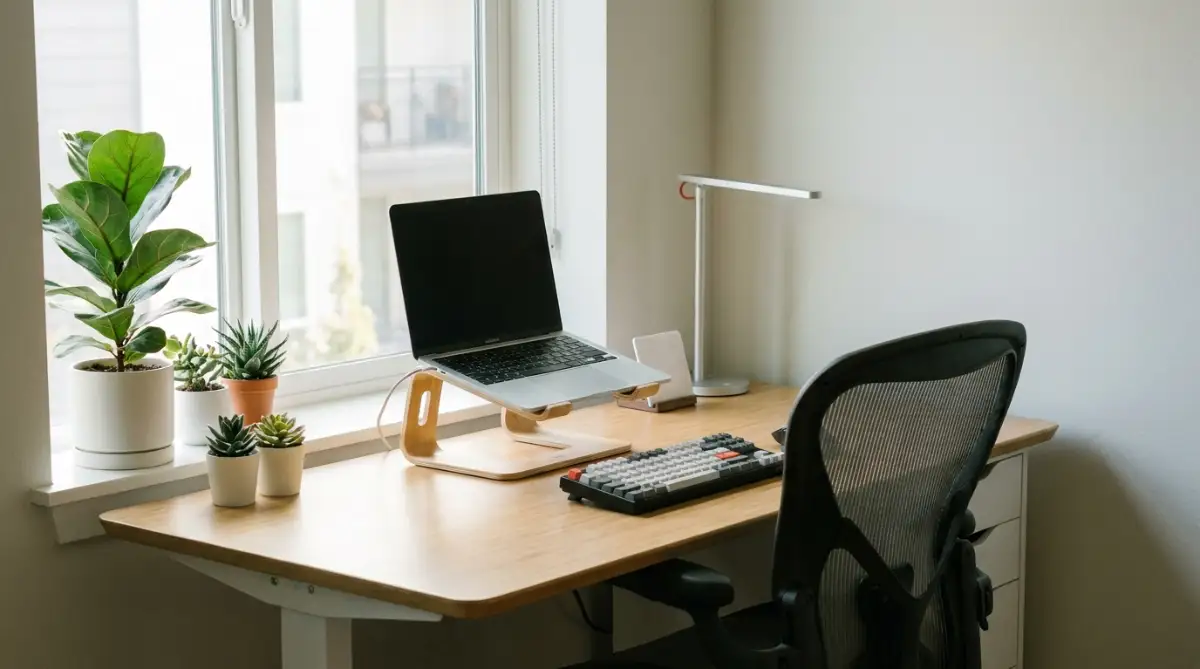
Changing your personal habits is amazing, but you also need to set up your physical desk space for maximum biological success. How you position your body directly impacts how hard your eyes have to work.
First, check the exact distance between your face and your computer monitor. If you can physically lean forward and touch the screen with your nose without stretching, you are sitting entirely too close. Your monitor should be positioned exactly an arm's length away from your normal sitting position.
Next, check the physical height of the screen. The very top edge of your monitor should be perfectly level with your natural eye line. When you read the text on the screen, your eyes should be looking slightly downward at a gentle fifteen-degree angle.
Looking slightly downward means your eyelids will naturally cover more of your eyeball. This simple mechanical shift instantly reduces the amount of tear evaporation happening in the dry office air. If you are constantly looking upward at a screen mounted high on a wall, your eyes are forced wide open, dramatically increasing your risk of severe dryness.
Expert Level Tactics for Long-Term Eye Protection
Now that you have fixed your physical desk setup, you need to turn your attention to the actual settings on your devices. You do not need to buy expensive external glasses when your computer already has the software built right in to protect you. Every modern smartphone, tablet, and laptop comes with a free, highly effective color temperature control system.
On Apple devices, this is called Night Shift, and on Windows, it is called Night Light. This software automatically removes the harsh, cool blue tones from your screen and replaces them with a warm, orange glow. You can easily read the clinical guidelines on managing screen time and lighting from the American Academy of Ophthalmology to see exactly why these software shifts are so highly recommended.
The secret is to not wait until the sun goes down to use these features. You should set your screen to a permanently warmer tone all day long. It might look a little strange for the first ten minutes, but your brain will completely adjust, and the harsh glare that causes tension headaches will practically vanish.
You also need to think about the physical environment surrounding your computer screen. Having a bright window directly behind your monitor creates a massive, painful contrast for your eyes to fight against. You are forcing your pupils to constantly adjust between the bright natural sunlight and the darker text on your screen.
If you cannot move your desk away from the window, you absolutely must install heavy blinds to soften the light.
For severe dryness, you should seriously consider buying a small desktop humidifier. Office buildings are notoriously dry, pulling moisture straight out of your skin and your open eyes. Running a tiny, cheap humidifier right next to your monitor provides a constant, gentle layer of moisture that completely prevents that terrible scratchy feeling.
If your eyes are already severely dried out, the humidifier will not work fast enough. You need to use high-quality, preservative-free artificial tears. Avoid the cheap eye drops that claim to "get the red out," as those chemicals actually shrink your blood vessels and make the dryness significantly worse over time.

Silent Mistakes That Quietly Destroy Your Vision
Even when we try our best to follow the rules, modern life makes it incredibly easy to fall into terrible habits. I have seen incredibly smart people completely destroy their eye health because they ignored tiny warning signs. We need to expose these dangerous traps so you never accidentally fall into them yourself.
The absolute most destructive mistake is completely ignoring the early warning signs of physical eye strain. When your eyes start burning at three o'clock in the afternoon, that is your body loudly screaming for a break. Pushing through the pain to finish one more spreadsheet is a terrible decision that leads to chronic muscle tension.
Ignoring that pain is exactly like ignoring dangerous morning routine mistakes that secretly destroy your daily productivity. You think you are saving time, but you are actually guaranteeing that you will be completely useless and exhausted by dinner time. You must respect the physical limitations of your body.
Another massive trap is relying solely on blue light glasses while continuing to stare at your phone in complete darkness. Lying in bed with the lights off while scrolling through bright social media feeds puts a terrifying amount of focused light directly onto your retinas. The glasses will not save you from the extreme muscle fatigue caused by the high contrast of a bright screen in a pitch-black room.
This toxic nighttime habit is heavily linked to severe sleep disorders and chronic insomnia. It works very much like the overlooked habits that quietly destroy your smartphone battery lifespan; you are slowly burning out your system's natural ability to recharge properly. Always keep a soft bedside lamp turned on if you must look at a screen before sleeping.
Many people also make the terrible mistake of skipping their annual eye exam just because their vision seems fine. You might not need a stronger prescription to see clearly, but an optometrist does so much more than just read an eye chart. They can physically look inside your eye to spot early signs of severe dry eye disease or underlying muscle imbalances.
If you avoid the doctor because you are stressed about the cost, you might end up paying ten times more for advanced medical treatments down the road.
Finally, do not self-diagnose your headaches without getting a professional medical opinion. A persistent, severe headache behind your eyes could be a sign of something much more dangerous than simple screen fatigue. If you want to understand exactly how doctors separate simple strain from serious conditions, you can read expert research on digital eye strain pathology published in the National Library of Medicine.
Your Simple Blueprint For Pain-Free Screen Time
We have completely pulled back the curtain on the marketing hype today. You no longer have to waste your hard-earned money on stylish plastic frames that promise magical medical cures. You now understand exactly how the muscles in your eyes work, and more importantly, how they physically break down.
Your strict assignment for tomorrow morning is to set up your physical workspace for success. Before you even open your email, physically measure the distance from your nose to your computer screen. Make sure your monitor is pushed back to at least an arm's length away, and tilt it slightly downward.
Next, grab your smartphone and set a repeating, silent alarm for every twenty minutes. When that alarm vibrates gently on your desk, you must physically turn your head away from the glowing pixels. Stare at a poster across the room, forcefully blink your eyes ten times in a row, and let those tiny muscles completely relax.
My Personal Final Thought: I wasted so much money searching for a magical cure for my terrible screen headaches. The exact day I threw my fake glasses in a drawer and simply started forcing myself to blink every twenty minutes, the pain completely vanished. Stop looking for expensive shortcuts, trust your biology, and take back control of your own health today!
Common Questions About Digital Eye Strain
Will turning my screen brightness all the way down protect my eyes?
No, turning the brightness down too low can actually make the strain significantly worse. If the screen is too dark, your eye muscles have to squint and flex incredibly hard just to read the text. You should always adjust your screen brightness so it perfectly matches the ambient lighting of the room you are sitting in.
Why do my eyes feel totally fine on my phone but hurt on my laptop?
When you look at a small smartphone screen, you naturally look downward, which allows your eyelids to cover and protect more of your eyeball. Laptops are often propped up high on stands, forcing your eyes wide open and drastically increasing the rate of tear evaporation. Positioning your laptop slightly lower will instantly help reduce that specific irritation.
Do expensive gaming glasses work better than cheap blue light glasses?
No, they are fundamentally built on the exact same marketing premise. Whether they cost twenty dollars or two hundred dollars, they cannot fix the physical lack of blinking or the exhaustion of your internal focusing muscles. Save your money and invest in a high-quality desktop humidifier instead.
Can staring at a screen too long cause permanent blindness?
Absolutely not. There is currently zero scientific evidence that staring at a standard computer screen causes any permanent, long-term damage to your physical retinas or causes blindness. The pain you feel is muscular fatigue and severe surface dryness, both of which are completely reversible with proper rest and hydration.
Should I use anti-glare screen protectors on my office monitor?
Yes, using a matte anti-glare screen protector is actually a fantastic, medically sound idea. Bright, glossy screens reflect overhead office lights directly into your eyes, causing a massive amount of physical glare. An anti-glare film scatters those harsh reflections, significantly reducing the amount of work your focusing muscles have to do to read the screen clearly.
Disclaimer: The information provided in this article is for general educational and informational purposes only and does not constitute professional medical advice, diagnosis, or treatment. Severe, chronic eye pain or sudden changes in your vision can be signs of serious underlying health conditions. Always consult directly with a licensed optometrist or ophthalmologist for a comprehensive eye exam and personalized medical treatment.