
Depositing your crypto into a high-yield decentralized liquidity pool feels like unlocking free passive income—until a sudden market swing drains your original tokens and leaves you holding a bag of worthless reward coins. Most beginners get blinded by shiny four-digit percentage yields without realizing that automated market makers mathematically rebalance your funds against you. In this guide, I will show you how impermanent loss quietly robs your wallet, how to spot inflationary token traps, and how to safely earn real trading fees using stable, correlated pairs.
📌 What You Must Know Before Providing Crypto Liquidity:
-
Insane APYs are inflationary traps: Pools promising 1,000%+ yields print reward tokens out of thin air, causing the reward price to crash faster than you can harvest.
-
Impermanent loss is real: When one paired asset surges and the other lags, the pool sells your winning coin, leaving you with less value than simply holding.
-
Stick to correlated pairs: Pairing stablecoins (USDC/USDT) or pegged assets (ETH/stETH) drops impermanent loss to near zero while collecting safe fees.
-
Never grant infinite approvals: Manually edit your Web3 wallet spending permissions so rogue contracts cannot drain your entire wallet later.
Looking Behind the Curtain of Decentralized Finance
Before we start applying safety nets, we really need to look at what is happening inside these digital vaults. When you provide liquidity, you are basically acting as a digital currency exchange. You put two different tokens into a giant pot so other traders can swap between them instantly.
In return for supplying this service, the platform gives you a small cut of the trading fees. On the surface, this sounds like a beautifully fair deal. However, the math that runs these automated platforms is entirely blind to human emotions and real-world prices.
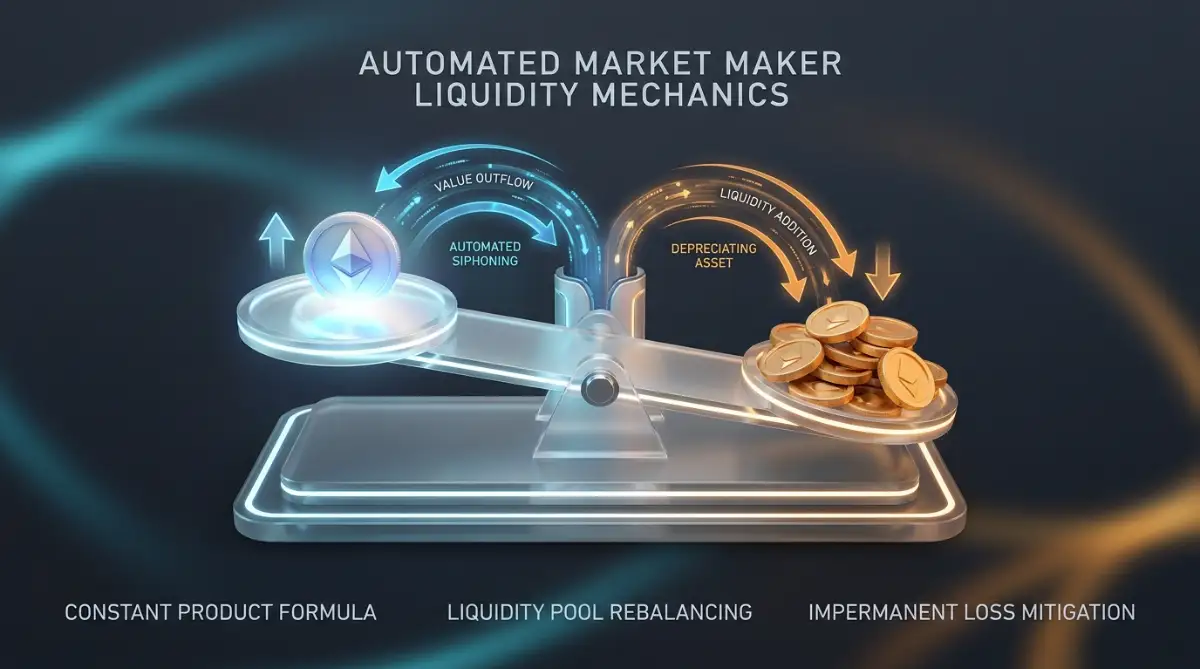
The system uses a strict mathematical formula to balance the two tokens in your pot. If one token suddenly becomes very popular and expensive, traders will rush to your pool to buy it. They will pull the good token out and dump the less valuable token back in, leaving you holding a bag of losing assets.
Understanding the Silent Thief: Impermanent Loss
This specific situation is known as impermanent loss, and it is the single biggest enemy of any liquidity provider. It happens when the price of your deposited tokens changes significantly from the exact moment you put them in.
Imagine you own a small fruit stand where you sell apples and oranges. You want to keep the total value of your apples and oranges exactly equal at all times. If a sudden shortage makes apples incredibly expensive everywhere else, people will rush to your stand to buy your cheap apples.
They will hand you lots of cheap oranges in return. By the end of the day, your stand is completely empty of valuable apples and overflowing with cheap oranges. Even though you collected small fees from every sale, the total value of your fruit stand is much lower than if you had just kept your original apples locked in a safe.
This is exactly how automated market makers drain your crypto wallet. If you do not actively plan for this mathematical balancing act, you will lose a massive portion of your initial investment.
📉 The Math of Impermanent Loss: What Price Swings Actually Cost You
My Liquidity Rule: If you expect one token to skyrocket while the other stays flat, never put them into a liquidity pool. Pools are meant for sideways, range-bound markets—not runaway moonshots!
The Trap of Sky-High Percentage Returns
One of the hardest things to ignore in the crypto world is the promise of massive yields. When you scroll through different platforms, you will often see pools offering returns of over a thousand percent. Your brain immediately starts calculating how quickly you can become a millionaire.
You must deeply understand that these giant numbers are highly manipulative marketing tactics. Platforms print new tokens out of thin air to pay you these rewards. When a platform offers a crazy high return, they are rapidly increasing the total supply of their own coin.
Simple economics tells us that when there is too much of something, its true value drops closer to zero. The platform might be paying you thousands of extra coins every day, but those coins are losing their market value at an even faster rate.
How to Spot a Sinking Ship
When I evaluate a new pool, I immediately look at where the reward money is actually coming from. If the platform is generating real revenue from actual trading fees, that is a healthy sign. Real people are using the platform, and you are getting a fair share of the business.
However, if the rewards are solely coming from the platform printing more of its own useless token, run far away. This creates a hyper-inflationary death spiral. Early investors will constantly sell their freshly printed rewards to secure their profits, driving the price down continuously.
Pro Tip: I used to chase pools offering ridiculous 500% returns, thinking I was so much smarter than everyone else. My biggest realization came when I tracked my portfolio for a month and saw that my "boring" 12% stablecoin pool actually made me more real money than the high-risk pools that eventually collapsed to zero.
The Illusion of Total Value Locked (TVL)
Many influencers will tell you to simply look at the Total Value Locked (TVL) to see if a platform is safe. The theory is that if billions of dollars are locked inside, it must be highly secure. This is a very dangerous assumption.
A high TVL simply means a lot of greedy people have rushed into the pool at the exact same time. It does not mean the underlying computer code is actually safe from hackers. In fact, a massive TVL acts like a giant glowing target for every sophisticated hacker on the internet.
You should absolutely check the TVL to ensure the platform has enough liquidity to function. But you should never use it as your only metric for safety.
Mastering the Art of Pair Selection
Choosing which two tokens to put together is the most critical decision you will make. Most beginners just pick their favorite coin and pair it with whatever token offers the highest reward. This random selection process is exactly how you get burned.
To manage your risk properly, you need to understand the relationship between the two assets. If the two coins usually move in opposite directions, your impermanent loss will be incredibly severe.
The Safety of Correlated Assets
The smartest way to protect your money is to pair two assets that naturally move together. The best example of this is pairing two different stablecoins, like USDC and USDT. Because both tokens are always designed to equal exactly one dollar, their prices never diverge.
Since the prices stay completely flat, impermanent loss basically drops to zero. You get to collect the trading fees without worrying about wild price swings draining your initial deposit. The returns might be lower, but you will actually sleep peacefully at night.
If you want slightly higher returns, you can look at highly correlated assets like Ethereum and Wrapped Ethereum. They are essentially the same asset just wrapped in different code, so their prices follow each other perfectly.
The Danger Zone: Volatile Micro-Caps
The absolute riskiest thing you can do is pair a strong, famous coin (like Bitcoin) with a brand-new, unknown meme coin. If the meme coin crashes to zero, the pool's math will try to balance the value.
The pool will automatically sell off all your precious Bitcoin to buy more of the dying meme coin. You will wake up to find your entire Bitcoin stack gone, replaced by millions of worthless tokens. This is the exact trap that ruins most new liquidity providers.
🎬 Animated Visual Guide: How Impermanent Loss Drains Your Wallet
If the math behind liquidity pools still feels confusing, watch this clear animated breakdown from the educators at Whiteboard Crypto. They use simple visual examples to show you how automated market makers shift your balances when coin prices diverge—and why holding tokens in your wallet sometimes beats yield farming:
Now that you have seen the animated math behind impermanent loss on screen, let us look at the silent technical vulnerability that can drain an entire pool in seconds: smart contract bugs.
The Hidden Threat of Smart Contract Bugs
Even if you pick the perfect tokens and avoid impermanent loss, you still face a massive technical hurdle. Decentralized finance operates entirely on smart contracts, which are just complex pieces of computer code.
Because humans write this code, it is naturally prone to hidden errors and bugs. When you deposit your money, you are locking it inside a digital vault controlled completely by this code. If there is a tiny typo or logical error in the programming, a clever hacker can drain the entire vault in seconds.
You have no customer service department to call when this happens. There is no manager to complain to, and no insurance policy will cover your lost funds. Once the crypto leaves the smart contract, it is gone forever.
How to Verify the Code
You do not need to become an expert computer programmer to protect yourself. Before depositing any money, you should aggressively search for independent security audits. Reputable platforms will hire third-party security firms to read their code and look for weaknesses.
Look for a public audit report on the platform's website. If they hide their audits or say they are "coming soon," you must keep your wallet disconnected.
Even with a proper audit, things can still go wrong. Security firms can miss highly complex exploits. This is why you must never put your entire life savings into one single protocol, no matter how safe it appears.
🛡️ The 60-Second DeFi Safety Checklist: Run This Before Depositing
Don't blindly trust a flashy dashboard. Run these four checks to protect your capital:
-
1. Check DefiLlama History: Confirm the platform has maintained steady TVL for at least six months without sudden 90% drops.
-
2. Verify the Audit Firm: Look for audits from top security firms like OpenZeppelin, Trail of Bits, or CertiK. Avoid projects with anonymous self-audits.
-
3. Inspect Timelocks: Ensure the smart contract uses a 48-hour multi-sig timelock so anonymous developers cannot drain funds overnight.
-
4. Cap Token Approvals: When connecting your Web3 wallet, manually set your spend limit to the exact deposit amount instead of clicking "Infinite Approval."