When your hands are shaking after a fender bender and a police officer asks you what happened, being polite can cost you thousands of dollars. An innocent "I am so sorry" or a quick "I'm totally fine" sounds like basic courtesy, but insurance adjusters treat those exact words as an admission of fault and a waiver of medical coverage. In this guide, I will show you why staying quiet protects your wallet, the exact phrases to say instead of apologizing, and how to handle police questioning without giving the other driver's insurance an excuse to deny your claim.
📌 What You Must Never Say After a Car Crash:
-
Never apologize at the scene: Saying "I'm sorry" is treated by insurance companies as a legal confession of fault, even if the other driver hit you.
-
Never say "I'm not hurt": Adrenaline masks severe whiplash and soft tissue injuries; say you are shaken up and will get evaluated by a physician.
-
Never guess speeds or distances: If an officer asks how fast you were traveling, state that you flowed with traffic rather than throwing out random numbers.
-
Decline recorded calls from their insurer: You have zero legal duty to give a recorded statement to the opposing insurance adjuster without your lawyer present.
The Psychology of the Accident Scene (Why We Talk Too Much)
Before we look at the specific mistakes, we need to understand why we make them in the first place. When you hear the crunch of metal, your body instantly goes into "fight or flight" mode. Adrenaline floods your system, making it incredibly hard to think clearly.
You might feel perfectly calm on the outside, but your brain is working in overdrive. This chemical rush actually makes most people extremely talkative. We try to regain control of a scary situation by explaining it away.
Police officers know this happens. They are trained to arrive, calm the situation, and gather facts as quickly as possible. But their job is to write a report, not to protect your personal insurance rates.
When an officer asks a broad question like, "Can you tell me what happened here?", they are giving you a blank canvas. Most nervous drivers take that canvas and paint a very messy picture. We start sharing our feelings, our assumptions, and our guesses, thinking it helps our case.
The "People Pleaser" Trap
Many of us are naturally raised to be polite and cooperative. When an authority figure in a uniform asks us questions, our first instinct is to please them. We want to show that we are good, law-abiding citizens who are easy to deal with.
This people-pleasing reflex is your absolute worst enemy at a crash scene. Being polite is completely fine. However, trying to make the officer's job easier by giving them a heavily detailed, dramatic story is a massive mistake.
You have to remember that everything you say is being documented. That little police notebook is basically the script for how your insurance claim will play out over the coming weeks.
Never Fall for the "Apology Reflex"
This is perhaps the most common and damaging mistake you can make. The moment you step out of your car, you might feel the urge to say, "I am so sorry!" to the other driver. You might even say it to the police officer just because you feel bad about blocking traffic.
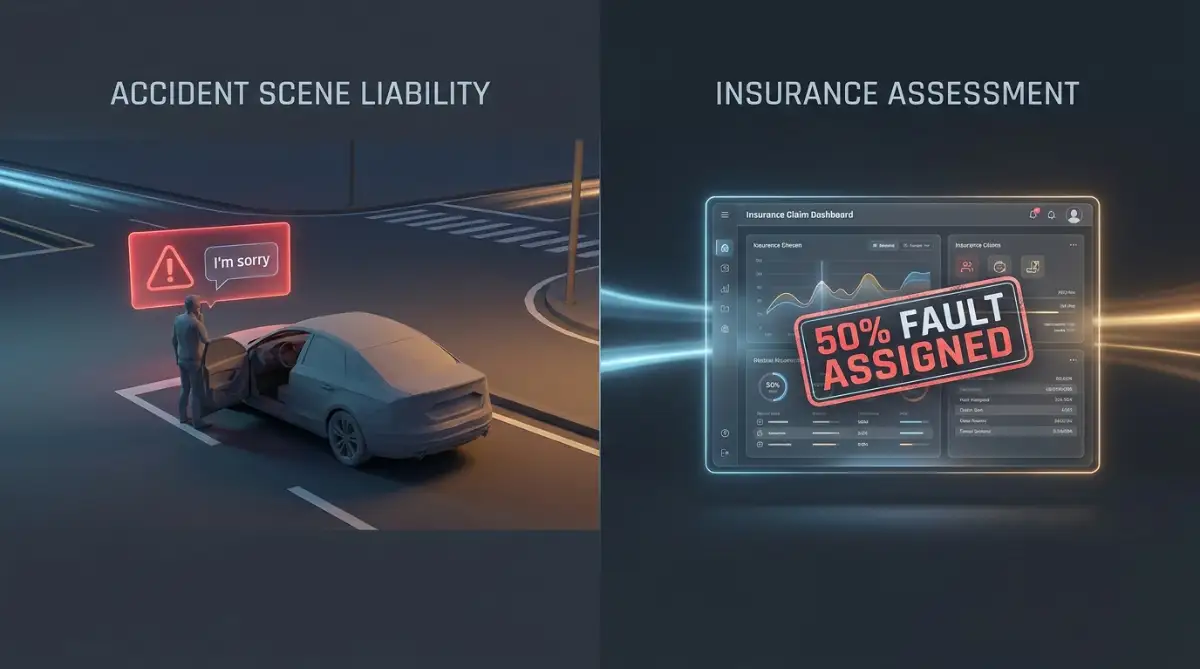
In everyday life, saying sorry is just a sign of empathy. If you bump into someone at the grocery store, you apologize. But in the legal and insurance world, an apology translates directly to an admission of guilt.
Even if the other driver clearly ran a red light and hit you, saying you are sorry gives their insurance company room to argue. They will point to the police report and say, "Look, your client apologized at the scene. They clearly felt responsible."
How to Show Empathy Without Admitting Fault
You can absolutely be a decent human being without ruining your legal standing. If you want to check on the other driver, keep it strictly focused on their well-being.
Instead of saying, "I am so sorry this happened," you can simply ask, "Is everyone in the vehicle okay?" or "Do you need me to call an ambulance?" This shows that you care about their safety without taking the blame for the actual collision.
When the police arrive, maintain this exact same boundary. You are there to provide facts, not to express regret. Leave your emotions out of the conversation completely.
The Danger of Guessing Facts and Numbers
When a police officer is filling out their report, they love exact numbers. They will often ask you questions about speed, distance, and time. "How fast were you going?" or "How far away was the other car when you first noticed them?"
Human beings are terrible at estimating speed and distance, especially during a traumatic event. If you tell an officer, "I think I was going about 30 miles per hour," and the speed limit is 25, you just confessed to speeding.
Even if you were actually going 20 miles per hour, your nervous guess is now a permanent part of the official record. The opposing insurance adjuster will use that guess to deny your entire claim.
Pro Tip: I always keep a small notebook in my glove box to remind myself of a simple rule: if I don't know the exact answer, I simply say, "I don't know." My biggest mistake was trying to guess the other driver's speed, which instantly made my statement look completely unreliable.
Stick strictly to the Known Facts
You are only required to tell the officer what you know for an absolute fact. If you do not know the exact speed you were traveling, it is completely acceptable to say, "I am not sure of my exact speed, but I know I was flowing normally with traffic."
If they ask how far away the car was, do not give them a number in feet or yards. Tell them, "I cannot estimate the exact distance." The police officer might press you for an estimate, but you must hold your ground nicely.
🎬 Attorney Insider: How Accident Statements Impact Your Settlement
If you want to see how your initial words on the side of the road affect your final payout, watch this practical walkthrough from personal injury attorney Justin at JZ Helps. He explains how insurance adjusters dissect police reports, evaluate fault, and calculate payouts—and shows you how staying factual protects your rightful compensation:
Now that you understand how lawyers turn on-scene facts into fair settlements, let us look at the next big trap that catches polite drivers: playing the role of a medical expert.
Do Not Play the Role of a Medical Expert
After a minor fender bender, it is totally normal to feel like you just got bumped around a little bit. The officer will almost always ask, "Are you injured?"
Because of the massive adrenaline rush we talked about earlier, your body naturally masks physical pain. Your immediate answer will probably be, "No, I am completely fine."
This simple four-word sentence can destroy your chances of getting medical bills paid later on. Whiplash, soft tissue damage, and even minor concussions often take hours or days to actually show symptoms.

The Delayed Onset of Pain
You might go to sleep feeling perfectly normal. The next morning, you might wake up unable to turn your neck or suffering from a blinding headache. When you go to the doctor and then file an insurance claim, the adjuster will pull up the police report.
They will see clearly that you told the officer you were "fine." They will immediately argue that your neck injury must have happened after the accident, perhaps while you were working out or sleeping funny.
To protect yourself, you need to change your vocabulary. Instead of saying you are fine, tell the officer, "I am currently shaken up, and I will be seeing a doctor to get fully evaluated." This leaves the door open for any future medical claims you might need to make.
Myth vs Reality at the Accident Scene
Let’s look at a quick comparison of what people think happens versus what actually happens.
Rambling and Volunteering Unasked Information
Silence makes human beings very uncomfortable. When the police officer is standing there quietly writing in their notepad, you might feel a strange urge to keep talking.
You might start over-explaining the situation. You might say things like, "I was just reaching for my coffee when he stopped suddenly," or "The sun was right in my eyes, so it was hard to see."
You might think you are just giving context to the situation. In reality, you are handing over ammunition. By mentioning the coffee or the sun, you are basically admitting that you were distracted or that your vision was impaired.
The "Yes or No" Strategy
The best way to handle a police interview after a crash is to treat it like a serious business transaction. Listen very carefully to the specific question being asked. Answer only that specific question, and then stop talking completely.
If the officer asks, "What color was the light?", your answer should be "Green." Do not say, "It was green, but I was looking at my GPS right before I crossed the line."
Keep your sentences incredibly short. Do not offer background stories about where you were driving to or how stressful your morning has been. The less you say, the less material they have to twist against you later.
🚫 The Roadside Script: What Never to Say vs. What to Say Instead