
How to Get an Unsecured Personal Loan Fast (Without Collateral)
When an emergency hits and you need thousands of dollars today, traditional banks make you feel like you are asking for a personal favor. If you do not own a home or have paid-off collateral to pledge, they often shut the door in your face. In this guide, I will show you how to qualify for an unsecured personal loan based on your signature alone, how to pass algorithmic cash-flow audits, and how to get funded without putting your family car or house at risk.

📌 What You Need to Know Before Borrowing Unsecured Cash:
- Your assets stay yours: Unsecured personal loans never require your home title or car keys; approvals depend strictly on verified income and credit reliability.
- Drop credit card usage first: Keeping active card utilization below 30% improves algorithmic approval chances far faster than waiting for old marks to age off.
- Prioritize soft credit checks: Only check loan offers where the platform explicitly uses soft credit pulls to keep your permanent credit score untouched.
- Skip mega-banks if credit is fair: Look toward credit unions or online fintech platforms that review bank cash flow instead of relying solely on an automated FICO score cutoff.
Your Strategic Blueprint for Securing Unsecured Money
Getting approved for a quick bank loan without collateral does not rely on wishing for good luck. It certainly does not matter if you know the local bank manager personally.
Getting a fast approval relies entirely on cold, hard data and smart preparation. Banks use very specific mathematical formulas to decide who gets emergency cash and who gets a quick rejection letter.
If you understand the exact rules their lending computers use, you can easily organize your profile to force an automatic approval. We are going to look at the three most practical, logical steps you must take right now to secure your money safely.
Step 1: Decode Your Financial Resume Before Applying
Because you are not offering your car or your house as a physical safety net, the bank has only one way to measure your trustworthiness. They must look extremely closely at your current credit score.
Think of your credit report as your adult financial resume. If you want a massive banking institution to hand you thousands of dollars based on trust alone, that resume needs to look highly professional.
Many people mistakenly assume their credit score is a mysterious number that banks invent just to punish them. That is a completely false myth. Your score is based on a very clear, scientific mathematical formula.
The most significant factor is your payment history, which makes up a massive 35% of your total score. The bank absolutely wants to see that you consistently pay your bills on time, every single month without fail.
The second most significant factor is your credit utilization ratio. This specific number represents exactly how much of your available credit you are actively using at this very moment.
Let me give you a highly practical analogy to understand this important concept better. Imagine you have a credit card with a $10,000 maximum spending limit for daily emergencies.
If you currently owe $9,000 on that specific card, your utilization is exactly 90%. To a banking computer algorithm, you look incredibly desperate for cash right now.
Even if you always make your monthly minimum payments strictly on time, top lenders will likely reject your new loan application. They will logically assume you are heavily stretched and very close to going completely broke.
Your Actionable Advice for Today:
Before you ever fill out an application for an unsecured loan, you must pull your free credit report online. Look very closely for small, silly administrative errors on the documents.
Sometimes a tiny medical bill that you paid off three years ago still shows up as an active, unpaid collection account. If you find any mistake, dispute that error immediately with the credit bureau online.
Next, try to aggressively pay down your current credit card balances before you apply for new money. Your immediate goal is to drop your overall credit utilization below 30% if humanly possible.
This one simple mathematical adjustment can easily boost your score by twenty points or more in a single month. This strategic move pushes you straight into the safe approval zone for top-tier banks.
⏳ The 14-Day Pre-Application Sprint (Boost Approval Odds Fast)
- Day 1 (Bureau Scrub): Pull your free credit report from AnnualCreditReport.com. File immediate online disputes for any paid debts that still show active collection flags.
- Day 7 (The Micro-Balance Wipe): Pay off cards that have tiny balances under $100. This wipes out separate minimum payment lines from your credit profile instantly.
- Day 14 (Utilization Reset): Keep all open credit card balances below 25% of their credit limit. When the statement cuts, your newly refreshed score gives underwriting algorithms the green light.
Step 2: Calculate Your True Affordability (The DTI Formula)
Your monthly income is a highly important metric, but it only tells half of your true financial story. You could easily earn $10,000 every single month and still get completely rejected for a simple signature loan.
Why does this happen so often to smart, hardworking people? Because of a specific metric called your Debt-to-Income (DTI) ratio.
This is the exact mathematical formula that bank underwriters use to determine if you can actually afford a brand new monthly bill. Think of your gross monthly income as a large bucket of fresh water.
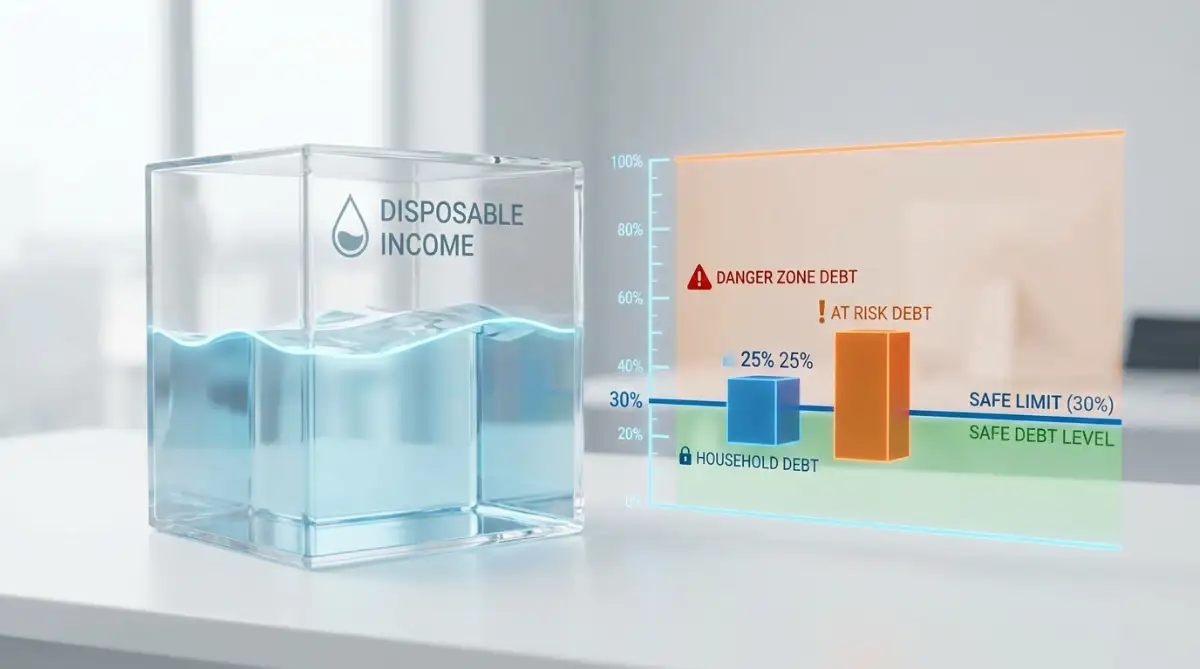
Every time you have a fixed legal debt payment, like apartment rent, a car loan, or a student loan, you scoop a large cup of water out of that bucket. Your DTI ratio is simply the percentage of the bucket that is already empty before you even buy food or pay for electricity.
Let us look at a real-life scenario to make this crystal clear for you. Let us say you bring home $6,000 every single month before taxes are taken out.
Your apartment rent is $2,000, your auto loan is $500, and your minimum credit card payments equal another $500. You are spending exactly $3,000 on basic fixed debts alone.
Therefore, your DTI is exactly 50%. You are emptying half of your bucket on debts before the month even officially begins.
Most reputable, top-tier banks get very nervous if they see a DTI ratio significantly higher than 36%. If your DTI is sitting heavily at 50%, they will automatically consider you a high-risk borrower.
They will logically assume that adding a new loan payment will completely break your household budget and force you to default. They simply do not want to set you up for a massive financial failure.
Your Actionable Advice for Today:
Grab a calculator and a blank piece of paper right now. Write down every single fixed debt payment you legally make each month.
Do not include random expenses like gym memberships or internet subscriptions; only include actual debts reported to credit bureaus. Divide that total debt number by your gross monthly income.
Multiply the final result by 100 to get your exact percentage. If your DTI number is too high, you must take immediate action before asking a bank for new money.
Focus your energy on paying off a small, annoying debt completely. Eliminating just one $150 monthly credit card bill can drastically improve your DTI ratio in the eyes of the bank's strict automated software.
Step 3: Identify the Safest Financial Institutions
One of the biggest mistakes everyday people make when looking for fast cash is applying at the wrong type of banking institution. Not all financial institutions are built to serve the exact same type of customer in an emergency.
If you blindly apply at a massive, highly conservative national bank, but you only have an average credit score, you are setting yourself up for a painful rejection. National banks are incredibly strict because they have millions of customers and very rigid corporate rules.
When you officially apply for credit at these strict institutions, they perform a "hard inquiry" on your permanent credit file. This hard inquiry acts like a bright red warning flag to the rest of the financial world.
It actually lowers your credit score by a few points instantly the moment they hit the button. If you walk into four different traditional banks in one week and fill out applications, you will get four hard inquiries. To other smart lenders, this makes you look deeply panicked and heavily disorganized. They will automatically deny you, even if your score was fairly decent to begin with.
To win this financial game, you need to completely change where you are looking for money. Local credit unions are often much better options than massive national banks for unsecured funding.
Credit unions are non-profit organizations designed specifically to help members of their community. Because they are not driven by massive Wall Street profits, their lending algorithms are often much more forgiving and human.
They will frequently sit down, look you in the eye, and listen to your personal story. If you have a decent job but a slightly bruised credit score, a local credit union is a fantastic, safe option to explore.
Unsecured Lender Battle-Card: Who Gives You the Best Shot?
My Insider Strategy: If your credit score is hovering in the low 600s, skip the mega-bank entirely. Apply to a credit union first for fair rates, or use a fintech pre-qualification tool if you need money in your hands before tomorrow morning.
Beyond credit unions, many highly respected modern online lenders (Fintech companies) offer incredible opportunities. These modern banks use advanced technology to review your application differently.
Instead of just looking at your FICO score, many online banks will ask to securely scan your checking account history. They want to look at your actual daily cash flow and banking habits.
If they see that you consistently get paid on time and never overdraw your account, they will often approve you even with an average credit score. Furthermore, these modern institutions usually offer a fast pre-qualification process.
This pre-qualification process uses a highly safe "soft credit check." A soft check allows the modern bank to legally peek at your credit history without leaving any permanent, damaging mark on your score.
Your Actionable Advice for Today:
Never let a bank manager or a website run a hard credit check until you are completely sure you want their specific loan terms. Always ask the loan officer upfront, "Will this pre-approval require a hard pull or a soft pull?"
If they tell you it requires a hard pull just to see your basic options, stand up, thank them for their time, and walk away immediately. There are plenty of better options available to you on the modern market.
Sit comfortably on your couch and fill out three different soft-pull pre-qualification forms online. These modern banks will show you exactly how much emergency cash they can offer you and what your exact interest rate will be.
Your credit score will not drop a single point during this entire safe shopping phase. By hunting for soft pulls and targeting credit unions or online banks, you keep the financial power firmly in your own hands.
My absolute biggest mistake back then was letting three different websites run hard checks on my credit in a single afternoon because I was completely panicking. I quickly realized the hard way that taking just ten extra minutes to find lenders who only do a "soft pull" would have saved my score from dropping instantly. Always protect your credit score first before you ever fill out a formal application!
Insider Secrets to Guarantee Your Bank Approval
Now that you know how to check your credit score and calculate your debt numbers, we need to go deeper. I want to share the exact strategies that financial insiders use every single day to get their applications approved.
When you ask a bank for money without offering any physical property, they are taking a massive financial risk. According to financial experts at Investopedia, an unsecured loan relies completely on your personal creditworthiness and your legal promise to repay the debt.
Because there is absolutely no collateral for the bank to repossess, you have to prove your reliability through other creative methods. You must present a flawless financial story that makes the lending computer feel completely safe.
The Consumer Financial Protection Bureau (CFPB) regularly reminds consumers that lenders heavily analyze your past data to calculate their future risk. We need to make sure your data screams safety, stability, and absolute trustworthiness.
If you want to get approved for an unsecured loan without unnecessary stress, you must look like a guaranteed win to the underwriter. Here are the advanced steps you can take today to build undeniable trust with any financial institution.
Create an Undeniable Income Paper Trail
Having a good job is a wonderful starting point, but proving your actual cash flow is where many people stumble. Banks want to see a rock-solid history of money entering your checking account every single month without fail.
If you work a standard corporate office job, this step is incredibly easy. You just hand the loan officer your last two paystubs, and their system instantly verifies your exact salary. But the modern economy has changed drastically for millions of hard-working people.
Many of us now earn our living through freelance writing, online businesses, or driving for local rideshare apps. Traditional banks get extremely nervous when they see this type of independent, gig-based income.
They view independent workers as a heavy financial risk because their paychecks can go up and down randomly. If you want to master how to get unsecured bank loans safely, you must create a perfectly clean paper trail of your earnings.
Let me give you a highly practical scenario. Imagine you make $3,000 a month selling handmade wooden crafts on the internet.
Instead of keeping that cash scattered across different mobile payment apps, you must deposit it all into one specific bank account. Do this consistently every single week without a single exception.
When the lender asks for proof of your income, you can confidently hand them twelve months of perfectly clean bank statements. This shows the underwriter that you have a highly reliable, steady cash flow. It proves your small side business is real and stable, completely destroying their initial doubts.
Borrow a Glowing Reputation With a Co-Signer
Sometimes, your personal credit score might be slightly too low to get an approval on your own. This does not mean you have to give up and accept a painful rejection letter from the bank manager.
This is the perfect moment to use a highly effective banking tool called a co-signer. A co-signer is usually a trusted family member or a very close friend who already has an excellent credit score and a strong income history.
When they officially sign the digital loan contract alongside you, they are essentially lending you their glowing financial reputation. The automated bank system uses their high credit score to approve your application immediately.
Think of this clever strategy like trying to enter a highly exclusive VIP club in the city. If you walk up to the door alone wearing old shoes, the strict security guard will probably reject you and send you home.
But if you walk up to that exact same door with a famous celebrity, the guard will smile and let you walk right inside. A co-signer acts exactly like your personal financial VIP pass.

The bank feels totally safe because they know the co-signer is legally responsible if you suddenly stop making your payments. However, you must treat this specific strategy with extreme caution and deep respect.
If you miss a single payment by just a few days, you will instantly damage your friend or family member's perfect credit score. As noted by Forbes Advisor, co-signing is a massive legal commitment for both parties involved, so only use this option if your budget is completely secure.
Automate Your Payments for Future Peace of Mind
Getting the emergency funds you need today is a truly great feeling. But your ultimate goal should be making sure that the next time you need cash, the entire process is completely effortless.
The absolute secret to borrowing success over the long term is building a flawless payment history starting today. Your payment history is the single most important piece of your total credit score puzzle.
To guarantee you never make a silly mistake, you must set up automatic payments on the exact day your loan is officially funded. Never rely on your own memory to manually pay a bill every month.
Life gets incredibly busy, and simply forgetting a payment can trigger painful late fees. If you accidentally pay thirty days late, the bank will report you to the credit bureaus, and your score will crash instantly.
By linking your monthly loan payment directly to your main checking account, the money moves completely on autopilot. You will never miss a due date, and your credit score will slowly climb higher and higher every single month.

Five Dangerous Borrowing Traps You Must Avoid
Even highly intelligent people make terrible choices when they are desperate for emergency money. The heavy panic of needing cash quickly often blinds them to the dangerous fine print hidden in bank contracts.
If you fall into these common traps, a simple unsecured bank loan can quickly turn into a massive financial nightmare. This nightmare can easily ruin your life for many years to come.
Here is exactly what you must avoid to keep your family safe and your bank account secure.
💡 Video Spotlight: The Smart Way to Compare Personal Loans
If you want a clear visual walkthrough of your best borrowing options, check out this practical guide from the financial experts at NerdWallet. They explain exactly where you should shop for a loan, how lenders judge your income, and how to avoid costly origination fees before you sign:
1. Falling for the "No Credit Check" Illusion
If you have a lower credit score, you will inevitably see bright online ads offering instant cash with absolutely no credit check. These are almost always predatory payday lenders wearing a clever disguise.
They might happily hand you a $500 loan today without asking for collateral, but their hidden terms are completely toxic. Their interest rates can mathematically reach 400% or even higher.
If you need cash fast with an average credit score, you must run far away from these payday scams. If you miss just one small payment, the penalty fees multiply so quickly that you will never catch up.
These bad companies are specifically designed to keep working-class people trapped in a never-ending cycle of extreme debt. Always stick to reputable banks and credit unions, even if their application process takes a few extra days.
2. The "Machine Gun" Application Method
When a traditional bank rejects a person, human nature makes them panic immediately. They run home, open their laptop, and apply to six different banks on the exact same afternoon.
This is the absolute worst possible action you can take when looking for money. Every single time a bank formally checks your credit file, it leaves a permanent mark called a "hard inquiry."
A hard inquiry temporarily lowers your score right on the spot. If smart algorithms see six hard inquiries placed in one single week, they will immediately assume you are completely broke and panicking.
They will automatically reject you, leaving your credit score heavily damaged for several months. You must only apply for a formal loan when you are confident in your approval odds based on safe soft checks.
3. Chasing the Smallest Monthly Payment
It is completely natural to want the lowest possible payment leaving your checking account each month. Predatory lenders understand this human psychology perfectly, and they use it to quietly steal your money.
They will gladly offer you a tiny, comfortable monthly payment, but they will stretch the loan contract out over seven or eight long years. While the monthly bill feels incredibly easy to pay today, the total interest you hand over to the bank over time is staggering.
Always look at the total overall cost of the loan before signing anything. Accepting a slightly higher monthly payment on a much shorter timeline will easily save you thousands of hard-earned dollars in pure interest.
4. Borrowing "Bonus" Money You Do Not Actually Need
Let us pretend you need exactly $3,000 to replace a broken home heating system during the winter. When you apply, the bank smiles and tells you that you are actually approved for a full $8,000.
It becomes extremely tempting to take all $8,000 so you can buy a new television or take a weekend vacation. You must fight this urge with everything you have.
Every extra dollar you borrow today is a dollar you have to pay back tomorrow with heavy interest attached. Taking extra luxury money creates an unnecessary heavy burden on your household budget.
Think of it like putting heavy rocks in your backpack before climbing a steep mountain. This heavy debt load will slowly eat away at your future paychecks, making it much harder to survive the next unexpected emergency.
5. Changing Jobs Right Before You Apply
Lenders look very closely at your recent employment history to measure your overall stability. They want to see that you have been at the exact same company for at least one full year.
Many people make the terrible mistake of quitting their job for a slightly better one just days before applying for a loan. To an automated banking computer, a brand new job looks like a massive, unpredictable risk.
They do not know if you will pass your probationary period or if you will get fired next week. If you want a quick online approval without unexpected delays, you must keep your job status perfectly stable.
Wait until the money is securely deposited in your checking account before handing in a resignation letter to your boss. Absolute stability is the ultimate key to a fast approval.
Your New Path to Total Financial Confidence
Navigating the complex world of bank loans does not have to be a scary or overwhelming experience. You now hold the exact same knowledge that professional bankers use every single day to protect their own money.
By taking a few hours to polish your credit profile and understand your true limits, you completely remove the heavy fear of rejection. You are no longer begging a wealthy bank for a desperate favor.
Instead, you are confidently presenting yourself as a highly reliable, mathematically safe customer who respects the rules. This simple shift in your mental approach gives you incredible power over your entire financial future.
You are fully capable of securing emergency funding without feeling stressed, rushed, or confused by banking jargon. Remember that a no collateral bank loan is simply a tool in your financial toolbox. Like a sharp saw, it can help you build a beautiful home, or it can cause massive damage if you swing it carelessly. Take a deep breath and start with the very first step today.
Pull your free credit report, dispute any silly administrative errors, and write down your monthly debt numbers on a clean piece of paper. You have the total ability to handle unexpected life emergencies smoothly and intelligently.
Protect your fragile credit score, read the digital fine print slowly, and take complete control of your financial journey starting right now.
Looking back, surviving that awful money crisis actually forced me to become much smarter and more confident about my personal finances. You can absolutely get through this temporary emergency without ruining your future, so take a deep breath and start organizing your credit report today.
Common Questions About Unsecured Personal Loans
How can I get an unsecured personal loan without offering collateral?
You can secure an unsecured personal loan by applying through reputable online lenders, credit unions, or fintech banks. These institutions review your credit history, income consistency, and debt-to-income ratio to approve your funds without requiring you to pledge your house or car.
Will checking my pre-qualification options lower my credit score?
No, as long as you make sure to choose lenders that use soft credit inquiries for pre-qualification. This allows you to review your potential interest rates and loan offers safely without leaving any permanent or damaging marks on your credit report.
Why do online lenders analyze my checking account history?
Online lenders look at your recent checking account activity to verify your cash flow stability and observe your everyday money habits. A clean checking history free of overdrafts proves to automated systems that you can comfortably handle monthly loan payments.
What should I avoid when searching for a quick online personal loan?
Always stay away from predatory payday lenders that hide mathematically impossible 400% interest rates in the fine print, and never trust any website asking for upfront processing fees. Sticking to transparent, well-reviewed lenders will keep you safe from dangerous debt cycles.
Is it possible to pay off an unsecured personal loan early without fees?
Many reputable lenders let you pay off your loan balance early without charging extra penalties, but you must always read the digital contract first. Finding a transparent lender with zero prepayment penalties will save you a lot of hard-earned money in total interest over time.
Financial & Health Disclaimer:
The content provided on globalsinfo regarding finance, crypto, real estate, health, and legal topics is strictly for informational and educational purposes only. We are not licensed financial advisors, doctors, or attorneys. Any decisions made based on our articles are at your own risk. Always consult with a certified professional before making any financial or health-related decisions.