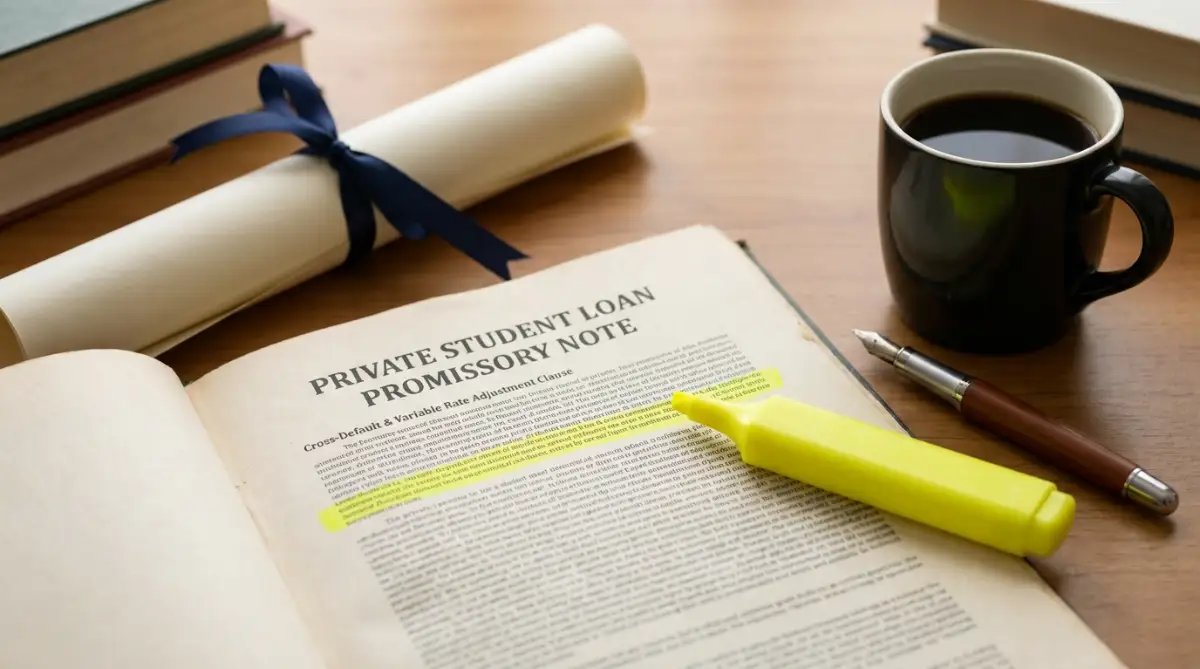
Signing a private student loan promissory note at eighteen feels like a routine step toward your dream career, but the dense legal jargon hidden inside can quietly double your debt before you even walk across the graduation stage. Commercial lenders intentionally bury compounding interest rules, impossible co-signer release hurdles, and aggressive default triggers in the fine print. In this guide, I will show you how to decode the dangerous clauses in your private loan contract, how interest capitalization quietly explodes your balance, and what you must verify before letting anyone co-sign your paperwork.
📌 What You Must Know Before Signing a Private Student Loan:
-
Variable rates are a dangerous gamble: Low 4% teaser rates can legally jump past 12% when inflation rises, doubling your monthly bill overnight.
-
Capitalization snowballs your balance: Unpaid interest collected during college gets added directly to your principal loan on graduation day, forcing you to pay interest on interest.
-
Co-signer release is almost impossible: Banks intentionally design release rules so strictly that over 90% of borrowers fail to get their parents' names off the loan.
-
Max out federal aid first: Private lenders offer zero income-driven repayment or public service forgiveness protections; treat private debt as an absolute last resort.
Exposing the Hidden Language of Promissory Notes
When you agree to borrow money for school, you have to sign a primary contract called a promissory note. This document is a legally binding promise that outlines exactly how and when you will give the bank their money back. Unfortunately, lenders intentionally write these notes using confusing legal vocabulary that most average citizens cannot easily digest.
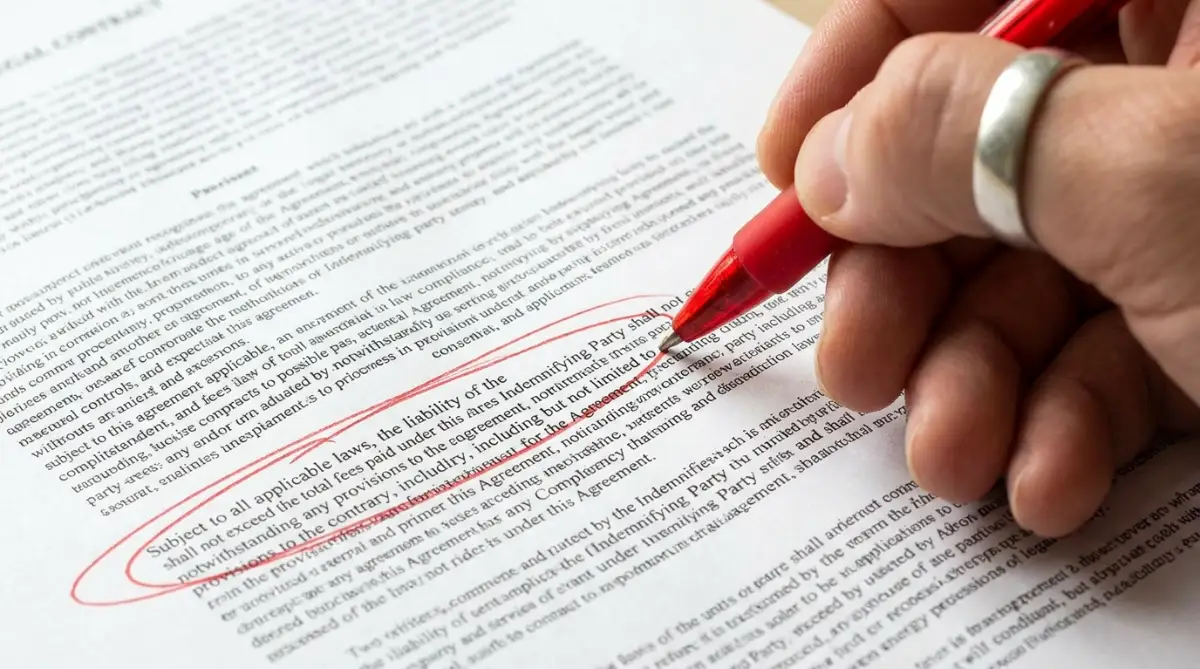
They bury the most dangerous rules deep in the middle of paragraphs that look entirely harmless. If you only skim the bold headings, you will miss the exact clauses that can double your total debt over time. We need to dissect these specific sections logically so you can recognize the warning signs from a mile away.
The Unpredictable Trap of Variable Interest Rates
One of the biggest selling points private lenders use is advertising incredibly low starting interest rates. They will highlight a number that looks significantly cheaper than what the federal government offers. However, if you look closely at the fine print, you will often see the word "variable" attached to that low number.
A variable interest rate means the bank has the legal right to increase your rate based on the overall economy. You might start your freshman year paying a very reasonable four percent interest on your borrowed money. By the time you graduate and start working, that rate could easily jump to twelve or fourteen percent without any warning.
Imagine going to the grocery store and buying a loaf of bread, but the cashier tells you the price might double by the time you reach your car. That is exactly how variable rates work; they pass all the economic risk directly onto your shoulders. When inflation goes up, your monthly loan payment goes up, making it impossible to stick to a personal budget.
Always search the contract for a "fixed rate" option instead of gambling with your financial future. A fixed rate stays exactly the same for the entire life of your loan, no matter what happens in the stock market. It brings absolute predictability to your bank account, which is the foundation of good money management.
⚖️ The Protection Gap: Federal Direct vs. Private Student Loans
My Golden Rule: Exhaust every single dollar of federal subsidized and unsubsidized loans before touching a private bank. Federal loans come with government-backed lifelines; private loans are commercial debt with zero sympathy.
The Illusion of the Co-Signer Release
Most young college students do not have enough credit history to borrow tens of thousands of dollars on their own. Therefore, private lenders almost always demand that a parent or relative co-signs the loan application. The sales representative will usually smile and tell you that you can remove your parent from the loan after making a few on-time payments.
This promise is known as a co-signer release, and it is heavily advertised to make families feel safe. The harsh reality is that banks make this process incredibly difficult to actually complete. They place hidden hurdles in the contract that disqualify almost every single applicant who asks for a release.
They might require you to prove a massive jump in your yearly income before they even process the paperwork. They will also look for absolutely perfect credit behavior, meaning one late credit card payment can ruin your chances.
I assumed I could easily remove my mother from my loan after making twelve consecutive on-time payments, just like the brochure promised. I quickly realized that the bank quietly required forty-eight months of perfect payment history and a salary I simply did not have yet. Always ask the lender to highlight the exact, written requirements for a co-signer release before you let a family member sign on the dotted line.
🛑 The Hidden Trap: The "Co-Signer Death" Acceleration Clause
Before your parent signs that promissory note, search the agreement text for the phrase "Acceleration upon Death or Bankruptcy":
-
The Trap: In many aggressive private contracts, if the co-signer passes away or files for bankruptcy, the bank has the legal right to place the loan in immediate "auto-default."
-
The Nightmare: The bank can demand that you pay the entire $40,000 balance in cash within 30 days—even if you have made every monthly payment on time for five straight years!
-
Your Action: Demand a written guarantee that the loan will remain in good standing as long as monthly payments continue, regardless of what happens to the co-signer.
The Mathematical Nightmare of Capitalization
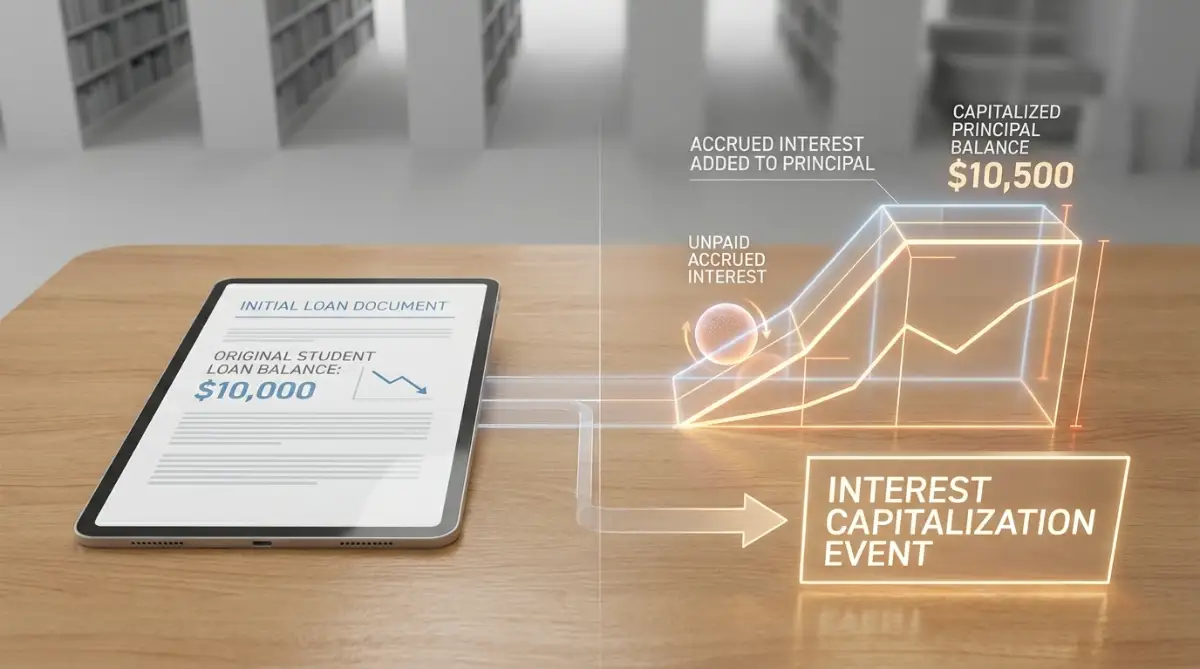
This is perhaps the most destructive financial concept hidden inside any private student loan agreement. When you are sitting in class, your loan is quietly gathering daily interest charges in the background. Because you are an active student, the bank usually allows you to pause making payments until you finally graduate.
Most students think this is a generous favor, but the bank is actually setting a mathematical trap. When your grace period ends, all that unpaid interest you collected over four years does not just sit there. The bank takes that massive pile of interest and adds it directly to your original principal balance.
This process is called interest capitalization, and it is exactly how a thirty-thousand-dollar loan turns into a forty-thousand-dollar nightmare. You are now paying new interest on top of the old interest that was just added to your main balance. It creates a compounding snowball effect that rolls down a mountain, getting heavier and heavier every single month.
The best way to fight this snowball is to read the contract to see when capitalization actually occurs. Smart borrowers make small, twenty-dollar interest payments every month while they are still in school just to keep the balance flat. Stopping capitalization is the most effective way to save yourself thousands of dollars in the long run.
🎬 Official Warning: How to Avoid Predatory Student Loan Traps
When you are stressed about paying for college, commercial lenders and scammers know you are looking for fast answers. Watch this official alert directly from the regulators at Federal Student Aid. They explain how predatory companies try to trick young borrowers and what you must verify before trusting any lender with your financial future:
Now that you have seen how federal regulators warn against bad offers, let us look at another strict trap hidden in private contracts: lifetime hardship caps.
Artificial Limits on Financial Hardship
Life is incredibly unpredictable, and sometimes bad things happen to hard-working people. You might lose your job, face a sudden medical emergency, or need to take time off to care for a sick relative. Federal student loans offer highly flexible protections for these moments, allowing you to pause payments based on your income.
Private lenders, however, are notoriously strict when it comes to offering temporary help. You must carefully search the agreement for terms like "forbearance" or "deferment" to see exactly what they offer. Many private contracts put a strict lifetime limit on how many months you can pause your payments.
Understanding the Lifetime Hardship Cap
Let us look at a real-life scenario to understand why this limit is so dangerous. Imagine you get laid off from your job and use three months of forbearance to survive while interviewing. Five years later, you have a medical emergency and need to pause your payments again to cover hospital bills.
If your contract has a strict six-month lifetime limit, you are officially out of luck. The private bank will demand their full monthly payment regardless of your hospital stay or your empty bank account. If you cannot pay, they will immediately report you to the credit bureaus and begin aggressive collection calls.
Myth vs Reality: Private Loan Flexibility
You need to know exactly how much a safety net you have before a financial storm hits. Look for lenders who offer generous forbearance periods that do not carry massive administrative penalty fees. Understanding your absolute worst-case scenario protects your family from sudden financial ruin.
The Universal Default Danger Zone
There is a deeply hidden clause in some older or highly aggressive private loans called "universal default." This is a terrifying legal trick that allows the lender to punish you for mistakes you make outside of your student loan. It essentially connects all of your personal financial behaviors together into one massive risk profile.
Here is how the trap actually works in the real world. Let us say you pay your private student loan perfectly on time, every single month for three years. However, you accidentally miss a payment on a totally unrelated department store credit card.
The student loan company constantly monitors your credit report in the background. When they see the mistake you made with the store card, the universal default clause activates immediately. They can use that unrelated mistake as an excuse to instantly raise the interest rate on your student loan.
They argue that because you missed a credit card payment, you are now a higher risk to them as well. It is an incredibly unfair practice that penalizes you twice for a single, small error. You must scan the agreement for any mention of cross-default policies or universal default triggers before signing your name.