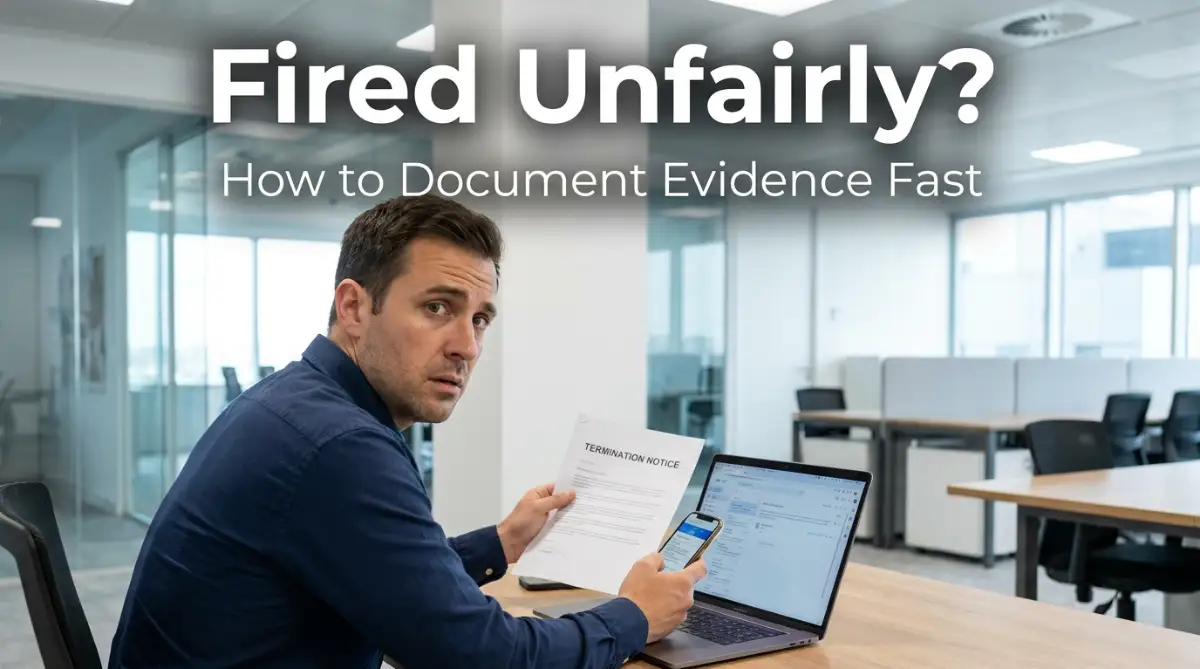
Getting pulled into an unexpected HR meeting and handed a pink slip is terrifying, especially when you know you are being pushed out for reporting a safety issue or asking for medical leave. Company human resources reps are trained to rush you out the door in minutes before you can document what really happened, leaving you empty-handed against corporate lawyers. In this guide, I will show you how to quietly build an unbreakable paper trail, how to avoid the dangerous severance release trap, and how to protect your legal rights before your work computer access is shut off forever.

📌 What You Must Do If You Suspect an Unlawful Firing:
-
Never forward emails to your personal account: Emailing company data triggers security alarms; use your personal smartphone camera to take clear screen photos instead.
-
Save your good reviews first: Capture proof of sales targets, glowing client emails, and positive evaluations before the company invents a fake "poor performance" story.
-
Never sign severance in the room: Taking the paperwork home is your legal right; signing on the spot waives your right to pursue a wrongful termination claim.
-
Build a date-stamped timeline: Write down exact dates, meetings, and witnesses in a private journal so your lawyer can prove a clear pattern of retaliation.
Securing Your Digital Footprint Before the Screen Goes Black
To actually win a fight against a massive company, you have to understand exactly how the legal game is played. When an employment lawyer looks at your case, they do not care about how angry you are or how poorly your manager treated you.
They only care about hard, undeniable physical proof. You need evidence that shows a clear timeline of events leading up to your sudden dismissal.
The absolute biggest mistake people make is waiting until they get home to start gathering their thoughts. The exact second you suspect you are being pushed out, the clock starts ticking incredibly fast.
Your employer's IT department can and will lock you out of your company email, Slack channels, and internal servers with the single push of a button. You have to act fast, but you must act completely within the bounds of the law to ensure your evidence is actually usable in a courtroom. Let us break down the exact strategies you need to deploy right now.
The Art of Saving the Right Emails
If you suspect foul play, your company inbox is your absolute best friend. You need to identify any emails that prove your competence, prove you complained about an illegal issue, or show your boss treating you differently than your coworkers.
However, you cannot just randomly forward three thousand company emails to your personal Gmail account. This is a massive trap.
If you forward highly sensitive, proprietary company information—like secret client lists, upcoming product designs, or massive financial spreadsheets—the company will instantly sue you for stealing trade secrets. They will use this as the perfect excuse to justify firing you, completely ruining your wrongful termination claim.
You must only save emails that directly relate to your specific employment status.
⚖️ The Evidence Rule: What You Can Save vs. What Gets You Sued
My Safety Rule: Never email attachments to your personal Gmail. Take clear, date-stamped photos of your computer screen with your personal smartphone. Photos do not trigger corporate data-loss firewalls!
Look for your past performance reviews, emails where you explicitly requested medical leave, or messages where you formally complained to HR about a hostile environment.
The absolute safest way to capture this information without triggering the company's automated security software is to physically take out your personal smartphone and snap clear, readable photos of the computer screen. Make sure the date, time, and the sender's email address are perfectly visible in every single picture.
I once lost a massive piece of evidence because I tried to forward an email to myself, and the corporate firewall blocked it instantly. The IT department got an alert, and my computer was locked five minutes later. From that day on, I only used the camera on my phone to quietly capture the truth.
⚖️ Attorney Walkthrough: How Lawyers Actually Prove Retaliation
Proving that your employer broke the law requires very specific types of documentation that hold up under cross-examination. Watch this clear explanation from California employment attorney Branigan Robertson. He explains the exact evidence you need to collect before you leave the building to prove your firing was illegal retaliation:
Now that you know what attorneys look for, let us build your evidence into an organized chronological timeline that tells an undeniable story:
Building the Unbreakable Master Timeline
Raw photos of emails are great, but they are just random pieces of a very confusing puzzle. To make a lawyer take your case seriously, you have to organize those pieces into a clear, compelling story.
You need to sit down at your kitchen table tonight with a fresh notebook and start building a chronological master timeline.
Do not rely on your memory. Human memory gets incredibly fuzzy when you are dealing with severe trauma and stress. Write down the exact date you started noticing the weird behavior from your manager.
Did they suddenly exclude you from weekly team meetings right after you announced you were pregnant? Write down the exact date of that specific meeting. Did they start giving you impossible, conflicting deadlines right after you complained about unpaid overtime? Document exactly what those deadlines were and who assigned them to you.
When you build a timeline, you start to see a clear, undeniable pattern of retaliation. This pattern is exactly what a judge or a jury needs to see to understand that your firing was not just a random business decision.

The Power of the "Follow-Up" Email Trap
If you are still currently employed but you feel the ax slowly swinging toward your neck, you can actively generate powerful new evidence right now. Most illegal discrimination or retaliation happens quietly, behind closed doors, during verbal one-on-one meetings.
A terrible boss will never put their illegal threats into writing because they know it leaves a paper trail.
You have to force them onto the record. Whenever you have a suspicious meeting with your manager or human resources, go back to your desk immediately and write a polite "follow-up" email.
Keep your tone entirely professional and completely emotionless. Say something simple like, "Hi Susan, I just wanted to quickly summarize our meeting today. As we discussed, you mentioned that my recent request for legally protected medical leave was 'causing too many problems for the team,' and that my future here might be in jeopardy. Please let me know if I misunderstood anything."
Send that email and immediately take a picture of it with your phone.
If your boss replies and confirms it, you have absolute gold. If your boss completely ignores the email, that silence often acts as a quiet confirmation in the eyes of the law. You just took a totally undocumented verbal threat and turned it into hard, date-stamped digital evidence.
Securing Your Own Performance Metrics
When a company fires someone for an illegal reason, they almost always try to cover it up by claiming the employee was simply bad at their job. They will suddenly invent a narrative that you were lazy, missed deadlines, or lacked basic skills.
To completely destroy this fake defense, you need to gather proof of your actual competence before they lock you out of the system.
Take pictures of your official monthly sales dashboards showing you hit your targets. Save copies of the official end-of-year review where your manager rated you as "exceeds expectations."
If a client recently sent an email praising your excellent customer service, make sure you capture that message. If you recently won a company award or received a random bonus for hard work, document it heavily.
If you can prove to a jury that you were an objectively fantastic employee right up until the exact moment you reported a safety violation, the company's "bad performance" excuse completely falls apart.
The Danger of Signing the "Severance Package"
This is the exact moment where the company will try to permanently trap you. When they pull you into the final termination meeting, HR will usually slide a thick packet of paper across the desk.
They will offer you a month of free salary and extended health benefits. It sounds incredibly generous, especially since you are suddenly terrified about how you will pay your bills.
But there is a massive, highly toxic hook buried in the fine print. To get that severance money, you have to sign a "General Release of Claims."
When you sign that specific piece of paper, you are legally signing away your absolute right to ever sue the company for wrongful termination, discrimination, or unpaid wages. You are literally selling your silence for a few thousand dollars.
Never, ever sign a severance agreement in the room on the day you are fired. The emotional shock makes it impossible to read the legal jargon clearly.
🛑 Know Your Legal Rights: The 21-Day Severance Rule
If HR tells you, "You must sign this severance agreement before leaving the room today or you lose the money," they are bluffing:
-
Federal Protection: Under the Older Workers Benefit Protection Act (and standard contract law), employees are legally entitled to up to 21 days to review a severance release, plus a mandatory 7-day revocation window after signing.
-
The Golden Response: Smile politely, take the paperwork, and say: "I need to review this legal document with my family and legal counsel before signing."
-
The Leverage: A signed release waives your right to sue forever. If you have evidence of retaliation, an employment attorney can often negotiate a payout significantly larger than the initial offer.
Politely take the packet, tell HR you need time to review it with your family, and walk out of the building. You legally have the right to take the document home. You should immediately take that un-signed packet straight to an employment lawyer.
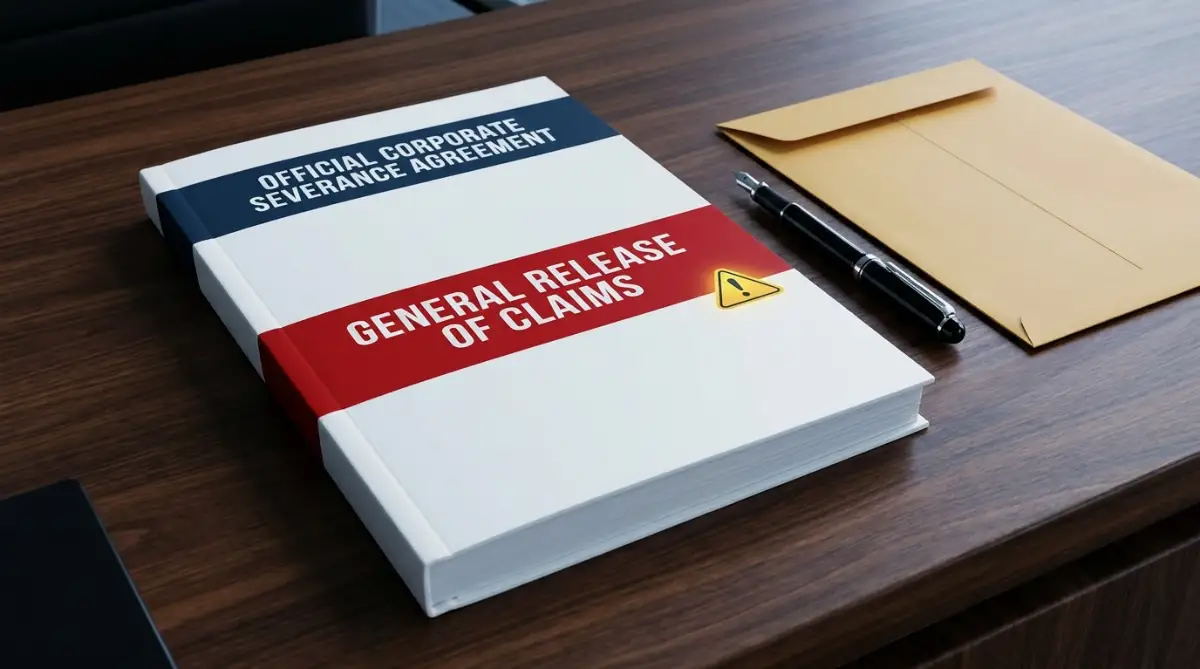
Sometimes, the lawyer can look at the evidence you gathered and successfully negotiate a massive, six-figure settlement that is ten times larger than the tiny severance check they initially offered you.