
The Heavy Price of the Wrong Addition
I still feel a sharp pain in my chest when I think about the very first person I ever hired for my startup. We were growing so fast that I felt like I was drowning in daily support emails and administrative tasks. I panicked, completely skipped checking references, and hired a guy simply because he was a friend of a friend who needed a job. Within three short weeks, his terrible attitude had completely poisoned the positive energy of my tiny, three-person team. I spent my weekends secretly redoing all of his sloppy work, terrified of confronting him and making the office atmosphere even worse.
This heavy, suffocating feeling is exactly what happens when you bring the wrong personality into a very small room. When a massive corporation hires a bad employee, that person just blends into a sea of thousands of other workers. But when your entire company is only four people sitting around a single folding table, one bad attitude instantly contaminates the entire operation.
You start dreading your own morning meetings, quietly hoping the new hire calls in sick so you can just get some actual work done. Your original, loyal team members start taking longer lunch breaks because they hate the toxic tension in the room. You watch your hard-earned startup budget drain away on a salary that brings absolutely zero value back to the business.
The mental exhaustion of managing a poor fit completely ruins your ability to focus on actually growing the company. You become a full-time babysitter instead of a visionary founder, constantly cleaning up easily avoidable mistakes. Many promising startups quietly die not because they ran out of money, but because the founders hired the wrong people and lost their passion.
We rarely talk about how incredibly lonely it feels to realize you made a massive hiring error that is hurting your original crew. You want to build a perfect, happy family environment, but reality often slaps you directly in the face. Let us break down the exact traps that catch new founders, so you can build a team that actually pushes you forward.
Designing a Bulletproof Recruitment Funnel
When you are desperate for help, your natural instinct is to simply yell into the internet and hire the very first person who responds. This desperate approach is the root cause of almost every single bad hire in the startup world. You cannot treat recruitment like a casual weekend project; it requires the exact same strategic thinking you applied to building your actual product.
To protect your company culture, you need to build a heavy filtration system that automatically removes bad fits before you even speak to them. If you make the application process too easy, you will be flooded with hundreds of lazy resumes from people who never even read your company name. Your goal is to attract a few highly motivated candidates, not a massive crowd of unengaged job seekers.
Let us walk through the psychological shifts you need to make to stop attracting the wrong talent and start finding your future leaders.
The Problem with "Corporate" Job Descriptions
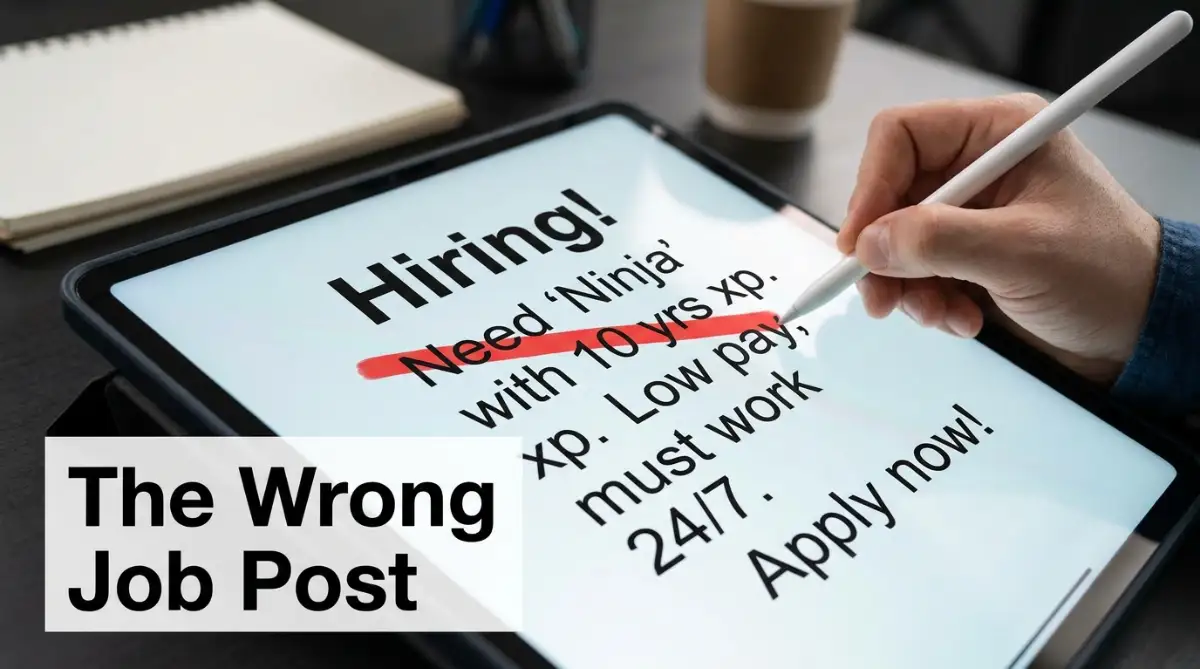
The very first interaction a candidate has with your company is reading the job description you post online. Most tired founders simply copy and paste a boring, generic job description they find on a massive corporate career website. They list twenty different bullet points of strict requirements, demanding five years of experience for an entry-level salary.
This is a terrible mistake because a startup is absolutely nothing like a massive, stable corporation. Corporate employees usually want a quiet, predictable day where they do the exact same highly specific task from nine to five. If you accidentally hire a rigid corporate worker for your chaotic startup, they will suffer a complete mental breakdown during their first week.
Startups are messy, highly unpredictable, and require people who love wearing five different hats on the same day. Your job description must be brutally honest about the current chaos of your working environment. You want to actively scare away people who need constant hand-holding and attract the rare individuals who actually enjoy building processes from scratch.
Instead of writing a dry list of requirements, tell a compelling story about exactly what this person will achieve in their first ninety days. Say something like, "You will be responsible for figuring out why our customer onboarding is broken, and you will have the total freedom to rebuild it." This type of language acts as a massive magnet for hungry problem-solvers.
The Danger of Hiring Mini-Clones of Yourself
Human beings have a massive psychological bias where we naturally trust and like people who remind us of ourselves. When a founder sits down for an interview, they often look for someone who shares their exact same hobbies, talking speed, and educational background. This creates a very comfortable conversation, leading the founder to instantly offer them the job.
However, hiring someone who thinks exactly like you is a guaranteed way to build massive blind spots into your business. If you are an incredibly aggressive, fast-moving salesperson, you do not need to hire another aggressive salesperson. You actually need to hire a calm, highly organized operational thinker who can clean up the messy trails you leave behind.
I made this exact error early on by hiring three wildly creative thinkers because we got along perfectly during the interviews. We spent entire weeks dreaming up amazing new features, but nobody in the room actually knew how to launch them on time. Our company almost went bankrupt because we had way too much vision and absolutely zero operational execution.
Here is exactly how you can structure an interview to find someone who perfectly balances your own weaknesses:
You have to swallow your pride and intentionally hire people who are significantly better than you at the things you hate doing. If you hate looking at accounting spreadsheets, you must hire someone who naturally loves staring at numbers all day long. A strong startup team should look like a puzzle, where completely different shaped pieces lock together to form a perfect picture.
Testing for Actual Skills Instead of Resumes
We have all met someone who looks like an absolute superstar on their printed resume but performs terribly in the real world. Many candidates have become true experts at hacking the interview process by memorizing all the perfect corporate buzzwords. They can talk smoothly about "synergy" and "growth hacking" for an hour without actually knowing how to execute a single task.
If you rely entirely on a standard question-and-answer interview, you will frequently be tricked by charming talkers. The only way to find out if someone can actually do the job is to force them to do a small piece of the job before you hire them. You must incorporate a short, paid test project into the middle of your hiring funnel.
Let us say you are hiring a customer support manager to handle your angry clients. Do not just ask them, "How do you handle angry customers?" Instead, hand them a printed copy of a real, highly aggressive email a customer sent you last week. Tell them to sit quietly in the corner for fifteen minutes and type out the exact email response they would send.
When you review their written test, you will immediately see their true communication skills, their empathy, and their spelling habits. This completely removes the emotional bias of a charming conversation and focuses purely on their ability to deliver real results. You should absolutely pay them fifty dollars for this hour of work, as it proves you respect their time and sets a professional tone immediately.
Proven Tactics for Dominating the Phone Lines
Now that you have their attention, you must guide the conversation using a very specific psychological structure. The absolute best way to handle a cold call is to adopt the mindset of an emergency room doctor. A doctor does not run into the waiting room and instantly prescribe medication without asking any questions. They calmly ask the patient where it hurts, how long it has been hurting, and how much it affects their daily life.
You need to ask highly targeted, open-ended questions that force the prospect to complain about their current problems. For example, instead of asking "Do you like your current software?", ask them "What is the most frustrating part about your current software setup?" Reviewing modern sales psychology research published by the Harvard Business Review proves that prospects are much more likely to buy when they physically say their problems out loud.
When they give you a long, detailed complaint, you must practice active listening without interrupting them. Write down the exact words they use to describe their pain, and repeat those exact words back to them later in the call. If they say their current process is a "complete organizational nightmare," you must say, "I can show you how to stop that organizational nightmare."
This mirroring technique builds massive, subconscious trust because it proves you are actually paying attention to them. It is very similar to understanding how to rescue your lost files before a complete system crash; you are offering a precise lifeline exactly when they feel the most vulnerable.
Finally, never try to close the entire massive deal on the very first phone call. Your only goal on a cold call is to sell the prospect on attending a fifteen-minute follow-up meeting later in the week. Keep the call under five minutes, secure a specific calendar invitation, and hang up while they are still highly curious.

Silent Mistakes That Sabotage Your Sales Confidence
Watching a new founder completely destroy their own sales confidence is incredibly painful to witness. These mistakes do not happen because the founders are lazy; they happen because they let their own internal anxiety dictate their actions. The most dangerous trap is treating your daily call block like an optional task that can be pushed to tomorrow.
When you push your calling schedule back because you suddenly need to "organize your desk," you are actively lying to yourself. This procrastination is driven purely by the fear of rejection, and it quietly empties your future bank account. It is exactly like ignoring dangerous morning routine mistakes that secretly destroy your daily productivity. You are letting small distractions ruin your most important revenue-generating activity.
If you skip your calls for three days, the fear only grows stronger, making it infinitely harder to pick up the phone on Thursday. You must build an iron-clad discipline where you sit down and dial regardless of how you feel emotionally. Treat your two-hour dialing block like a legally binding contract that you simply cannot break.
The Danger of Arguing with the Gatekeeper
Another incredibly common mistake is treating the receptionist or executive assistant like an annoying obstacle in your way. Sales reps often get highly frustrated and act rude when a gatekeeper refuses to transfer their call directly to the CEO. Some reps even try sneaky tactics, like pretending to be a personal friend, just to get past the front desk.
This strategy is absolutely toxic and will instantly destroy your professional reputation at that company. The executive assistant is highly trusted by the CEO to filter out dishonest, aggressive salespeople. If you lie to the gatekeeper, they will simply pass a note to the boss telling them exactly how rude you were.
Treat the assistant with the exact same massive respect you would give the company owner. Be completely honest about why you are calling and ask for their expert advice on the best way to get on the boss's calendar. Exploring modern B2B outreach research from Forrester confirms that building strong internal champions at the ground level often accelerates enterprise deals significantly.
Relying on a Robotic Script
Many beginners absolutely terrify themselves by trying to memorize a three-page sales script word for word. When the prospect finally answers the phone, the rep freezes, panics, and starts reading the paper like a nervous robot. They talk incredibly fast, completely ignoring the tone and mood of the person on the other end.
A rigid script completely destroys any chance of making a genuine human connection. If the prospect interrupts you with a random question, you will totally lose your place on the paper and sound completely incompetent. This lack of natural communication is just like making silent freelance profile mistakes that keep you from getting your first client. Nobody wants to hire or buy from someone who sounds fake.
Instead of a script, you only need a simple bullet-point outline covering three main topics: your opening hook, your pain-point question, and your meeting request. This outline keeps your brain focused on the goal while allowing your actual personality to shine through. You want the call to flow naturally, exactly like two professionals chatting over a cup of coffee.
Failing to Record and Review Your Mistakes
You cannot possibly improve your communication skills if you completely refuse to listen to your own errors. Many reps absolutely hate the sound of their own voice, so they never record or review their daily calls. This is a massive failure because your memory of a high-pressure call is heavily distorted by your own adrenaline.
You might think you handled a rejection perfectly, but the audio recording will clearly show that you interrupted the prospect mid-sentence. Ignoring your own data acts like a silent system drain, much like the overlooked habits that quietly destroy your smartphone battery lifespan. You have to face the ugly reality of your bad habits to fix them.
Dedicate thirty minutes every Friday afternoon to reviewing your three worst calls of the entire week. Write down the exact moment you lost the prospect's attention and script out a better response for the following Monday. This painful, honest self-review is the exact separator between average reps and top-tier revenue generators.
A Clear Blueprint for Smashing Your Sales Targets
Growing a profitable B2B company is entirely dependent on your ability to generate real, human conversations. Automated emails and digital ads are fantastic tools, but they will never replace the raw, persuasive power of picking up the telephone. When you combine targeted digital marketing with direct phone outreach, you build an absolutely unstoppable sales machine.
Stop waiting for your perfect prospects to magically discover your website and fill out a contact form. Grab a piece of paper right now and write down the names of ten specific companies you desperately want to work with. Find the direct phone numbers for their decision-makers, take a deep breath, and dial the first number tomorrow morning at nine o'clock.
I remember staring at my phone for hours, terrified of the rejection hiding on the other end of the line. The moment I finally made that first call, the fear instantly shattered, and I realized it was just another human being saying hello. I want you to pick up the phone today, face the fear head-on, and watch how quickly your empty calendar fills up with highly profitable meetings.
Real Questions About B2B Cold Calling
How many times should I call a prospect before giving up completely?
A professional outreach sequence usually involves six to eight touches spread across phone calls, emails, and LinkedIn messages over a three-week period. If they do not respond after eight professional attempts, move them to a long-term nurture list and try calling them again in six months.